Comparison
Are Cheap Air Quality Monitors Accurate?
Accurate enough to be useful, not accurate enough to be quoted. The distinction matters, and almost nobody explains it.
By Scooter M. · Published · Last updated
How this page is funded: the buy links below are affiliate links. If you buy through one, we earn a commission at no extra cost to you. It does not change the order of the picks or what we say about them. Full disclosure.
The short answer
Accurate enough for relative comparisons, not for absolute numbers. A consumer optical sensor is reliable at telling you the air is worse than it was an hour ago, or that closing the windows helped. It is not reliable as a precise concentration figure, because it infers mass from light scattering using assumptions that vary with what the particles actually are. Use it to compare, not to quote.
How the measurement works, and where the error enters
An optical particle counter draws a small air sample past a light source and measures how the light scatters. From the scattering pattern it estimates how many particles there are and how big, and from that it calculates a mass concentration in micrograms per cubic meter.
That last step is where the uncertainty lives. Converting a count into a mass requires assuming a particle density and optical behavior - and wood smoke, cooking grease, road dust and pollen are all different in both. A sensor calibrated against one aerosol will read differently against another. It is not broken; it is answering a slightly different question from the one on the display.
What they are genuinely good at
- Detecting change. The number going up when you sear a steak, or down after you close a window, is real information regardless of absolute calibration.
- Comparing rooms. The same sensor moved between rooms gives a valid comparison, because the error is consistent across the readings.
- Proving an appliance is doing something. Reading before and after running a purifier for an hour is one of the most useful things a household monitor does.
- Finding where smoke gets in. Walking a monitor around during a smoke event will find the leaky window or the unsealed door.
- Driving an appliance. This is the same sensor class that runs auto mode inside a smart air purifier, and detecting change is exactly what the fan needs from it - which is why auto mode works even though the figure beside it should not be quoted.
Where they mislead
- Quoting a number as if it were a fact. A reading of 35 on a consumer device is not the same measurement a regulatory monitor would produce.
- High humidity. Optical sensors can read high in very humid air because water droplets scatter light too. A reading that climbs in a steamy bathroom is not necessarily particles.
- Single-number “air quality scores.” Many devices collapse several measurements into one index using an undisclosed formula. Look for the underlying measured values instead.
- Drift over time. Sensors degrade. A reading you trusted two years ago may not be the same reading today, and few consumer devices give you any way to check.
Buy a cheap monitor if...
- You want to know whether things are getting better or worse
- You want to see whether your purifier is earning its running cost
- You are trying to find where outdoor smoke is entering
Do not buy one if...
- You need a defensible figure - for a landlord dispute, an insurance claim or a health assessment. That requires professional measurement, and no consumer device substitutes for it.
- Your problem is moisture. It cannot see moisture at all - buy a hygrometer.
What we would buy for this
Chosen from the same registry as our roundups, on published specifications and computed running cost.
Temtop M10 Air Quality Monitor
Watching PM2.5 during smoke events
A particulate monitor rather than a hygrometer - it answers a different question, and it is the question you want answered during wildfire season.
#ad We do not hold a current price for this product, so we do not show one. How we make money.
Published specifications
| Specification | Value | Source |
|---|---|---|
| Measures | PM2.5 particulate and AQI; some variants add HCHO and TVOC | Temtop published specification |
What is good about it
- PM2.5 is the number that matters during a smoke event, and a monitor is the only way to tell whether closing the windows actually worked
- Small enough to move room to room, which is how you find where the smoke is getting in
What is not
- Consumer optical particle sensors drift and are not laboratory instruments; treat readings as relative rather than absolute
- It does not measure humidity, so it is not a substitute for a hygrometer
Who should skip this
Skip this if your problem is damp or dryness. It measures particles, and it will tell you nothing at all about humidity.
How it scored
- Usefulness during smoke events9.5
- Absolute accuracy6.0
- Portability9.0
Overall 8.0 / 10. This is our editorial score from published specifications and computed running cost. It is not a test result, and it is deliberately not marked up as a rating in this page’s structured data.
Govee H5075 Bluetooth Hygrometer
Diagnosing a problem that changes overnight
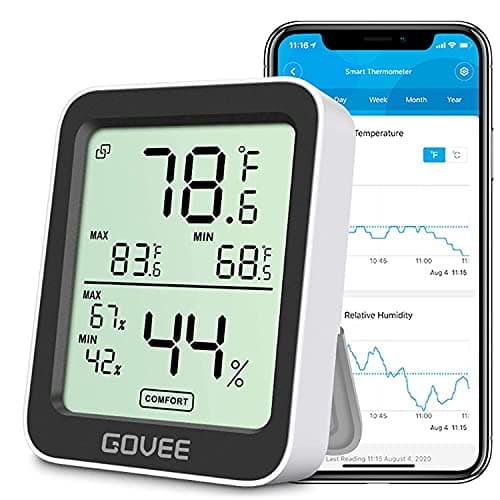
The one that logs. If your problem is that the house is dry at night but fine during the day, a hygrometer you have to walk over and read will never tell you that.
#ad Price as of October 18, 2026, from Amazon. Prices change. How we make money.
Published specifications
| Specification | Value | Source |
|---|---|---|
| Function | Bluetooth temperature and humidity sensor with app-based logging and data export | Govee published specification |
What is good about it
- Logging is the feature. Overnight humidity swings are invisible to a spot reading, and they explain most morning symptoms
- Data export means you can check whether the humidifier actually changed anything, rather than assuming
What is not
- Bluetooth range is room-scale; a basement sensor will not reach a phone upstairs
- Requires an app and an account, which is a genuine cost for some people
Who should skip this
Skip this if you just want a number on a wall. The logging is the whole premium, and it is wasted if you will not look at it.
How it scored
- Logging and history9.5
- Value for the decision it informs9.0
- Range and placement freedom6.0
Overall 8.6 / 10. This is our editorial score from published specifications and computed running cost. It is not a test result, and it is deliberately not marked up as a rating in this page’s structured data.
How we ranked these
We have not tested these units. Nobody here owns one. What we did was compile each manufacturer’s published specifications, check the coverage claims against AHAM’s room-sizing rule, and compute what each one costs to run for a year at the current US average electricity price. Every figure on this page is attributed to whoever published it, and the arithmetic is shown so you can redo it.
How we rank these sets out the full method, including what would change a ranking.
Questions people ask
+−What is the most accurate home air quality monitor?
We are not going to name one, because we have not tested any and comparative accuracy claims without measurement would be exactly the kind of thing this site exists not to do. What we can say is what to look for: published sensor model, stated measurement method, and access to the raw measured values rather than a single derived score. Reading those values sensibly is covered in PM2.5 explained.
+−Why does my monitor read high in the bathroom?
Very likely humidity. Water droplets scatter light in much the same way small particles do, so an optical sensor can register steam as particulate. It is a known characteristic of the measurement rather than a fault.
+−How often should I replace an air quality monitor?
Optical sensors drift with age and dust accumulation. Manufacturers rarely publish a service life. The practical answer is to be suspicious when the baseline you established shifts without any change in your circumstances. To turn all of this into a single number for your own room, use what size air purifier do I need.
+−Do more expensive monitors read more accurately?
Generally the more expensive devices use better sensors and disclose more about them, which is worth something. But every consumer optical sensor shares the same fundamental limitation in converting scattered light to a mass figure, and money does not remove that.