Guide
Are Humidifiers Worth It?
This is the one device on the site that can be working perfectly and still be a waste of money - because whether it helps depends entirely on a number most buyers never check.
By Scooter M. · Published · Last updated
How this page is funded: the buy links below are affiliate links. If you buy through one, we earn a commission at no extra cost to you. It does not change the order of the picks or what we say about them. Full disclosure.
The short answer
Worth it below 30% relative humidity. Not worth it above 40%. The EPA’s recommended indoor band is 30-50 percent, and it advises against humidifying past 50. Between 30 and 40 you are in the region where it is a comfort call. The problem is that almost nobody buying a humidifier has measured the room, so the purchase gets made on a symptom that may have nothing to do with humidity.
Settle it with a measurement, not a symptom
Dry skin, a dry throat, static shocks and a winter cough are all real, and none of them is a reading. They are also all produced by things other than low humidity - soap and hot showers dry skin, flooring and footwear produce static, and plenty of coughs are not environmental at all.
A hygrometer costs a fraction of any humidifier. Put one in the room you sleep in and look at the overnight figure rather than the number at dinnertime, because rooms are driest in the small hours after a night of heating - which is also when the symptoms happen. A logging sensor earns its small premium here for exactly that reason: a spot reading cannot show you an overnight curve.
| Overnight reading | Verdict | What to do |
|---|---|---|
| Below 30% | Worth it | A genuine deficit. This is what a humidifier is for |
| 30-40% | Marginal | Inside the EPA band. Comfort call - try sealing drafts first |
| 40-50% | Not worth it | Already mid-band. The symptom has another cause |
| Above 50% | Actively wrong | The EPA advises against humidifying here. You may need the opposite device |
The cost nobody quotes: maintenance
The purchase price is the smallest part of owning a humidifier. The EPA’s guidance is to change the water daily and clean portable units every third day, and it notes that scale from tap-water minerals can be a breeding ground for microorganisms, and that breathing mist containing those pollutants has been implicated in a certain type of lung inflammation.
That is the real price: a small recurring chore, forever, through the heating season. Add the consumable - wicks on an evaporative unit, or distilled water on an ultrasonic one, since the EPA recommends distilled or switching to an evaporative model to avoid dispersing minerals. A humidifier that does not get cleaned is not a neutral purchase; it is a worse outcome than the dry room you started with. The routine is at humidifier mold and cleaning.
Four times it is clearly worth it
- The overnight reading is consistently below 30% through the heating season. This is the unambiguous case.
- Winter nosebleeds or a cough that appears only when the heating goes on and disappears in spring - a pattern that points at the environment rather than at you.
- Wooden instruments or furniture you care about. These have their own humidity requirements and are less forgiving than people.
- A single bedroom you can close the door on. Small closed volumes are where a portable unit actually holds a number.
Four times it is not
- The room already reads 40-50%. Nothing to add, and adding anyway moves you toward condensation.
- You want to treat a whole open-plan floor with one portable unit. It will run continuously and move the number by a couple of points - the commonest disappointment in this category, covered at still dry with a humidifier running.
- You will not keep the cleaning schedule. Be honest about this one before buying, not after.
- The symptom is congestion and you have not checked which direction it points. Congestion sits at both ends of the humidity scale, and treating it with moisture when the room is already at 50% makes it worse.
What about the running cost?
Electricity is a smaller factor here than in the dehumidifier question, and it depends heavily on type. An evaporative unit at 30 W is about $24 a year run year-round at our standard 12-hours-a-day arithmetic, and roughly half that over a heating season. A warm-mist unit that boils its water is a different proposition entirely - at 280 W it is around $225 a year on the same basis, because boiling water is expensive. If you are choosing on cost of ownership, that gap dwarfs the purchase price difference.
What we would actually do
Buy the hygrometer first. It is the cheapest device on this site, it either justifies the humidifier or saves you the money and the chore, and it is the only way to know which of the two you are looking at. If the overnight figure is genuinely below 30%, seal the obvious drafts, then buy an evaporative unit sized on sustained output rather than on a coverage claim, target 40-45%, and put the cleaning on a calendar.
What we would buy for this
Chosen from the same registry as our roundups, on published specifications and computed running cost.
Govee H5075 Bluetooth Hygrometer
Diagnosing a problem that changes overnight
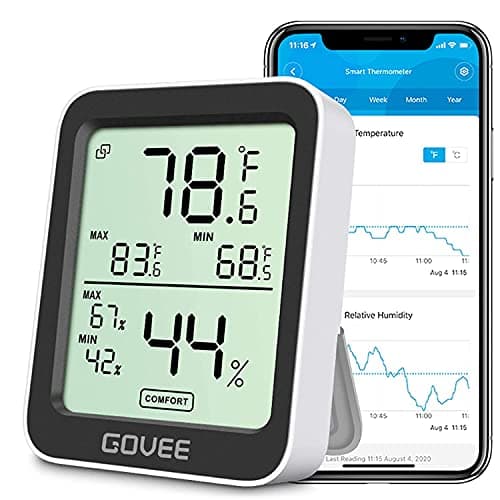
The one that logs. If your problem is that the house is dry at night but fine during the day, a hygrometer you have to walk over and read will never tell you that.
#ad Price as of October 18, 2026, from Amazon. Prices change. How we make money.
Published specifications
| Specification | Value | Source |
|---|---|---|
| Function | Bluetooth temperature and humidity sensor with app-based logging and data export | Govee published specification |
What is good about it
- Logging is the feature. Overnight humidity swings are invisible to a spot reading, and they explain most morning symptoms
- Data export means you can check whether the humidifier actually changed anything, rather than assuming
What is not
- Bluetooth range is room-scale; a basement sensor will not reach a phone upstairs
- Requires an app and an account, which is a genuine cost for some people
Who should skip this
Skip this if you just want a number on a wall. The logging is the whole premium, and it is wasted if you will not look at it.
How it scored
- Logging and history9.5
- Value for the decision it informs9.0
- Range and placement freedom6.0
Overall 8.6 / 10. This is our editorial score from published specifications and computed running cost. It is not a test result, and it is deliberately not marked up as a rating in this page’s structured data.
Levoit Superior 6000S
Whole floors, and anyone tired of refilling
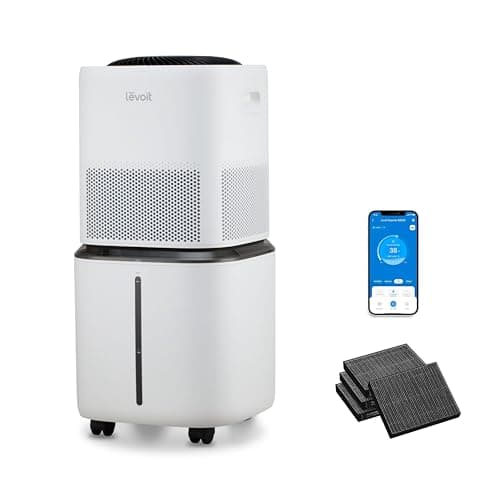
A 6-gallon evaporative unit at 30 W. If you have spent a winter refilling a small humidifier twice a day, this is the one that ends that.
#ad Price as of October 18, 2026, from Amazon. Prices change. How we make money.
Published specifications
| Specification | Value | Source |
|---|---|---|
| Tank capacity | 6 gal / 22.7 L | Levoit published specification |
| Coverage | 3,000 sq ft | Levoit published specification |
| Rated power | 30 W | Levoit published specification |
| Run time | Up to 72 hours on the low fan setting | Levoit published specification |
| Max output | 1,500 mL/h | Levoit published specification |
What it costs to run
About $12-13 a year in electricity across a heating season at 12 hours a day.
30 W / 1000 x 12 hours x 365 days = 131.4 kWh = $24.10 a year run year-round, so roughly $12-13 across a six-month heating season. On any evaporative unit the filters, not the electricity, are the larger cost.
What is good about it
- 30 W against 3,000 sq ft of claimed coverage is the best power-to-output ratio of any humidifier we list
- Evaporative, so it self-limits the same way the Honeywell does - it will not flood a room
- 72 hours per fill means refilling twice a week rather than twice a day
What is not
- It is a large object and it looks like one
- The 3,000 sq ft coverage claim assumes air moves freely between those rooms, which in a real house with doors it does not
Who should skip this
Skip this if you only need one bedroom humidified. A 6-gallon tank in a 120 sq ft room is a lot of standing water to keep clean for no additional benefit.
How it scored
- Cannot over-humidify10.0
- Refill interval9.5
- Power efficiency9.5
- Cleaning burden6.5
Overall 8.6 / 10. This is our editorial score from published specifications and computed running cost. It is not a test result, and it is deliberately not marked up as a rating in this page’s structured data.
Levoit LV600S Hybrid
People who want the option of warm mist
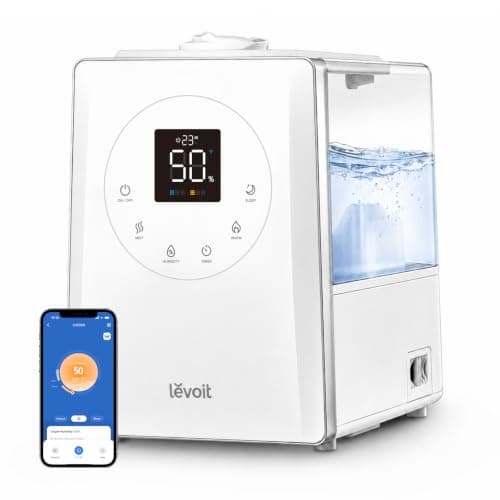
The one to pick if you specifically want warm mist - but note the 280 W rated power, because that is what heating water actually costs.
#ad Price as of October 18, 2026, from Amazon. Prices change. How we make money.
Published specifications
| Specification | Value | Source |
|---|---|---|
| Tank capacity | 1.58 gal / 6 L | Levoit published specification |
| Coverage | 753 sq ft | Levoit published specification |
| Rated power | 280 W | Levoit published specification |
| Run time | Up to 50 hours | Levoit published specification |
What it costs to run
Up to $225 a year on warm mist at 12 hours a day - the most expensive thing to run on this site.
280 W / 1000 x 12 hours x 365 days = 1,226 kWh = $224.86 a year at full warm-mist draw. On cool mist it draws a small fraction of that. This number, not the feature list, is what should decide whether you actually want warm mist.
What is good about it
- Warm and cool mist in one unit, so you are not committed to one type before you know which you prefer
- 50 hours per fill is good going for a 1.58 gallon tank
What is not
- 280 W rated. Warm mist is a kettle with a fan attached - the heat is the cost, and it is roughly ten times the Superior 6000S
- Ultrasonic, so it can over-humidify a room and it will aerosolize whatever minerals are in your water
Who should skip this
Skip this if you have hard water and no intention of using distilled. Ultrasonic units put the minerals in your water onto every surface in the room as white dust.
How it scored
- Cannot over-humidify3.0
- Refill interval8.0
- Power efficiency3.0
- Flexibility9.0
Overall 7.4 / 10. This is our editorial score from published specifications and computed running cost. It is not a test result, and it is deliberately not marked up as a rating in this page’s structured data.
How we ranked these
We have not tested these units. Nobody here owns one. What we did was compile each manufacturer’s published specifications, check the coverage claims against AHAM’s room-sizing rule, and compute what each one costs to run for a year at the current US average electricity price. Every figure on this page is attributed to whoever published it, and the arithmetic is shown so you can redo it.
How we rank these sets out the full method, including what would change a ranking.
Questions people ask
+−Are humidifiers actually worth buying?
Below 30% relative humidity, yes - that is a genuine deficit and a humidifier is the device that fixes it. Above 40% it is not, because you are already inside the EPA’s recommended 30-50% band and the symptom has another cause.
+−How do I know if I need a humidifier?
Measure the room overnight, not at dinnertime - rooms are driest in the small hours after a night of heating. A hygrometer costs a fraction of a humidifier and settles the question in two nights.
+−What are the downsides of a humidifier?
Maintenance, mainly. The EPA advises changing the water daily and cleaning portable units every third day, and warns that scale can be a breeding ground for microorganisms. An unmaintained humidifier is worse than none.
+−Do humidifiers help with dry skin?
Only if the air is genuinely dry. Skin dryness is also produced by hot showers, soap and cold weather itself, so a room already reading 45% will not improve because you added moisture.
+−Is a humidifier expensive to run?
It depends on type. An evaporative unit at 30 W is roughly $24 a year at 12 hours a day; a warm-mist unit that boils water at 280 W is roughly $225 on the same basis. The type matters far more than the purchase price. If you are weighing one appliance against two, we compare them in air purifier and humidifier combos.