Symptom guide
Why Is My House So Dry?
Cold outside air holds almost no water. Bring it inside and heat it and the relative humidity collapses. That is the whole mechanism.
By Scooter M. · Published · Last updated
How this page is funded: the buy links below are affiliate links. If you buy through one, we earn a commission at no extra cost to you. It does not change the order of the picks or what we say about them. Full disclosure.
The short answer
Cold air physically cannot hold much water. When your furnace heats that air to 70°F, the amount of water in it does not change - but the amount it could hold rises sharply, so relative humidity falls. Air that was a comfortable 70% outside at 20°F can land under 15% once it is heated indoors. Nothing has dried your house out. The heating did it.
This is why the complaint is so reliably seasonal, and why it starts within days of the heating coming on rather than gradually over the autumn. It is also why the fixes that work are not the ones most people try first.
How to tell if this is actually your problem
Dry air produces a specific and fairly distinctive cluster of signs. If you are seeing several of these together, and they arrived with the cold weather, the diagnosis is straightforward:
- Static shocks from door handles, the car, or the cat. Static builds up when there is not enough moisture in the air to bleed the charge away. This is the single most reliable indicator - it is essentially a humidity meter you already own.
- A dry throat or blocked nose on waking that clears within an hour of getting up.
- Cracked lips and itchy skin that no amount of moisturizer fixes for long.
- Wooden furniture, floors or instruments developing gaps. Wood gives up moisture to dry air and shrinks. Doors that stick in summer and rattle in winter are the same effect.
- Houseplants drying out faster than the watering schedule expects.
The number you are aiming at
The EPA states that indoor relative humidity should be kept below 60 percent, and ideally between 30 and 50 percent. That is the target band for a humidifier, and the top of it is a real ceiling, not a suggestion - above 60% you have traded a dryness problem for a mold and dust mite problem.
| Outdoor temperature | Practical indoor target | Why |
|---|---|---|
| Above 40°F | 40-50% | Windows stay warm enough that condensation is unlikely. |
| 20 to 40°F | 35-40% | Window glass is now cold enough that higher humidity will condense on it. |
| 0 to 20°F | 25-35% | Below the EPA's ideal band, but running higher will put liquid water on your windows and in your wall cavities. |
| Below 0°F | 20-25% | Comfort has to give way to not causing condensation damage. Address drafts instead. |
That table is the part most humidifier guides leave out, and it is why people who set a humidifier to 45% in January end up with condensation running down the inside of every window. The ideal band assumes the building can carry it. In hard cold, it cannot.
What actually fixes it, in order
1. Stop pulling in so much cold air (free)
Every cubic foot of cold outdoor air that leaks into the house has to be heated, and heating it is what dries it. Drafty houses are dry houses. Sealing gaps around window frames, letterboxes, loft hatches and the bottoms of external doors reduces the volume of air you have to dry out in the first place. This is the fix with no running cost, and it is the one nobody sells.
2. Stop actively venting moisture you have already made (free)
Running a bathroom extractor for an hour after a shower, or a kitchen hood through an entire meal, exports moisture you would otherwise get for free in winter. Run them long enough to clear the steam and then stop. In summer this advice reverses entirely.
3. Add moisture deliberately (a humidifier)
This is where a device earns its place - but only once you have measured, and only sized to the room you actually use. The type matters more than the brand:
- Evaporative (wick) units pass air over a wet wick. They self-limit - as a room approaches its capacity, evaporation slows on its own - so they physically cannot over-humidify a room, and the minerals in your water stay in the wick rather than landing on your furniture.
- Ultrasonic units vibrate water into a fine mist. Silent, but they will keep pushing moisture into a saturated room, and they aerosolize every mineral in the water as white dust.
- Warm mist units boil the water. That kills whatever is in the tank, but boiling water is expensive: the Levoit LV600S is rated at 280 W, which works out to roughly $225 a year at 12 hours a day.
Full comparison at warm mist vs cool mist.
When it is not dry air
The differential matters, because two of these are made worse by a humidifier:
- The symptoms are year-round. Dry-air symptoms follow the heating season. Something constant is more likely dust, dander or an irritant - see waking up congested.
- The room feels clammy rather than parched. Dust mites thrive above 50% RH and produce very similar morning congestion. Raising the humidity would feed them. Measure.
- Only one room is affected and it has no heating in it. An unheated room is usually the damp one, not the dry one.
- You already run a humidifier and it changed nothing. Either it is too small for the room, or the air is leaking out as fast as you can moisten it. Both are solved by the first fix on this page, not a bigger humidifier.
This page is about the environment - humidity, particles, ventilation - and what changes it. It is not medical advice and we hold no medical qualification. If symptoms are persistent, severe or getting worse, that is a question for a clinician rather than a purchase.

What we would buy for this
Chosen from the same registry as our roundups, on published specifications and computed running cost.
ThermoPro TP49 Hygrometer
Anyone about to buy a humidifier or a dehumidifier
An inexpensive digital hygrometer is the highest-value purchase on this entire site, because it is the one that tells you whether to buy anything else.
#ad We do not hold a current price for this product, so we do not show one. How we make money.
Published specifications
| Specification | Value | Source |
|---|---|---|
| Function | Digital temperature and relative humidity readout with a comfort indicator | ThermoPro published specification |
What is good about it
- Cheap enough to buy three and put one in the bedroom, one in the basement and one in the living room, which is what you actually want
- Gives you the reading that decides between a humidifier and a dehumidifier - a decision people routinely get backwards
What is not
- Consumer hygrometers are typically accurate to within a few percentage points, which is fine for the 30-50% question and not fine for anything precise
- No logging, so you see now rather than overnight
Who should skip this
Skip this only if you already own a hygrometer. There is no household we would tell not to measure.
How it scored
- Value for the decision it informs10.0
- Accuracy for the 30-50% question8.0
- Logging and history2.0
Overall 9.0 / 10. This is our editorial score from published specifications and computed running cost. It is not a test result, and it is deliberately not marked up as a rating in this page’s structured data.
Honeywell HCM350 Germ Free Cool Mist
Bedrooms, and anyone who has had white dust from an ultrasonic
An evaporative wick humidifier, which is the type that physically cannot over-humidify a room or spray minerals onto your furniture. That is the whole argument for it, and it is a good one.
#ad We do not hold a current price for this product, so we do not show one. How we make money.
Published specifications
| Specification | Value | Source |
|---|---|---|
| Tank capacity | 1.1 gallon | Honeywell published specification |
| Rated power | 50 W | Honeywell published specification |
| Run time | Up to 24 hours per fill | Honeywell published specification |
| Output | Up to 2 gallons of moisture per 24 hours | Honeywell published specification |
| Filter | Protec HAC-504AW antimicrobial wick filter | Honeywell published specification |
What it costs to run
About $20-22 a year in electricity across a heating season at 12 hours a day, plus wicks.
50 W / 1000 x 12 hours x 365 days = 219 kWh = $40.16 a year if run year-round. Most people run a humidifier for roughly half the year, so call it $20-22, plus replacement wicks at the manufacturer's stated interval.
What is good about it
- Evaporative design self-limits: as a room approaches saturation it simply evaporates less, so it will not push you past 50% RH the way an ultrasonic will
- No white mineral dust, because the minerals stay in the wick instead of being aerosolized into the room
- The tank is designed to come apart and be cleaned, which is the maintenance that actually matters
What is not
- There is a fan, so it is not silent the way an ultrasonic is
- The wick is a consumable - budget for it, and replace it on schedule or it becomes the thing growing mold
Who should skip this
Skip this if you want silence above all else, or if you will not buy replacement wicks. A neglected wick is worse than no humidifier at all.
How it scored
- Cannot over-humidify10.0
- No mineral dust10.0
- Quiet operation6.5
- Cleaning burden7.5
Overall 8.5 / 10. This is our editorial score from published specifications and computed running cost. It is not a test result, and it is deliberately not marked up as a rating in this page’s structured data.
Levoit Superior 6000S
Whole floors, and anyone tired of refilling
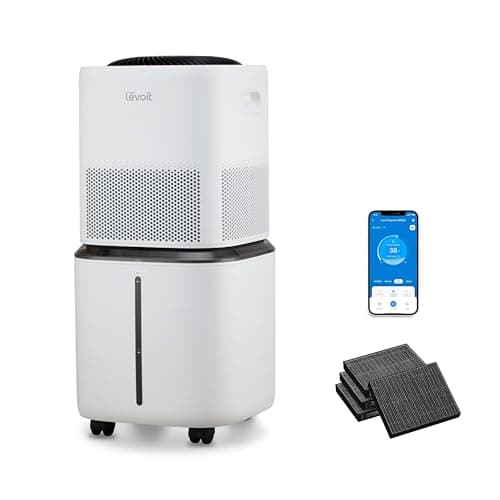
A 6-gallon evaporative unit at 30 W. If you have spent a winter refilling a small humidifier twice a day, this is the one that ends that.
#ad Price as of October 18, 2026, from Amazon. Prices change. How we make money.
Published specifications
| Specification | Value | Source |
|---|---|---|
| Tank capacity | 6 gal / 22.7 L | Levoit published specification |
| Coverage | 3,000 sq ft | Levoit published specification |
| Rated power | 30 W | Levoit published specification |
| Run time | Up to 72 hours on the low fan setting | Levoit published specification |
| Max output | 1,500 mL/h | Levoit published specification |
What it costs to run
About $12-13 a year in electricity across a heating season at 12 hours a day.
30 W / 1000 x 12 hours x 365 days = 131.4 kWh = $24.10 a year run year-round, so roughly $12-13 across a six-month heating season. On any evaporative unit the filters, not the electricity, are the larger cost.
What is good about it
- 30 W against 3,000 sq ft of claimed coverage is the best power-to-output ratio of any humidifier we list
- Evaporative, so it self-limits the same way the Honeywell does - it will not flood a room
- 72 hours per fill means refilling twice a week rather than twice a day
What is not
- It is a large object and it looks like one
- The 3,000 sq ft coverage claim assumes air moves freely between those rooms, which in a real house with doors it does not
Who should skip this
Skip this if you only need one bedroom humidified. A 6-gallon tank in a 120 sq ft room is a lot of standing water to keep clean for no additional benefit.
How it scored
- Cannot over-humidify10.0
- Refill interval9.5
- Power efficiency9.5
- Cleaning burden6.5
Overall 8.6 / 10. This is our editorial score from published specifications and computed running cost. It is not a test result, and it is deliberately not marked up as a rating in this page’s structured data.
How we ranked these
We have not tested these units. Nobody here owns one. What we did was compile each manufacturer’s published specifications, check the coverage claims against AHAM’s room-sizing rule, and compute what each one costs to run for a year at the current US average electricity price. Every figure on this page is attributed to whoever published it, and the arithmetic is shown so you can redo it.
How we rank these sets out the full method, including what would change a ranking.
Questions people ask
+−Why is my house so dry even with a humidifier running?
Usually one of three things. The humidifier is sized for a smaller room than the one it is in; the house is drafty enough that moist air is leaking out as fast as you add it; or it is working fine and your hygrometer is in a different room from the humidifier. Measure in the same room as the unit before concluding the unit is at fault - the full checklist is at still dry with a humidifier running.
+−Why is my house so dry and dusty at the same time?
Both are downstream of the same thing: air movement. A drafty house pulls in outside air, which dries it out and brings particulate with it, and dry air keeps dust airborne longer instead of letting it settle. Sealing drafts improves both. A purifier addresses the dust half only - see do air purifiers help with dust.
+−Why is my house so dry all of a sudden?
A sudden change almost always means something changed in the building rather than the weather: the heating switched to a new mode, a humidifier on the furnace stopped working, a window is being left open, or an extractor fan is running continuously. Whether the fix is a machine at all is worth settling first - are humidifiers worth it. Sudden onset with no weather change is worth investigating before buying anything.
+−Does a bowl of water on the radiator work?
It adds a genuinely small amount of moisture - the evaporation rate from an open bowl is low, and it is not adjustable or measurable. It is not a fraud, it is just too small to move a whole room. Sealing drafts is a better free option.
+−What relative humidity should I set a humidifier to in winter?
Start at 35-40% and watch your windows. If condensation appears on the glass in the morning, come down by 5% and check again. The right number is the highest one your windows tolerate without wetting, which in a hard freeze can be as low as 25%. Whether your unit can hold that number at all is a sizing question: what size humidifier do I need.