Roundup
Best Dehumidifiers for RVs and Campers
The vehicle that needs this most is usually the one standing unplugged all winter, and that single fact rules out most of the machines sold for the job.
By Scooter M. · Published · Last updated
How this page is funded: the buy links below are affiliate links. If you buy through one, we earn a commission at no extra cost to you. It does not change the order of the picks or what we say about them. Full disclosure.
The short answer
The right answer depends entirely on whether the vehicle has power. Standing unplugged over winter - which is when RVs and boats get damp - nothing electrical is an option, and a renewable desiccant unit is the only thing that works. Plugged into shore power, a small Peltier unit will keep a cabin’s condensation down. A compressor dehumidifier, the machine most people picture, is almost always the wrong shape, the wrong noise and the wrong power draw for a vehicle.
Why a parked vehicle gets damp at all
It is a small, sealed, poorly insulated box with large single-skin windows. Outside temperature swings, the metal and glass go cold, and any moisture already inside condenses on the coldest surface it can find. There is no heating cycling on and off to dry things out and no occupant opening doors. The result is the classic picture: water running down the inside of the windows and a musty smell in the soft furnishings by spring.
That matters for what you buy, because the total quantity of water involved is small. You are not drying a basement. You are stopping a few hundred millilitres a week from settling into cushions - which is why the physics of the cheap devices actually stands up here, when it does not in a room.
The three technologies, matched to the situation
| Technology | Needs power? | What it will do | What it will not do |
|---|---|---|---|
| Renewable desiccant | No - recharges in a socket, then works unpowered | Hold a locker, a cabin or a cab through a winter of standing | Collect any volume, or work in a large open saloon |
| Peltier (thermoelectric) | Yes, continuously | Keep condensation down in a small cabin on shore power, near-silently | Work well once the vehicle gets cold, which is when you need it |
| Compressor | Yes, and a real load | Genuinely dry a large motorhome that is lived in and hooked up | Fit, stow, or run quietly enough to sleep beside |
How we judged these
- Does it work in the state the vehicle is actually in? Most RV damp happens while the vehicle is unplugged and unvisited, which disqualifies anything that needs a socket.
- Does the manufacturer publish an extraction figure with conditions? Almost nothing in this tier does. Where the conditions are stated, we quote both.
- Will it survive being stowed? Vehicles move. Anything with a full open tank of water is a mess waiting to happen.
- Honest fit over capability. As with our budget dehumidifier recommendations, these are not comparable machines, so we ranked them by which job each genuinely wins.
Cold is the thing that breaks the electrical options
Peltier units work by chilling a small plate below the dew point. They have no compressor and no refrigerant, which is what makes them cheap, tiny and silent - and it is also what makes them fade as the ambient temperature drops, because the plate can only get so far below an already-cold room. The season when a caravan is dampest is the season when a Peltier unit is least effective.
Compressor units have the same problem in a different form: below roughly 41F their coils frost and they spend their time defrosting. There is no small electrical dehumidifier that is at its best in a cold, unheated vehicle. That is the honest reason a bag of silica gel keeps winning this category.
A note on moisture absorbers
Disposable tubs of calcium chloride are the default in marinas and storage yards, and they do work - they are the same idea as a renewable desiccant without the reusable part. The trade is ongoing cost and a tub of corrosive liquid brine sitting in a moving vehicle. We compared the two approaches in dehumidifier vs DampRid, and for a vehicle the rechargeable unit is usually the better long-term buy simply because nobody has to remember to restock it.
What we would actually do
For a vehicle stored unplugged: two renewable desiccant units, one in the cabin and one in the shower or wet locker, recharged whenever you visit. Leave interior doors and lockers open so air can move, and lift cushions off the bench so the cold surface is not trapped against fabric. That combination costs very little and prevents most of the damage.
For a vehicle on shore power over winter: add a small Peltier unit and accept that its contribution falls away in the coldest weeks. For a large motorhome that is actually lived in and hooked up, stop reading RV advice and buy a small compressor unit - the guidance in best small dehumidifiers applies directly, because at that point you are drying a room.
Quick picks
Ranked on published specifications and computed running cost. Tap any row for the full write-up, including who should skip it.
| # | Product | Best for | Score | Price |
|---|---|---|---|---|
| 1 | 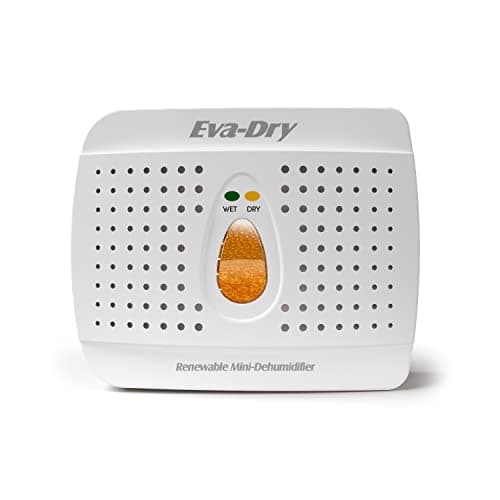 Eva-Dry E-333 RenewableSafes, sealed closets, boats | Best with no power | 7.2 | $14.97 - View on Amazon |
| 2 | 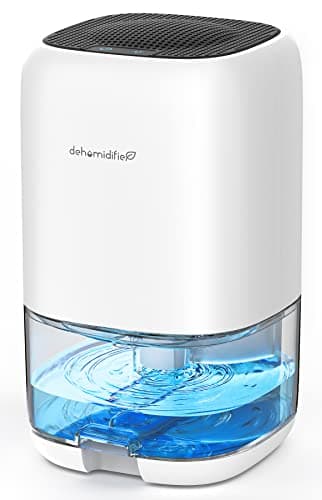 TABYIK 35 oz DehumidifierA caravan, a boat cabin, a wardrobe or a small bathroom | Best on shore power | 7.0 | $39.99 - View on Amazon |
| 3 | 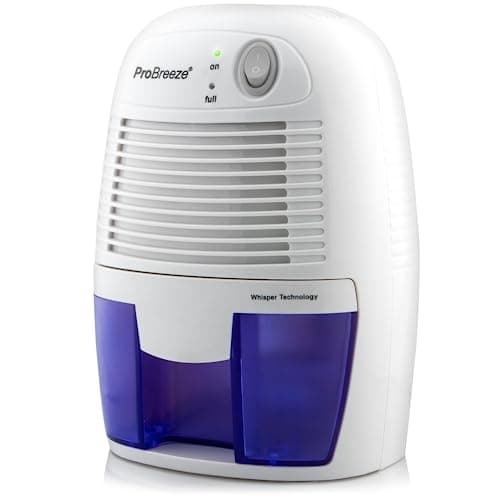 Pro Breeze Mini DehumidifierClosets, gun safes, small bathrooms, RVs | Best for a larger cabin | 7.6 | $43.99 - View on Amazon |
#1 - Best with no power
Eva-Dry E-333 Renewable
Safes, sealed closets, boats
No power, no tank, no fan - a silica desiccant you plug in for a few hours to dry out and then put back. For a gun safe or a sealed closet this is often the honest answer.
#ad Price as of October 18, 2026, from Amazon. Prices change. How we make money.
Published specifications
| Specification | Value | Source |
|---|---|---|
| Type | Renewable silica gel desiccant, recharged by plugging in | Eva-Dry published specification |
What is good about it
- Zero running cost while it is working - it draws power only during the recharge cycle
- Nothing to empty, nothing to break, and no standing water to grow anything in
What is not
- Capacity is tiny; this handles a sealed cubic foot or two, not a room
- You have to remember to recharge it, and nothing reminds you
Who should skip this
Skip this for anything with a door that opens regularly. Desiccant works in sealed spaces; in a closet you open daily it never gets ahead of the moisture coming in.
How it scored
- Running cost10.0
- Fit for sealed spaces9.0
- Capacity2.0
- Maintenance burden6.0
Overall 7.2 / 10. This is our editorial score from published specifications and computed running cost. It is not a test result, and it is deliberately not marked up as a rating in this page’s structured data.
#2 - Best on shore power
TABYIK 35 oz Dehumidifier
A caravan, a boat cabin, a wardrobe or a small bathroom
A Peltier unit that publishes the one number most of its competitors hide: how much water it actually collects, and under what conditions. The number is small, and knowing it is worth more than the marketing.
#ad Price as of October 18, 2026, from Amazon. Prices change. How we make money.
Published specifications
| Specification | Value | Source |
|---|---|---|
| Water removal | Up to 16 oz (450 ml) in 24 h at 86F / 80% RH | TABYIK published specification |
| Tank | 35 oz (1,000 ml) | TABYIK published specification |
| Auto shut-off | At 700-800 ml in the tank | TABYIK published specification |
| Technology | Peltier (thermoelectric) | TABYIK published specification |
| Noise | 28 dB | TABYIK published specification |
| Dimensions and weight | 5.9 x 5.9 x 10.1 in, 2.19 lb | TABYIK published specification |
| Coverage (manufacturer claim) | 280 sq ft - see cons | TABYIK published specification |
What it costs to run
TABYIK publishes a consumption ceiling rather than a wattage: no more than 1 kWh per day.
TABYIK states the unit uses no more than 1 kilowatt-hour a day. At 18.34 cents/kWh a continuous 1 kWh/day would be $66.94 a year - more than a 20-pint compressor unit that removes twenty times the water. Run it in an enclosure, not a room, and that ceiling is academic; run it continuously in a room and it is the worst value in this category.
What is good about it
- Publishes its extraction rate WITH the test conditions attached, which almost nothing else in this tier does
- 28 dB and no compressor, so it can run in a sleeping space or a cabin without being noticed
- 2.19 lb and smaller than a shoebox - it stows in a caravan locker
- Auto shut-off at 700-800 ml means it will not overflow while you are away from it
What is not
- The 280 sq ft coverage claim and the 450 ml/day extraction figure do not describe the same machine. 450 ml a day across 280 sq ft is not dehumidification, it is a gesture
- That 450 ml is the BEST case, measured at 86F and 80% RH. In a cool caravan in spring it will collect far less
- Peltier units lose effectiveness as the room gets colder, which is exactly when a boat or caravan is damp
- Auto shut-off at 700-800 ml of a 1,000 ml tank means the usable tank is 70-80% of the advertised figure
- No compressor means no chance of holding a real room; this is a small-enclosure device only
Who should skip this
Skip this for any actual room. A bedroom, a basement or a garage needs a compressor unit, and no amount of runtime from a Peltier plate will substitute. Skip it too for an unheated space in winter.
How it scored
- Fit for an enclosure9.0
- Honesty of published data8.0
- Capability in a real room2.0
Overall 7.0 / 10. This is our editorial score from published specifications and computed running cost. It is not a test result, and it is deliberately not marked up as a rating in this page’s structured data.
#3 - Best for a larger cabin
Pro Breeze Mini Dehumidifier
Closets, gun safes, small bathrooms, RVs
A thermoelectric unit, not a compressor. That means it is quiet and small and it will not touch a basement - but in a closet or an RV it is exactly right.
#ad Price as of October 18, 2026, from Amazon. Prices change. How we make money.
Published specifications
| Specification | Value | Source |
|---|---|---|
| Type | Thermoelectric (Peltier), not a compressor | Pro Breeze published specification |
What is good about it
- Near-silent, because there is no compressor to cycle
- Small enough to sit inside a wardrobe or under a sink
What is not
- Thermoelectric units lose effectiveness sharply in cold rooms, which is exactly what an unheated basement is
- Capacity is a fraction of any compressor unit - this manages dampness, it does not dehumidify a room
Who should skip this
Skip this for any room-sized job. If you are searching for a basement dehumidifier, this is not it, no matter how many roundups file it under that heading.
How it scored
- Fit for small enclosed spaces9.0
- Quiet operation9.5
- Capacity3.5
- Cold-room performance3.0
Overall 7.6 / 10. This is our editorial score from published specifications and computed running cost. It is not a test result, and it is deliberately not marked up as a rating in this page’s structured data.
How we ranked these
We have not tested these units. Nobody here owns one. What we did was compile each manufacturer’s published specifications, check the coverage claims against AHAM’s room-sizing rule, and compute what each one costs to run for a year at the current US average electricity price. Every figure on this page is attributed to whoever published it, and the arithmetic is shown so you can redo it.
How we rank these sets out the full method, including what would change a ranking.
Questions people ask
+−What is the best dehumidifier for an RV in storage?
A renewable desiccant unit, and usually more than one. Storage means no power, and without power nothing else on this page functions at all. They need recharging in a socket periodically, which is the one thing to plan for.
+−Will a small dehumidifier stop condensation on RV windows?
It will reduce it, not eliminate it. Condensation forms because the glass is colder than the dew point of the air inside; lowering the humidity raises the point at which that happens. Thermal blinds or window insulation attack the same problem from the other side and often do more for less.
+−How much water should a small RV dehumidifier collect?
Less than the listing implies. The unit here publishes up to 450 ml in 24 hours at 86F and 80% RH - warm, very humid conditions. A cool caravan in spring will yield a fraction of that. If you are collecting litres a day in a parked vehicle, you have a leak, not a humidity problem.
+−Can I leave a dehumidifier running in a boat or RV unattended?
Only with care, and only on a unit with reliable auto shut-off and a tank that cannot slop. A desiccant unit has no tank and nothing to spill, which is one of the quieter reasons it suits a vehicle that moves. A sealed safe is the other enclosure where that matters - gun safe dehumidifiers.
+−Is a dehumidifier or a moisture absorber better for a camper?
For an unpowered vehicle, they are the same technology and the rechargeable one avoids a restocking habit and a tub of brine. For a powered one, a small electrical unit does more - until the temperature drops, at which point the desiccant is working and the electrical unit is mostly making noise.