Guide
Will a Dehumidifier Get Rid of Silverfish?
These insects are not a hygiene problem. They are a moisture reading you can see walking across the floor, which is why the appliance works where the spray does not.
By Scooter M. · Published · Last updated
How this page is funded: the buy links below are affiliate links. If you buy through one, we earn a commission at no extra cost to you. It does not change the order of the picks or what we say about them. Full disclosure.
The short answer
Yes - a dehumidifier is the control for silverfish, and it works because it removes a condition the insect cannot live without rather than killing individuals. The UC Statewide IPM Program states that in warmer rooms the relative humidity must be above 75% for silverfish, and Penn State Extension states that lowering relative humidity below 50% prevents the mold growth booklice feed on. Hold the room in the 30-50% band the EPA recommends and the population has nothing to live on. For a damp basement or storage room our pick is the Midea Cube 35; for a single closed cupboard or bookcase it is a renewable desiccant, because a compressor machine cannot dry a space it is not in. Buy a hygrometer first - it is the cheapest item on this page and it tells you whether any of this applies to you.
What the insect is actually telling you
Silverfish in a bathroom, booklice on a windowsill, springtails in a sink: none of these is a cleanliness failure, and all three are reporting the same thing. They are moisture-dependent species, which means they turn up where the air and the surfaces hold more water than the rest of the house. Penn State Extension puts it directly for booklice - they “feed on mold and fungi and are indicators of high humidity or moisture.” UC IPM says the same of springtails: “Their continued presence indoors is an indicator of moisture.”
That is why the spray disappoints people. It reduces the number of insects you can see without touching the reason they are there, so the population comes back on the timescale of its own life cycle. UC IPM is unusually blunt about this: “Insecticides won’t be effective unless you also remove the moisture, food, and hiding places that allow these pests to thrive,” and “It is almost impossible to control large populations of silverfish and firebrats unless you have removed dripping water and moist surfaces.”
A dehumidifier is therefore not an extra measure alongside pest control. In a room whose humidity is the cause, it is the pest control, and everything else is cleanup.
The humidity each species actually needs
These are published figures from land-grant extension programs, not estimates. They are the whole basis for deciding whether an appliance will help you:
| Insect | Humidity it needs | What the extension program recommends |
|---|---|---|
| Silverfish | Above 75% RH at higher temperatures; prefers rooms at 71 to 90°F (UC IPM) | Dehumidifiers in closed spaces; ventilation from fans to push RH below what they tolerate; repair leaks and drips |
| Booklice (psocids) | Feed on mold; development stops below 50% RH (Penn State Extension) | Remedy the underlying water issue; a dehumidifier or moisture absorber to lower room humidity. Pesticides stated as not normally necessary |
| Springtails | Need standing moisture; they “soon die after entering a home unless they find moisture” (UC IPM) | Airing out and drying the infested area, a fan to speed it up, repairing leaks. UC IPM does not recommend a dehumidifier here |
| Firebrats | The exception: they thrive at a relative humidity as low as 30% and above 90°F, optimum 98 to 102°F (UC IPM) | Moisture reduction will not do it. Look at heat sources - ovens, heating units, hot water pipes, the furnace |
The number you are aiming at, and why it is not zero
You are not trying to dry the room out. The target is the same band this site uses everywhere: the EPA recommends keeping indoor relative humidity below 60 percent, and ideally between 30 and 50 percent. That band happens to sit below every figure in the table above except the firebrat’s, which is a useful coincidence - the humidity that is right for the building and for you is also the humidity these insects cannot sustain a population in.
Going lower buys you nothing. A room at 35% is not meaningfully more hostile to a silverfish than a room at 45%, and getting there costs electricity and - in winter - risks the opposite problem, which is the whole of our dry-air hub. Set the humidistat at 50%, not at the bottom of the dial. The ideal indoor humidity page has the seasonal detail.
How long it takes, honestly
Slower than a spray, and the published life cycle is why. UC IPM gives development times that vary enormously with temperature: “When the temperature is below 50°F, firebrats can take as long as 300 days and silverfish as long as 500 days to develop into adults,” while “When it is above 75°F, it can take firebrats as few as 40 days and silverfish as little as 60 days.”
Read that as a schedule for your expectations. Drying a warm bathroom acts on a population that turns over in roughly two months; drying a cold cellar acts on one that may take well over a year. In both cases you will see fewer insects long before the population is gone, because the adults you are seeing today hatched under the old conditions. The appliance is working on the next generation, not on this one.
Which machine, for which space
This is where most advice goes wrong, because “buy a dehumidifier” covers three genuinely different products. The deciding question is the volume of air you need to hold dry, not the size of the insect problem.
- A basement, utility room, laundry or whole damp floor. A compressor dehumidifier, sized on the published pint capacity - the arithmetic is on what size dehumidifier do I need. This is the only category that can hold a real room in the band continuously. Put it on a humidistat and a gravity hose and forget about it.
- One closed cupboard, bookcase, wardrobe or box of papers. A renewable desiccant. It has no compressor, no power draw and no drain, and inside a genuinely closed space it holds moisture down well. In an open room it does almost nothing - see best small dehumidifiers for why that distinction matters more than the price.
- A room with an active water source. Neither, yet. UC IPM’s first instruction is to “Patch holes or spaces around pipes and conduits, and repair leaks and drips in plumbing.” A machine running against a dripping trap is a machine you pay for twice.
Clemson’s extension service frames the combination the way we would: “Reducing moisture problems and lowering relative humidity in a home with dehumidifiers and fans is often helpful.” Fans are in that sentence for a reason. UC IPM notes that “Ventilation from fans can reduce relative humidity to a point that is intolerable to silverfish,” which in a bathroom often means running the extractor properly is the first fix and the cheapest - how to lower humidity without a dehumidifier covers that ground before you spend anything.
Measure the space the insects are in, not the hallway
This is the single most common reason people conclude the humidity theory does not apply to them. A hallway hygrometer reading 48% tells you nothing about the inside of a closed cupboard on an external wall, or a bathroom at 7am, or the back of a bookcase. Those are the places silverfish and booklice are found, and they are routinely 15 to 20 points wetter than the room average.
So put the instrument where the problem is, and use one that logs rather than one you have to be standing in front of. An overnight peak inside a closed wardrobe is exactly the reading you will never catch by looking at a dial in the afternoon, and it is the reading that decides whether a desiccant in that wardrobe is enough or whether the whole room needs drying.
What a dehumidifier will not do
- It will not remove the ones you can see. Dropping the humidity acts on breeding and survival over a generation. The adults in the bath this week are a cleanup job - wash springtails down the drain, as UC IPM suggests, and vacuum the rest.
- It will not fix a leak. Every extension source leads with the water, and so do we. A running machine beside a failed seal is a dehumidifier used as a symptom-suppressant.
- It will not help with firebrats, for the reason in the callout above.
- It is not what UC IPM recommends for springtails. That page asks for drying, airing and leak repair, and we are not going to upgrade its advice to an appliance recommendation it does not make. If springtails are your only sign, start with the fan and the houseplant saucers.
- It will not reach a sealed cavity. If the damp is inside a wall or under a floor, the air you are drying is not the air the insects are in.
What we would actually do
Put a logging hygrometer in the exact spot the insects appear and leave it for two nights. If the overnight peak there is above 60%, you have found the cause and the machine is worth buying: a compressor unit for a room, a renewable desiccant for a cupboard. If the peak is in the 40s, the humidity is not your explanation - look for a leak, a cold bridge or a specific wet surface instead, because something local is holding water even though the air is not.
This page is about the environment - humidity, particles, ventilation - and what changes it. It is not medical advice and we hold no medical qualification. If symptoms are persistent, severe or getting worse, that is a question for a clinician rather than a purchase.
What we would buy for this
Chosen from the same registry as our roundups, on published specifications and computed running cost.
Midea Cube 35-Pint
Basements without a floor drain
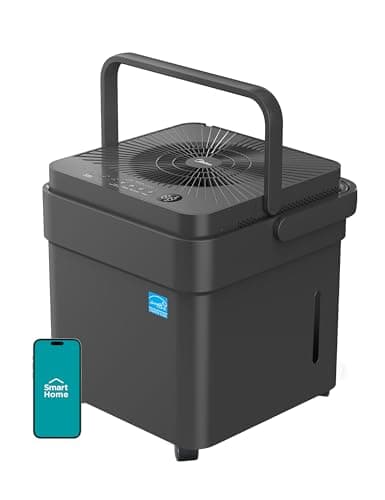
The adjustable 4.25-gallon bucket is the point. Most dehumidifiers get switched off because emptying a 2-gallon bucket twice a day is miserable; this one buys you a couple of days.
#ad Price as of October 18, 2026, from Amazon. Prices change. How we make money.
Published specifications
| Specification | Value | Source |
|---|---|---|
| Capacity | 35 pints per day | Midea published specification |
| Capacity (federal test) | 35.82 pints per day | ENERGY STAR certified products database |
| Coverage | Up to 3,500 sq ft | Midea published specification |
| Efficiency (IEF) | 2.01 L/kWh | ENERGY STAR certified products database |
| Annual energy use | 378 kWh/yr | ENERGY STAR certified products database |
| Bucket fill level | Adjustable, up to 4.25 gallons | Midea user manual |
| Fan speeds | 2 (High, Low) | Midea user manual |
| Dimensions | 14.76 x 14.57 x 14.45 in, 39.62 lb | Midea published specification |
| Certification | ENERGY STAR certified | ENERGY STAR certified products database |
What it costs to run
About $69 a year on ENERGY STAR's certified annual energy figure.
ENERGY STAR publishes 378 kWh a year for this model. At 18.34 cents/kWh that is $69.33 a year. That figure is calculated on the program's standardized test basis, not measured in your basement: a genuinely damp space where it cycles constantly will use more. Against the 50-pint Cube's 515 kWh ($94.45) it is the cheaper machine to own, which is the argument for sizing honestly rather than buying headroom.
What is good about it
- An adjustable bucket that holds up to 4.25 gallons - the difference between a unit you keep using and one you unplug in week three
- An IEF of 2.01 L/kWh removes about 18% more water per kWh than the 20-pint Cube's 1.70
- Nests down into a smaller shape for storage, which matters for an appliance you only use half the year
What is not
- The 3,500 sq ft coverage claim assumes conditions no real basement has; treat it as a ceiling, not a specification
- 35 pints is not enough for a genuinely wet basement with standing water
- Midea does not publish a rated wattage for this model, so we quote ENERGY STAR's certified annual energy figure instead
- No built-in pump on this model - without a floor drain you are either emptying the bucket or routing a gravity hose
Who should skip this
Skip this if your basement is wet rather than damp - visible water, white efflorescence on the walls, a musty smell that returns within a day of airing out. That is a drainage problem, and a 35-pint unit will run permanently and never win.
How it scored
- Tank interval10.0
- Capacity for the money8.5
- Efficiency per liter removed9.0
- Storage footprint9.0
Overall 8.7 / 10. This is our editorial score from published specifications and computed running cost. It is not a test result, and it is deliberately not marked up as a rating in this page’s structured data.
Eva-Dry E-333 Renewable
Safes, sealed closets, boats
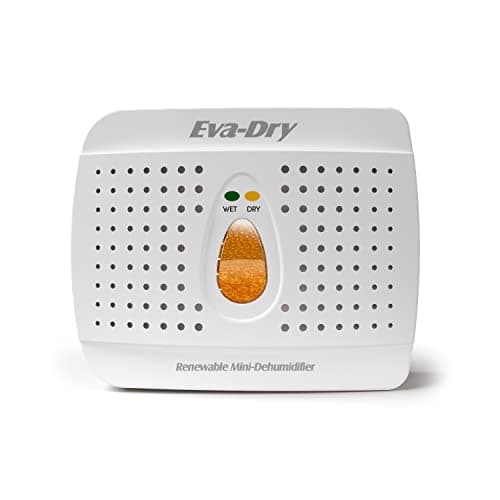
No power, no tank, no fan - a silica desiccant you plug in for a few hours to dry out and then put back. For a gun safe or a sealed closet this is often the honest answer.
#ad Price as of October 18, 2026, from Amazon. Prices change. How we make money.
Published specifications
| Specification | Value | Source |
|---|---|---|
| Type | Renewable silica gel desiccant, recharged by plugging in | Eva-Dry published specification |
What is good about it
- Zero running cost while it is working - it draws power only during the recharge cycle
- Nothing to empty, nothing to break, and no standing water to grow anything in
What is not
- Capacity is tiny; this handles a sealed cubic foot or two, not a room
- You have to remember to recharge it, and nothing reminds you
Who should skip this
Skip this for anything with a door that opens regularly. Desiccant works in sealed spaces; in a closet you open daily it never gets ahead of the moisture coming in.
How it scored
- Running cost10.0
- Fit for sealed spaces9.0
- Capacity2.0
- Maintenance burden6.0
Overall 7.2 / 10. This is our editorial score from published specifications and computed running cost. It is not a test result, and it is deliberately not marked up as a rating in this page’s structured data.
Govee H5075 Bluetooth Hygrometer
Diagnosing a problem that changes overnight
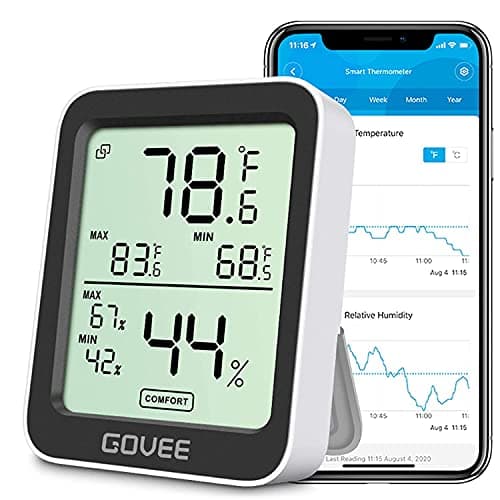
The one that logs. If your problem is that the house is dry at night but fine during the day, a hygrometer you have to walk over and read will never tell you that.
#ad Price as of October 18, 2026, from Amazon. Prices change. How we make money.
Published specifications
| Specification | Value | Source |
|---|---|---|
| Function | Bluetooth temperature and humidity sensor with app-based logging and data export | Govee published specification |
What is good about it
- Logging is the feature. Overnight humidity swings are invisible to a spot reading, and they explain most morning symptoms
- Data export means you can check whether the humidifier actually changed anything, rather than assuming
What is not
- Bluetooth range is room-scale; a basement sensor will not reach a phone upstairs
- Requires an app and an account, which is a genuine cost for some people
Who should skip this
Skip this if you just want a number on a wall. The logging is the whole premium, and it is wasted if you will not look at it.
How it scored
- Logging and history9.5
- Value for the decision it informs9.0
- Range and placement freedom6.0
Overall 8.6 / 10. This is our editorial score from published specifications and computed running cost. It is not a test result, and it is deliberately not marked up as a rating in this page’s structured data.
How we ranked these
We have not tested these units. Nobody here owns one. What we did was compile each manufacturer’s published specifications, check the coverage claims against AHAM’s room-sizing rule, and compute what each one costs to run for a year at the current US average electricity price. Every figure on this page is attributed to whoever published it, and the arithmetic is shown so you can redo it.
How we rank these sets out the full method, including what would change a ranking.
Questions people ask
+−Will a dehumidifier get rid of silverfish?
+−What humidity level kills silverfish?
+−How long does it take for a dehumidifier to clear an infestation?
+−Do I need a dehumidifier or will a fan do?
+−Will a dehumidifier help with booklice?
+−Will one small plug-in unit dry a whole damp room?
+−Are silverfish dangerous or just unpleasant?
Sources
- UC Statewide IPM Program - Silverfish and Firebrats (Pest Notes)
- Penn State Extension - Booklice
- UC Statewide IPM Program - Springtails
- Clemson Cooperative Extension HGIC - Silverfish & Firebrats
- EPA - A Brief Guide to Mold, Moisture and Your Home
- U.S. Energy Information Administration - Electric Power Monthly, Table 5.6.A