Guide
Do Air Purifiers Help With Dust?
Yes for what is floating, no for what is on the shelf. Whether that is worth the money depends entirely on which one bothers you.
By Scooter M. · Published · Last updated
How this page is funded: the buy links below are affiliate links. If you buy through one, we earn a commission at no extra cost to you. It does not change the order of the picks or what we say about them. Full disclosure.
The short answer
Yes for airborne dust, no for settled dust. A purifier removes particles from air passing through it, so it reduces what is floating and what you breathe. It has no effect at all on dust already on surfaces, and it does not stop dust being produced. If your complaint is having to dust the shelves, a purifier will disappoint you. If your complaint is symptoms, it may well not.
Where household dust actually comes from
Dust is not one substance. It is skin flakes, textile fibers from clothes and carpet, soil tracked in on shoes, pollen, pet dander, insect fragments and particulate that came in through a window or a vent. The mix decides how much of it is ever airborne.
- Light and long-lived in the air - dander, fine fibers, smoke particulate, pollen. A purifier is genuinely effective on these.
- Heavy and quick to settle - larger fibers, soil, dust mite allergen. These spend little time airborne, so a purifier rarely encounters them.
That split is the honest answer to the question, and it is why “does it help with dust” genuinely has two answers.
Are air purifiers worth it for dust?
It depends what you are buying it for, and the two motives point in opposite directions:
| What you want | Will a purifier do it? | What actually would |
|---|---|---|
| Less dusting | Barely. Some fine dust is captured before it settles, but the effect is modest. | Fewer textiles, shoes off at the door, better vacuuming, changing the furnace filter. |
| Fewer symptoms from airborne dust | Yes, in the room it is in and when sized correctly. | A correctly sized purifier is genuinely the right answer here. |
| Less dust mite allergen | Very little - it settles too fast. | Humidity below 50%, hot washing, allergen covers - dust mites in the bedroom |
| Less dust in the whole house | No - a portable unit treats one room. | A better furnace filter, if you have forced-air heating. |
The cheapest dust intervention you are probably not doing
If you have forced-air heating or central air, there is already a filter in the system that treats every room, and it is likely overdue. Replacing it - and considering a higher MERV rating if your system is specified for it - is a few dollars against a purifier’s purchase price, and it works house-wide rather than room-wide.
The caveat: a higher-MERV filter restricts airflow more, and not all systems tolerate it. Check before fitting one - HEPA filters explained covers the MERV scale.
Getting the most out of a purifier for dust
- Size it properly. AHAM’s rule is a smoke CADR of about two-thirds the room’s area - 132 CFM for a 200 sq ft room in their own worked example. An undersized unit in a large room is the single most common reason people conclude purifiers do not work.
- Run it continuously rather than in bursts. Dust is generated continuously, so intermittent filtering never gets ahead. This is where a unit with a low-power quiet setting matters - Coway publishes 3.7 W on speed one, which is under $6 a year at 24/7 running.
- Give it clearance. Against a wall or behind a sofa, it cannot deliver its rated airflow.
- Vacuum the pre-filter. A clogged pre-filter quietly reduces everything downstream of it.
This page is about the environment - humidity, particles, ventilation - and what changes it. It is not medical advice and we hold no medical qualification. If symptoms are persistent, severe or getting worse, that is a question for a clinician rather than a purchase.
When to buy nothing
- Your complaint is dusting furniture. Filtration is not the lever, and we would rather tell you that than sell you one.
- You have a forced-air filter you have not changed in a year. Do that first.
- The dust is coming from a specific source - a nearby construction site, an unsealed loft hatch, a dryer venting indoors. Sealing the source beats filtering the consequence.
What we would buy for this
Chosen from the same registry as our roundups, on published specifications and computed running cost.
Levoit Core 400S
Living rooms and open-plan spaces
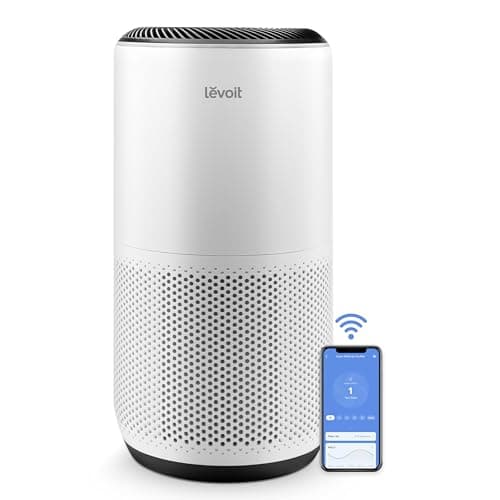
The one to buy if you want a purifier that genuinely covers a living room, and one of the few spec sheets in this bracket that publishes coverage at a useful air-change rate rather than only the flattering one.
#ad Price as of October 18, 2026, from Amazon. Prices change. How we make money.
Published specifications
| Specification | Value | Source |
|---|---|---|
| CADR | 231 CFM | Levoit published specification |
| Coverage | 358 sq ft at 4.8 air changes/hr (1,718 sq ft at 1 ACH) | Levoit published specification |
| Rated power | 38 W | Levoit published specification |
| Noise | 22-52 dB | Levoit published specification |
| Filtration | 3-stage: pre-filter, HEPA, activated carbon | Levoit published specification |
| Dimensions | 10.8 x 10.8 x 20.5 in, 11 lb | Levoit published specification |
What it costs to run
About $25-30 a year in electricity at 12 hours a day, before filters.
38 W / 1000 x 12 hours x 365 days = 166.4 kWh. At 18.34 cents/kWh that is $30.52 a year at rated power - and the unit only draws its full 38 W on the top fan speed, so a mid setting lands nearer $25. Add the replacement filter, which you should price before you buy rather than after.
What is good about it
- Levoit publishes coverage at both 1 ACH and 4.8 ACH, which is unusually straight - most brands quote only the flattering 1 ACH number
- 38 W is low for this CADR, which is what keeps the running cost down
- 22 dB on its lowest setting is quiet enough to sleep beside
- Carbon, pet-allergy and smoke-specific replacement filters are sold for the same body
What is not
- We could not find a published filter replacement interval in Levoit's specification, so we are not quoting one
- The 1,718 sq ft headline is a single air change per hour, which is not a useful rate for allergies
Who should skip this
Skip this if your room is under 200 sq ft. The Core 300S covers that at lower power and lower cost, and the extra CADR buys you nothing in a small bedroom.
How it scored
- Clean air per watt9.0
- Honest coverage claim9.5
- Quiet operation8.5
- Filter economics7.5
Overall 8.6 / 10. This is our editorial score from published specifications and computed running cost. It is not a test result, and it is deliberately not marked up as a rating in this page’s structured data.
Coway Airmega AP-1512HH Mighty
Running continuously in a medium room
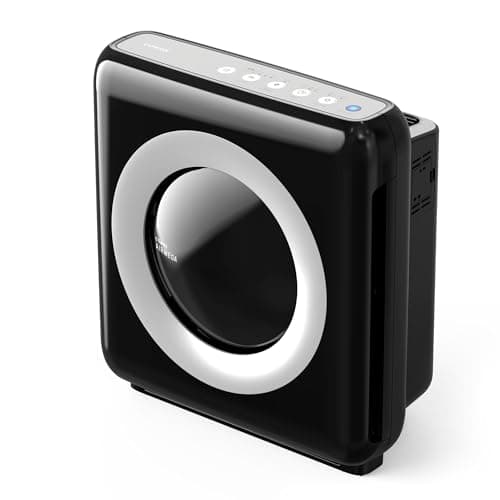
The most efficient unit here at low speed - 3.7 W on speed one - which matters enormously if you leave a purifier running all day and almost not at all if you do not.
#ad Price as of October 18, 2026, from Amazon. Prices change. How we make money.
Published specifications
| Specification | Value | Source |
|---|---|---|
| CADR (smoke) | 233 CFM | Coway published specification |
| CADR (dust) | 246 CFM | Coway published specification |
| CADR (pollen) | 240 CFM | Coway published specification |
| Coverage | 361 sq ft at 4.8 air changes/hr (1,748 sq ft at 1 ACH) | Coway published specification |
| Power draw by speed | 0.3 W standby / 3.7 W speed 1 / 8.7 W speed 2 / 75.3 W speed 3 | Coway published specification |
| Filtration | Pre-filter, odor filter, Green True HEPA, bipolar device | Coway published specification |
What it costs to run
About $6 a year running 24/7 on speed one, or $121 a year running 24/7 on speed three.
Speed 1: 3.7 W / 1000 x 24 x 365 = 32.4 kWh = $5.94 a year. Speed 3: 75.3 W / 1000 x 24 x 365 = 659.6 kWh = $120.97 a year. That twenty-fold spread is the most important number on this page, and it is why we chase per-speed figures instead of accepting a single rated wattage.
What is good about it
- Coway publishes power draw per fan speed, which almost nobody does and which is the only way to compute a real running cost
- 3.7 W on speed one is remarkable - cheaper to run continuously than most nightlights
- Coverage published at 1, 2 and 4.8 air changes per hour, so you can size it honestly
What is not
- 75.3 W on speed three is the highest draw here; how the auto mode behaves decides your bill
- The bipolar device is a stage we would rather do without; check it can be disabled
Who should skip this
Skip this if you only run a purifier for an hour or two at a time. Its whole advantage is low-speed efficiency over long hours, and short bursts on high speed give that straight back.
How it scored
- Clean air per watt9.5
- Honest coverage claim9.5
- Quiet operation8.0
- Filter economics7.5
Overall 8.7 / 10. This is our editorial score from published specifications and computed running cost. It is not a test result, and it is deliberately not marked up as a rating in this page’s structured data.
How we ranked these
We have not tested these units. Nobody here owns one. What we did was compile each manufacturer’s published specifications, check the coverage claims against AHAM’s room-sizing rule, and compute what each one costs to run for a year at the current US average electricity price. Every figure on this page is attributed to whoever published it, and the arithmetic is shown so you can redo it.
How we rank these sets out the full method, including what would change a ranking.
Questions people ask
+−Are air purifiers worth it for dust?
For airborne dust and the symptoms it causes, yes when correctly sized. For the visible dust you wipe off shelves, not really - most of that settled before a filter could have reached it. Which answer applies depends on which problem brought you here. If budget is the binding constraint, we set out what genuinely changes below $100 in best cheap air purifiers.
+−Will an air purifier reduce how often I need to dust?
Slightly, at best. Some fine particulate gets captured before settling, but most visible surface dust is heavy enough to fall out of the air quickly. We would not buy one for this reason.
+−Do air purifiers help with dust mites?
Very little. Dust mite allergen is relatively heavy and settles within minutes of being disturbed. The effective levers are keeping relative humidity under 50%, hot-washing bedding and using allergen-proof covers.
+−Should I run the purifier while vacuuming?
Yes, and for a while afterwards - vacuuming puts a great deal of settled dust back into the air, which is exactly the situation a purifier is good at. Running it on high during and after is a sensible use.
+−Is a HEPA vacuum better than an air purifier for dust?
They do different jobs. A vacuum removes settled dust from surfaces, which is most of it; a purifier removes airborne dust from the room, which is what you breathe. If you had to choose one for a dust problem, the vacuum removes more material.