Guide
Dust Mites in the Bedroom
The one indoor allergen where an air purifier is close to the wrong purchase, and a cheap hygrometer is close to the right one.
By Scooter M. · Published · Last updated
How this page is funded: the buy links below are affiliate links. If you buy through one, we earn a commission at no extra cost to you. It does not change the order of the picks or what we say about them. Full disclosure.
The short answer
Dust mites depend on humidity - they absorb moisture from the air rather than drinking, so a bedroom held below 50% relative humidity is a much harder place for them to thrive. The EPA lists dust mites among biological contaminants and advises keeping indoor humidity below 60%, ideally 30-50%. Humidity and bedding do the work here; an air purifier does very little, because the allergen is heavy and settles within minutes.
This page is about the environment - humidity, particles, ventilation - and what changes it. It is not medical advice and we hold no medical qualification. If symptoms are persistent, severe or getting worse, that is a question for a clinician rather than a purchase.
Why filtration is the wrong lever
This is the clearest case on the site of a mismatch between the popular purchase and the actual mechanism. Dust mite allergen is comparatively heavy: disturbed by making a bed, it becomes airborne briefly and then settles. It spends very little time suspended where a filter could encounter it.
An air purifier running in a bedroom will capture some of it during those brief windows. It will not reduce the reservoir living in the mattress, and the reservoir is the problem. Compare that with humidity: mites cannot maintain their water balance in dry air, so lowering the humidity acts on the population itself rather than on the fraction that happens to be floating.
| Intervention | Acts on | Effect |
|---|---|---|
| Relative humidity below 50% | The mite population itself | The most direct lever available |
| Allergen-proof mattress and pillow covers | Your exposure to the reservoir | Large, and immediate |
| Hot-washing bedding weekly | Mites and allergen in the washable layers | Substantial |
| Removing carpet and heavy drapes from the bedroom | Habitat | Substantial, and permanent |
| Vacuuming with a good filter | Settled allergen | Moderate; briefly increases airborne allergen while you do it |
| Air purifier | Airborne allergen only | Small for mites specifically |
Signs it is dust mites rather than something else
- Symptoms worse in the morning and easing through the day
- Worse in summer or in humid weather, not in dry winter cold
- Noticeably worse just after making or stripping the bed
- Better when sleeping somewhere else
- Bedroom humidity measuring above 50%
The seasonal direction is the most useful single clue, because it points the opposite way from dry air. If symptoms are worse in winter with static shocks, you are looking at dryness instead - why is my house so dry.
What actually works, in order
- Measure the bedroom overnight. If it is above 50%, that is your first target.
- Bring humidity down. Ventilation, not drying laundry indoors, and a dehumidifier if the room stays high - the free options come first.
- Cover the mattress and pillows with allergen-proof encasements. This is the highest-value purchase for this specific problem.
- Wash bedding weekly at the hottest temperature the fabric allows.
- Reduce soft habitat in the room - carpet, heavy curtains, cushions, soft toys on the bed.
- Then consider a purifier, for the airborne fraction and for other allergens in the room. It is a supplement here, not the fix.
The trap this page exists to flag
Morning congestion sends a lot of people to buy a humidifier. If the cause is dust mites, adding moisture makes the room more hospitable to them and the symptoms get worse - which is then blamed on the humidifier being too small, and the next purchase is a bigger one.
The whole loop is prevented by one measurement before the first purchase.
What we would buy for this
Chosen from the same registry as our roundups, on published specifications and computed running cost.
ThermoPro TP49 Hygrometer
Anyone about to buy a humidifier or a dehumidifier
An inexpensive digital hygrometer is the highest-value purchase on this entire site, because it is the one that tells you whether to buy anything else.
#ad We do not hold a current price for this product, so we do not show one. How we make money.
Published specifications
| Specification | Value | Source |
|---|---|---|
| Function | Digital temperature and relative humidity readout with a comfort indicator | ThermoPro published specification |
What is good about it
- Cheap enough to buy three and put one in the bedroom, one in the basement and one in the living room, which is what you actually want
- Gives you the reading that decides between a humidifier and a dehumidifier - a decision people routinely get backwards
What is not
- Consumer hygrometers are typically accurate to within a few percentage points, which is fine for the 30-50% question and not fine for anything precise
- No logging, so you see now rather than overnight
Who should skip this
Skip this only if you already own a hygrometer. There is no household we would tell not to measure.
How it scored
- Value for the decision it informs10.0
- Accuracy for the 30-50% question8.0
- Logging and history2.0
Overall 9.0 / 10. This is our editorial score from published specifications and computed running cost. It is not a test result, and it is deliberately not marked up as a rating in this page’s structured data.
Govee H5075 Bluetooth Hygrometer
Diagnosing a problem that changes overnight
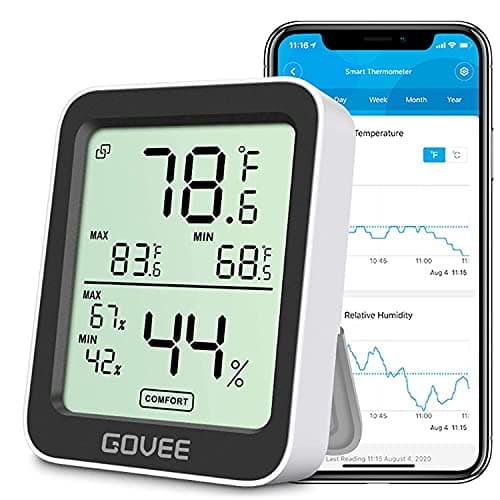
The one that logs. If your problem is that the house is dry at night but fine during the day, a hygrometer you have to walk over and read will never tell you that.
#ad Price as of October 18, 2026, from Amazon. Prices change. How we make money.
Published specifications
| Specification | Value | Source |
|---|---|---|
| Function | Bluetooth temperature and humidity sensor with app-based logging and data export | Govee published specification |
What is good about it
- Logging is the feature. Overnight humidity swings are invisible to a spot reading, and they explain most morning symptoms
- Data export means you can check whether the humidifier actually changed anything, rather than assuming
What is not
- Bluetooth range is room-scale; a basement sensor will not reach a phone upstairs
- Requires an app and an account, which is a genuine cost for some people
Who should skip this
Skip this if you just want a number on a wall. The logging is the whole premium, and it is wasted if you will not look at it.
How it scored
- Logging and history9.5
- Value for the decision it informs9.0
- Range and placement freedom6.0
Overall 8.6 / 10. This is our editorial score from published specifications and computed running cost. It is not a test result, and it is deliberately not marked up as a rating in this page’s structured data.
Midea Cube 35-Pint
Basements without a floor drain
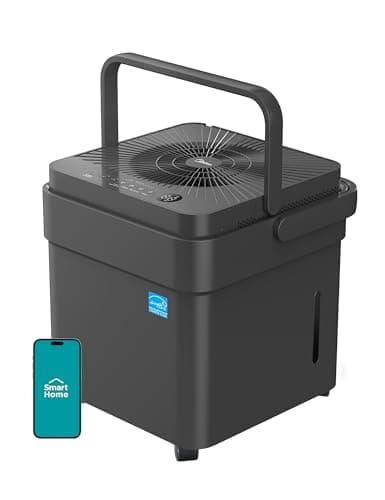
The adjustable 4.25-gallon bucket is the point. Most dehumidifiers get switched off because emptying a 2-gallon bucket twice a day is miserable; this one buys you a couple of days.
#ad Price as of October 18, 2026, from Amazon. Prices change. How we make money.
Published specifications
| Specification | Value | Source |
|---|---|---|
| Capacity | 35 pints per day | Midea published specification |
| Capacity (federal test) | 35.82 pints per day | ENERGY STAR certified products database |
| Coverage | Up to 3,500 sq ft | Midea published specification |
| Efficiency (IEF) | 2.01 L/kWh | ENERGY STAR certified products database |
| Annual energy use | 378 kWh/yr | ENERGY STAR certified products database |
| Bucket fill level | Adjustable, up to 4.25 gallons | Midea user manual |
| Fan speeds | 2 (High, Low) | Midea user manual |
| Dimensions | 14.76 x 14.57 x 14.45 in, 39.62 lb | Midea published specification |
| Certification | ENERGY STAR certified | ENERGY STAR certified products database |
What it costs to run
About $69 a year on ENERGY STAR's certified annual energy figure.
ENERGY STAR publishes 378 kWh a year for this model. At 18.34 cents/kWh that is $69.33 a year. That figure is calculated on the program's standardized test basis, not measured in your basement: a genuinely damp space where it cycles constantly will use more. Against the 50-pint Cube's 515 kWh ($94.45) it is the cheaper machine to own, which is the argument for sizing honestly rather than buying headroom.
What is good about it
- An adjustable bucket that holds up to 4.25 gallons - the difference between a unit you keep using and one you unplug in week three
- An IEF of 2.01 L/kWh removes about 18% more water per kWh than the 20-pint Cube's 1.70
- Nests down into a smaller shape for storage, which matters for an appliance you only use half the year
What is not
- The 3,500 sq ft coverage claim assumes conditions no real basement has; treat it as a ceiling, not a specification
- 35 pints is not enough for a genuinely wet basement with standing water
- Midea does not publish a rated wattage for this model, so we quote ENERGY STAR's certified annual energy figure instead
- No built-in pump on this model - without a floor drain you are either emptying the bucket or routing a gravity hose
Who should skip this
Skip this if your basement is wet rather than damp - visible water, white efflorescence on the walls, a musty smell that returns within a day of airing out. That is a drainage problem, and a 35-pint unit will run permanently and never win.
How it scored
- Tank interval10.0
- Capacity for the money8.5
- Efficiency per liter removed9.0
- Storage footprint9.0
Overall 8.7 / 10. This is our editorial score from published specifications and computed running cost. It is not a test result, and it is deliberately not marked up as a rating in this page’s structured data.
How we ranked these
We have not tested these units. Nobody here owns one. What we did was compile each manufacturer’s published specifications, check the coverage claims against AHAM’s room-sizing rule, and compute what each one costs to run for a year at the current US average electricity price. Every figure on this page is attributed to whoever published it, and the arithmetic is shown so you can redo it.
How we rank these sets out the full method, including what would change a ranking.
Questions people ask
+−What humidity kills dust mites?
Mites depend on absorbing moisture from the air, so drier conditions are hostile to them. We are not going to give you a precise lethal threshold because that is not a figure we can source cleanly. What we can point to is the EPA’s guidance for indoor air generally: below 60%, ideally 30-50%. Aiming under 50% in a bedroom is the practical target. If you are still deciding whether to buy at all, we price the whole three years in are air purifiers worth it.
+−What are the signs of dust mites in a bed?
Environmental signs are symptoms worse in the morning, worse right after disturbing the bedding, worse in humid weather, and better when sleeping elsewhere. Mites themselves are microscopic - you will not see them, and anything claiming to show you them in a photograph is not showing you your bed.
+−Do air purifiers help with dust mites?
Only marginally. The allergen settles quickly, so it is rarely airborne where a filter could catch it. Humidity control and bedding management are the effective measures, and a purifier is a reasonable addition once those are in place.
+−Does a dehumidifier help with dust mites?
If the bedroom is running above 50%, yes - it acts on the conditions the population depends on. If the room is already at 40%, a dehumidifier has nothing to contribute and you are looking at the wrong cause.
+−How often should I wash bedding?
Weekly, at the hottest temperature the fabric tolerates, is the commonly cited environmental measure. Pillows and duvets need attention on their own schedule too - covers are what make that manageable.
+−Are mattress covers worth it?
For this specific problem, they are the single highest-value purchase. They put a barrier between you and the largest reservoir in the room, and they work immediately rather than over weeks. Cat allergen is the opposite case, where filtration genuinely is the right lever - cat allergies.