Guide
Can You Put Vicks or Essential Oils in a Humidifier?
The company that sells the mentholated liquid prints the answer in its own use and care manual, and it is clearer than anything on the internet.
By Scooter M. · Published · Last updated
How this page is funded: the buy links below are affiliate links. If you buy through one, we earn a commission at no extra cost to you. It does not change the order of the picks or what we say about them. Full disclosure.
The short answer
No - nothing but water goes in the tank, and that is the manufacturer’s own instruction rather than ours. The Vicks V745 Series use and care manual states: “DO NOT add any essential oils, medication, or other additives to the water,” and separately “DO NOT add any essential oils or medications (Vicks VapoSteam) into Nozzle, Base, Reservoir or Water Tank.” The same manual says what you do instead: “Liquid Inhalants such as Vicks VapoSteam can be used in the medicine cup.” So if you want the menthol, buy a unit with that cup - the Vicks Warm Steam Vaporizer is the one we carry - or use a VapoPad, which is a dry pad in an external slot and never touches water. If you only want moisture, an evaporative unit and plain water is the whole answer.
The manufacturer settles this, which is unusual and useful
Most questions in this category come down to interpreting a specification. This one does not, because the brand whose name is on the mentholated product also makes the humidifiers, and its manual addresses the exact thing people are tempted to do. We read the current V745 Series use and care manual from Vicks’ own site rather than relying on a summary of it, and here is what it says, verbatim and in three separate places:
- In the safety instructions: “DO NOT add any essential oils or medications (Vicks VapoSteam) into Nozzle, Base, Reservoir or Water Tank.”
- In the filling instructions: “CAUTION: DO NOT add any essential oils, medication, or other additives to the water.”
- In the inhalant section, in capitals: “DO NOT ADD LIQUID INHALANTS OR ANY ADDITIVES OTHER THAN THOSE RECOMMENDED BY THE HUMIDIFIER MANUFACTURER TO THE WATER. DOING SO CAN HAVE ADVERSE EFFECTS ON THE HUMIDIFIER.”
Note what that third line does not say. It does not say the inhalant is unsafe - Vicks sells it. It says the water is the wrong place for it. The correct place is a dedicated cup, and the manual gives the dose: “Add 1 tbs (Table Spoon) of inhalant to the medicine cup.”
So what does go in the tank
Water, and the only live question is which water. That is a real decision with a real trade-off, and it has its own page: distilled vs tap water in a humidifier. The short version is that it depends on the mechanism - an ultrasonic unit aerosolizes dissolved minerals as white dust and genuinely benefits from distilled water, while an evaporative unit leaves the minerals in the wick and does not care.
Everything else people are told to add is either pointless or actively harmful:
| Added to the tank | What it does | Verdict |
|---|---|---|
| Vicks VapoRub | It is petrolatum-based and does not dissolve. It coats the inside of the tank and whatever mechanism is in contact with the water | No. There is no humidifier design this is correct for |
| Vicks VapoSteam liquid | Correct product, wrong place. The manual puts it in the medicine cup at 1 tablespoon, and says "DO NOT" put it in the water | Only in a medicine cup, on a unit that has one |
| Essential oils | Named explicitly in the prohibition. Clogs wicks, films transducers, and can degrade plastics | No - and see the pet warning below. A diffuser is the appliance for this |
| Bleach or vinegar as a routine additive | Both have a legitimate role in cleaning a unit you have emptied, and no role in water you intend to breathe | Cleaning only, per the cleaning routine |
| Tap water in an ultrasonic unit | Permitted, but the dissolved minerals leave the tank as white dust on every surface in the room | Allowed; distilled is better for this mechanism |
| Salt | Sometimes suggested for ultrasonic output. It is a corrosive electrolyte sitting against metal | No |
If you have pets, the essential-oil question is not just about the machine
This is the part most pages on this subject miss entirely, and it changes the answer for a lot of households. The ASPCA’s guidance on essential oil diffusers is specific about birds: “it is best to avoid using an essential oil diffuser in your house if you have birds,” because “Birds’ respiratory tracts are very sensitive, and they may develop more serious problems if you use a diffuser.” It adds that the same concerns “will apply to other pets such as rabbits, guinea pigs and hamsters.”
For dogs and cats the ASPCA is more measured - a short run in a secured area the animal cannot access is “not likely to be an issue” - but it warns about direct contact, noting that “Dogs and cats who have either walked through oils” can develop problems, and recommends keeping oils “up and out of paws’ reach.” Its general position is the one we would adopt: “The best way to avoid exposing your pets to dangerous substances is always to err on the side of caution.”
Put that next to the fact that a humidifier is a machine you run all night in a closed bedroom, which is the opposite of a short run in a secured area, and the case for keeping oils out of it gets stronger rather than weaker.
The two ways to get menthol without a problem
Neither of them involves the tank, and both are the manufacturer’s own designed route:
- A unit with a medicine cup. On the Vicks warm steam vaporizer the cup sits on top of the cooling chamber, outside the water path. You put a tablespoon of liquid inhalant in it and the rising steam carries the vapor. This is the design the instruction “can be used in the medicine cup” refers to.
- A VapoPad. A dry scent pad that slots into the outside of a compatible unit. It never contacts water at all, so there is nothing to clog or corrode, and a pad is a fixed dose rather than an improvised one. The catch is compatibility: it needs a model with the slot, and taping one to a humidifier that has no slot is not a workaround.
A third option is to separate the two jobs completely: run a plain evaporative humidifier for the humidity and a diffuser, if you want one, for the scent. That is genuinely the cleanest arrangement, and the reason it works is that these appliances do opposite things - one adds water to the air, one adds aerosolized oil, and combining them in a single tank is what the manual is trying to prevent.
What we are not telling you
Whether any of this helps a cold is a clinical question and we are not qualified to answer it. What we can report is the state of the published evidence on the broader idea, and it is thinner than the marketing implies: a Cochrane systematic review of heated, humidified air for the common cold pooled six trials with 387 participants and concluded that “The current evidence does not show any benefits or harms from the use of heated, humidified air,” rating the evidence low quality. That is a finding about humidified air generally, not about any inhalant, and we are presenting it as context rather than as advice.
So buy the menthol because you like it and it feels good, which is a perfectly honest reason. Do not buy a humidifier expecting it to be a medicine, and do not put the medicine in the humidifier.
This page is about the environment - humidity, particles, ventilation - and what changes it. It is not medical advice and we hold no medical qualification. If symptoms are persistent, severe or getting worse, that is a question for a clinician rather than a purchase.
If you already did it
Empty the tank completely, then clean the unit properly before the next use rather than just rinsing it - the cleaning routine is the same one you should be running anyway. On an ultrasonic unit, check the transducer disc specifically: if output has dropped, oil film on that disc is the first thing to suspect. On an evaporative unit, replace the wick, because you will not get oil out of it. And if the unit now smells when it runs, that is residue in a warm wet place, which is the start of the problem that page exists to prevent.
What we would buy for this
Chosen from the same registry as our roundups, on published specifications and computed running cost.
Vicks Warm Steam Vaporizer (1.5 gal)
Anyone who actually wants the menthol, done the way the manufacturer specifies
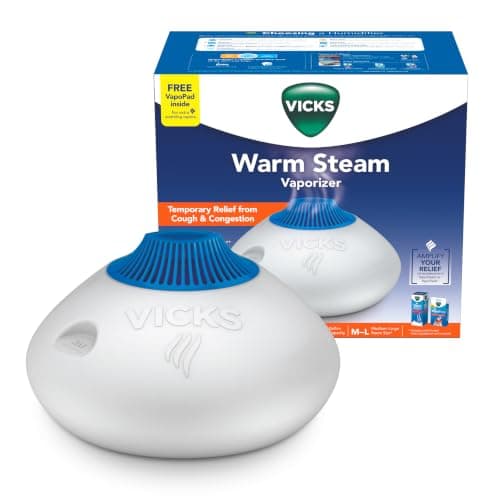
The only humidifier we carry with a separate medicine cup, which is the whole reason to pick it: it is the design that lets you use a mentholated inhalant without ever putting it in the water.
#ad Price as of October 18, 2026, from Amazon. Prices change. How we make money.
Published specifications
| Specification | Value | Source |
|---|---|---|
| Tank capacity | 1.5 gallon | Product listing published specification |
| Type | Warm steam vaporizer - the water is boiled, so the steam leaves the minerals behind | Vicks V745 Series use and care manual |
| Medicine cup | A dedicated cup on top of the cooling chamber. The manual states liquid inhalants "can be used in the medicine cup" at 1 tablespoon per use | Vicks V745 Series use and care manual |
| Additives in the tank | "DO NOT add any essential oils, medication, or other additives to the water" - the manufacturer's own instruction | Vicks V745 Series use and care manual |
| Filters | None required | Vicks V745 Series use and care manual |
| Controls | Two output settings, auto shut-off, night light | Vicks V745 Series use and care manual |
| Rated power | Not published by Vicks in the manual we could read - see cons | Vicks V745 Series use and care manual |
What is good about it
- It is the design that answers the question people actually ask: the inhalant goes in its own cup, never in the tank, so the unit is not damaged and the dose is the one the manufacturer specifies
- Boiling the water kills what is growing in the tank, which is the one genuine hygiene advantage warm-steam units have over cool mist
- No filters at all, so there is no consumable to forget and no wick to go moldy
- Auto shut-off when the reservoir empties, and a night light, both stated in the manual
- Among the cheapest humidifiers in the registry, and the cheapest route to the mentholated-vapor experience without buying a plug-in diffuser as well
What is not
- Warm steam means boiling water in a child's bedroom. The manual carries a hot-steam burn warning and a keep-out-of-reach-of-children instruction, and that is the deciding factor for a nursery
- Vicks does not publish a wattage in the manual, and the model is not covered by any efficiency certification program, so we cannot compute its running cost the way we do for every other unit here. Boiling water is not cheap - treat it as the most expensive-to-run humidifier on the site until a figure exists
- No humidistat. It runs at the setting you choose until the water is gone, which means it can push a small closed room past 50% RH with nothing to stop it
- Vicks does not publish an output figure, so it cannot be sized against our output-based method
- The inhalant and the VapoPads are both recurring purchases if you use them, and neither is required for the unit to humidify
Who should skip this
Skip this if there is a small child or a pet who could reach it, if you want a humidistat that holds a setpoint, or if you only want humidity - an evaporative unit does that job more cheaply, more safely and with a figure you can size on.
How it scored
- Does the job it is bought for9.0
- Published specification4.0
- Safety around children3.5
- Cannot over-humidify3.0
Overall 6.8 / 10. This is our editorial score from published specifications and computed running cost. It is not a test result, and it is deliberately not marked up as a rating in this page’s structured data.
Vicks VapoPads Original Menthol, 20-pack
Getting the menthol without putting anything in the tank
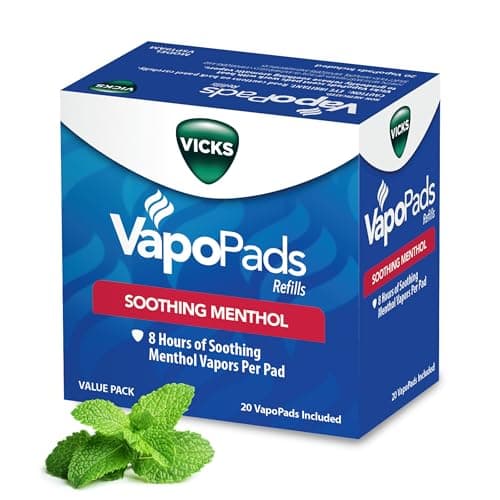
The scent pad that drops into a slot on the outside of a compatible unit. It is the one mentholated product that never touches the water, which is exactly why it is the safe answer to this question.
#ad Price as of October 18, 2026, from Amazon. Prices change. How we make money.
Published specifications
| Specification | Value | Source |
|---|---|---|
| Format | Dry scent pad, loaded into a dedicated external slot - not added to water | Product listing published specification |
| Pack size | 20 pads | Product listing published specification |
| Compatibility | Vicks humidifiers and steam inhalers with a VapoPad slot. It is not a universal accessory - check your model has the slot before buying | Product listing published specification |
What is good about it
- It is the only mentholated option in this category that is used dry, outside the water path, so it cannot damage a tank, a transducer or a heating element
- A pad is a fixed dose, which removes the guesswork that putting drops in a tank creates
- Cheap per use, and it works in the steam inhalers as well as the humidifiers
What is not
- It only works if your unit has the slot. On a humidifier without one there is no correct way to use this product, and taping it to the housing is not a plan
- It is a scent, not a treatment. Nothing here should be read as a medical claim, and we make none
- Recurring cost for as long as you keep using it, where the humidity itself is free once the machine is bought
Who should skip this
Skip this if your humidifier has no VapoPad slot, or if what you actually need is simply more moisture in the air - in which case the pads add cost and change nothing about the humidity.
How it scored
- Safe for the machine10.0
- Dose control9.0
- Universality3.0
Overall 7.5 / 10. This is our editorial score from published specifications and computed running cost. It is not a test result, and it is deliberately not marked up as a rating in this page’s structured data.
Honeywell HCM350 Germ Free Cool Mist
Bedrooms, and anyone who has had white dust from an ultrasonic
An evaporative wick humidifier, which is the type that physically cannot over-humidify a room or spray minerals onto your furniture. That is the whole argument for it, and it is a good one.
#ad We do not hold a current price for this product, so we do not show one. How we make money.
Published specifications
| Specification | Value | Source |
|---|---|---|
| Tank capacity | 1.1 gallon | Honeywell published specification |
| Rated power | 50 W | Honeywell published specification |
| Run time | Up to 24 hours per fill | Honeywell published specification |
| Output | Up to 2 gallons of moisture per 24 hours | Honeywell published specification |
| Filter | Protec HAC-504AW antimicrobial wick filter | Honeywell published specification |
What it costs to run
About $20-22 a year in electricity across a heating season at 12 hours a day, plus wicks.
50 W / 1000 x 12 hours x 365 days = 219 kWh = $40.16 a year if run year-round. Most people run a humidifier for roughly half the year, so call it $20-22, plus replacement wicks at the manufacturer's stated interval.
What is good about it
- Evaporative design self-limits: as a room approaches saturation it simply evaporates less, so it will not push you past 50% RH the way an ultrasonic will
- No white mineral dust, because the minerals stay in the wick instead of being aerosolized into the room
- The tank is designed to come apart and be cleaned, which is the maintenance that actually matters
What is not
- There is a fan, so it is not silent the way an ultrasonic is
- The wick is a consumable - budget for it, and replace it on schedule or it becomes the thing growing mold
Who should skip this
Skip this if you want silence above all else, or if you will not buy replacement wicks. A neglected wick is worse than no humidifier at all.
How it scored
- Cannot over-humidify10.0
- No mineral dust10.0
- Quiet operation6.5
- Cleaning burden7.5
Overall 8.5 / 10. This is our editorial score from published specifications and computed running cost. It is not a test result, and it is deliberately not marked up as a rating in this page’s structured data.
How we ranked these
We have not tested these units. Nobody here owns one. What we did was compile each manufacturer’s published specifications, check the coverage claims against AHAM’s room-sizing rule, and compute what each one costs to run for a year at the current US average electricity price. Every figure on this page is attributed to whoever published it, and the arithmetic is shown so you can redo it.
How we rank these sets out the full method, including what would change a ranking.
Questions people ask
+−Can you put Vicks VapoRub in a humidifier?
+−Where does Vicks VapoSteam actually go?
+−Can you put essential oils in a humidifier?
+−Are essential oils in the air safe for pets?
+−What is the best thing to put in a humidifier?
+−Will a humidifier with menthol help a cold?
+−I already put oil in my humidifier. What now?
Sources
- Vicks - V745 Series humidifier use and care manual (Kaz/Helen of Troy)
- ASPCA - Is the Latest Home Trend Harmful to Your Pets? What You Need to Know! (essential oil diffusers, 17 January 2018)
- EPA - Indoor Air Facts No. 8: Use and Care of Home Humidifiers
- Singh M, Singh M, Jaiswal N, Chauhan A - Heated, humidified air for the common cold. Cochrane Database of Systematic Reviews, 2017. DOI 10.1002/14651858.CD001728.pub6
- U.S. Energy Information Administration - Electric Power Monthly, Table 5.6.A