Review
Aranet4 Home Review
We have not tested this unit and we will not pretend otherwise. What we have done is read what Aranet publishes, work out what the accuracy figure actually commits to, and find the one place its own numbers disagree with each other.
By Scooter M. · Published · Last updated
How this page is funded: the buy links below are affiliate links. If you buy through one, we earn a commission at no extra cost to you. It does not change the order of the picks or what we say about them. Full disclosure.
The short answer
Buy it if you want a carbon dioxide number you can defend, and understand that you are buying a ventilation gauge rather than an air quality monitor. The Aranet4 Home is the only unit in our CO2 monitor roundup that publishes an accuracy figure together with the range and conditions that figure is specified over, which is the difference between an instrument and a gadget. It measures no particles at all, it needs a calibration routine most buyers do not know about, and Aranet itself publishes two different battery lives in two different places. All three of those are below.
What you are actually buying
Indoor carbon dioxide is useful because it tracks how much of the air in a room has already been breathed. It is a proxy for ventilation rate, not a pollutant reading in the way PM2.5 is - ASHRAE’s position document on indoor carbon dioxide is explicit that CO2 concentration should not be treated as a general surrogate for indoor air quality. So the honest description of this device is: it tells you whether a room is being ventilated, and it tells you that very well.
That matters because of what it does not do. There is no particle sensor in this unit. It will read 500 ppm and look reassuring while someone sears a steak two rooms away and the PM2.5 climbs. If what you want is a reading that responds to cooking, smoke or dust, you want a particle monitor instead - our air quality monitors page covers those, and what PM2.5 actually is explains why the two instruments answer different questions. Buying this one expecting a general air-quality score is the single most common way to be disappointed by it.
What Aranet publishes
| Specification | Aranet's figure |
|---|---|
| Sensor type | True NDIR (non-dispersive infrared) |
| CO2 range | 0 to 9,999 ppm |
| CO2 accuracy | ±(30 ppm + 3% of reading) |
| Accuracy specified over | 0 to 5,000 ppm, 59-95°F, 0-80% RH |
| Temperature | 32 to 122°F, ±0.54°F |
| Also measures | Relative humidity, atmospheric pressure |
| Display | E-Ink |
| Connectivity | Bluetooth to the phone app; no Wi-Fi |
| Measurement interval | Selectable, default every 10 minutes |
| Battery life | see below - Aranet publishes two figures |
| Warranty | 2 years, extendable to 3 |
The accuracy figure is the reason to buy this and not something cheaper
Almost every cheap CO2 display quotes a bare tolerance, or none at all. A bare “±50 ppm” is close to meaningless, because the two things that decide whether a sensor holds its tolerance are the range you are reading over and the conditions you are reading in. Aranet states both: the ±(30 ppm + 3% of reading) figure is specified from 0 to 5,000 ppm, between 59 and 95°F, and from 0 to 80% relative humidity.
Work that through and it tells you something useful. At a well-ventilated 500 ppm the promise is roughly ±45 ppm. At a stuffy 2,000 ppm it is roughly ±90 ppm - the percentage term grows with the reading, which is normal for NDIR and is exactly the kind of thing a single-number tolerance hides. Above 5,000 ppm the device still displays a figure, but it is outside the specified band and should be read as “very high” rather than as a measurement.
It is also a true NDIR sensor, meaning it measures carbon dioxide by infrared absorption rather than inferring it. Several cheaper “CO2” displays report an eCO2 value estimated from a volatile-organic-compound sensor, which is a different measurement wearing the same label. Our CO2 roundup is built around that distinction and is titled accordingly.
The calibration routine nobody mentions in a product listing
This is the most practically useful thing on the page and it is absent from almost every review of this device. An NDIR sensor drifts, and the Aranet4 corrects for it by automatic background calibration - it assumes that the lowest reading it sees over a period is fresh outdoor air and anchors itself to that. Aranet states the condition plainly: the routine needs roughly 8 hours of exposure to about 420 ppm CO2 within each 30-day period.
Read that again as a requirement rather than a feature, because it has a failure mode. If the unit lives somewhere that never actually reaches outdoor concentration - a bedroom in a tightly sealed house in winter, an interior office, a basement - then the background calibration never gets the reference it needs, and the reading can drift without anything on the display telling you so. Aranet provides a manual calibration, either with a switch on the back of the unit or through the app, and recommends calibrating once a year.
In practice: put it near a window you open, or carry it outside for a few hours occasionally, or do the manual calibration annually. None of that is onerous. All of it is invisible if nobody tells you, which is why a unit that drifts quietly is worse than one that is obviously wrong.
What it costs to own
There are no filters and no consumables beyond the two AA cells, which makes the ownership cost unusually simple for anything on this site - compare that with a purifier, where the filter schedule often outweighs the purchase. The warranty is two years, extendable to three through a paid extension, with a further year available for registering the product.
The purchase itself sits at roughly three times the cheaper NDIR units in our roundup, and that is the real question with this device. The Inkbird IAM-O2 is also a true NDIR unit at a fraction of the price, and for someone who glances at a number occasionally rather than watching a trend, it is the more sensible buy. What the Aranet adds is a specification stated with its conditions, an e-ink display readable across a room, and a battery life measured in years rather than months. Whether that is worth the difference depends entirely on whether you are going to act on the readings.
Honest cons
- No particle sensor. It is not an air quality monitor and does not replace one.
- Bluetooth only. No Wi-Fi, so pulling the logged data means being in the room with it. There is no remote monitoring from another building.
- Ten-minute default sampling. Fine for tracking ventilation over a day, too coarse to show the effect of opening a window in real time unless you shorten it - which costs battery.
- The automatic calibration has a precondition that a sealed room may never meet, and nothing on the display warns you when it has not been met.
- Roughly three times the price of a cheaper true-NDIR unit for a sensor whose published accuracy is better by tens of ppm rather than by an order of magnitude.
- Aranet publishes two different battery lives in two different places, as above.
Who should not buy it
Anyone who wants one device for everything. CO2 and particles are separate sensors answering separate questions; this unit does one of them. Start from which instrument answers which question before spending anything.
Anyone who only wants an occasional sanity check. If you are not going to watch a trend or change anything because of it, the cheaper NDIR unit gives you the same answer to the same question for much less.
Anyone needing remote alerts. Bluetooth-only means the data lives where the device is. That is a deliberate trade for battery life, and it is the wrong trade for a rental you are monitoring from elsewhere.
What we would buy for this
Chosen from the same registry as our roundups, on published specifications and computed running cost.
Aranet4 Home
Anyone who wants a CO2 reading they can trust without a second opinion
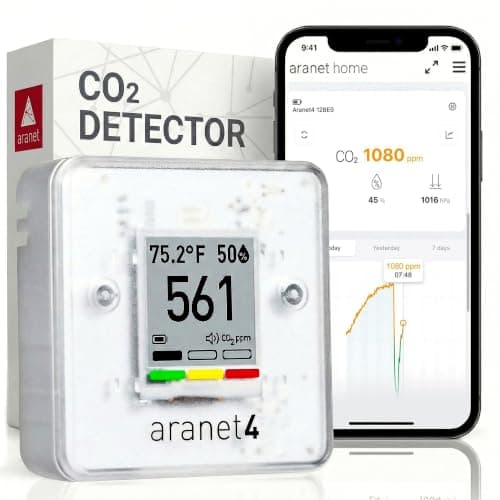
The reference instrument in this category, and the only one of the three that publishes a calibrated accuracy figure alongside the range it applies to. You are paying for a specification you can actually hold it to.
#ad Price as of October 18, 2026, from Amazon. Prices change. How we make money.
Published specifications
| Specification | Value | Source |
|---|---|---|
| Sensor | NDIR (true infrared) | Aranet published specification |
| CO2 range | 0-9,999 ppm | Aranet published specification |
| CO2 accuracy | +/-30 ppm +/-3% of reading, specified 0-5,000 ppm | Aranet published specification |
| Also measures | Temperature, relative humidity, atmospheric pressure | Aranet published specification |
| Battery | Up to 7 years on 2 lithium AA | Aranet published specification |
| Measurement interval | Selectable, default every 10 minutes | Aranet published specification |
| Accuracy conditions | Specified 59-95F and 0-80% RH | Aranet published specification |
What is good about it
- Publishes accuracy AND the range and conditions it is specified over - the single thing that separates an instrument from a gadget
- A true NDIR sensor, so it measures carbon dioxide rather than inferring it from something else
- Up to seven years on two lithium AA cells; there is no charging routine to forget
- E-ink display is readable across a room in daylight and costs almost nothing to keep lit
What is not
- Roughly three times the price of either cheaper unit here, for a sensor whose published accuracy is 10 ppm and 2 percentage points better
- Default ten-minute sampling means it will not show you the effect of opening a window in real time unless you shorten the interval, which costs battery
- Bluetooth only - no Wi-Fi, so logging to a phone means being in the room
- No PM2.5, so it does not replace the particle monitors on our monitors page
Who should skip this
Skip this if what you actually want is a general air quality monitor. It measures CO2 superbly and does not measure particles at all. If you only ever check the number occasionally, the cheaper NDIR units publish specifications close enough to matter little.
How it scored
- Published accuracy10.0
- Battery and upkeep9.5
- Price6.0
Overall 9.1 / 10. This is our editorial score from published specifications and computed running cost. It is not a test result, and it is deliberately not marked up as a rating in this page’s structured data.
INKBIRD IAM-O2
Anyone who wants a real CO2 number without paying instrument prices
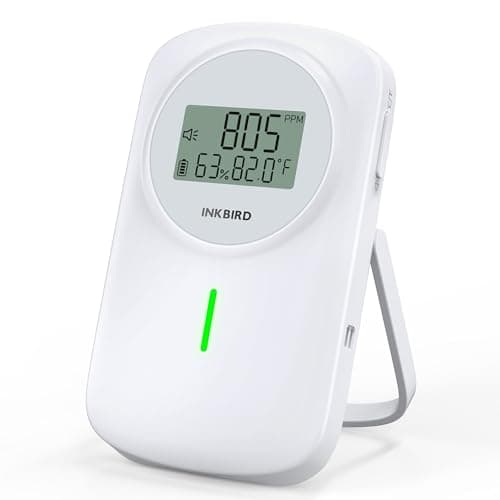
A true NDIR sensor with a published accuracy figure, at under a third of the reference price. The gap to the Aranet4 on paper is 10 ppm and two percentage points, which for deciding whether to open a window is no gap at all.
#ad Price as of October 18, 2026, from Amazon. Prices change. How we make money.
Published specifications
| Specification | Value | Source |
|---|---|---|
| Sensor | NDIR (true infrared) | INKBIRD published specification |
| CO2 range | 0-9,999 ppm | INKBIRD published specification |
| CO2 accuracy | +/-40 ppm +/-5% of reading | INKBIRD published specification |
| Temperature accuracy | +/-0.2C (+/-0.36F) | INKBIRD published specification |
| Humidity accuracy | +/-1.8% RH | INKBIRD published specification |
| Also measures | Temperature and relative humidity | INKBIRD published specification |
What is good about it
- A genuine NDIR sensor at a price where estimated-CO2 sensors are the norm, and INKBIRD prints NDIR in the listing title so you can check before buying
- Publishes a CO2 accuracy figure, which the similarly-priced competition mostly does not
- Also publishes temperature and humidity accuracy, so it doubles as a credible hygrometer
- Reads CO2, temperature and humidity on one screen - the three numbers that decide whether to ventilate
What is not
- +/-40 ppm +/-5% is looser than the Aranet4, and at 1,500 ppm that 5% is 75 ppm of slack before the fixed term is added
- Manufacturer and retailer listings disagree on the battery arrangement - some describe AA cells, others a built-in rechargeable pack - so we do not quote a battery life for it
- No pressure sensor and no PM2.5
- INKBIRD sells several similar-looking CO2 monitors; check the IAM-O2 model code and not just the photograph
Who should skip this
Skip this if you need a documented, conditions-qualified accuracy specification for work purposes - Aranet publishes one and INKBIRD publishes a bare figure. For a home ventilation decision, that distinction does not change what you would do.
How it scored
- Published accuracy for the price9.5
- Sensor type you can verify9.0
- Documentation quality6.5
Overall 8.5 / 10. This is our editorial score from published specifications and computed running cost. It is not a test result, and it is deliberately not marked up as a rating in this page’s structured data.
How we ranked these
We have not tested these units. Nobody here owns one. What we did was compile each manufacturer’s published specifications, check the coverage claims against AHAM’s room-sizing rule, and compute what each one costs to run for a year at the current US average electricity price. Every figure on this page is attributed to whoever published it, and the arithmetic is shown so you can redo it.
How we rank these sets out the full method, including what would change a ranking.