Roundup
Gun Safe Dehumidifiers
Two completely different devices are sold under one name here. One removes water from the air. The other removes none and is still, for a lot of safes, the better buy.
By Scooter M. · Published · Last updated
How this page is funded: the buy links below are affiliate links. If you buy through one, we earn a commission at no extra cost to you. It does not change the order of the picks or what we say about them. Full disclosure.
The short answer
The best-selling “gun safe dehumidifier” is a heating rod, and it removes no water at all. A GoldenRod-type rod is a sealed heating element that warms the air inside the safe a few degrees. Warmer air holds more moisture before it condenses, so the relative humidity falls and the steel stays above the dew point - but every gram of water is still in the box. A renewable desiccant does the opposite: it actually absorbs the moisture, and it needs no power. Which one you want depends almost entirely on whether you can get a cord into the safe.
The two devices, and what each physically does
This is the only product category on this site where the top two sellers work by opposite mechanisms while sharing a product name. It is worth being precise about it, because the choice follows directly from the physics.
| Heated rod | Renewable desiccant | |
|---|---|---|
| Mechanism | Warms the air so relative humidity falls | Absorbs water into silica gel |
| Water removed | None | Up to 6 oz per cylinder |
| Needs power inside the safe | Yes, permanently | No |
| Maintenance | None | Recharge when the beads change color |
| Running cost | About $19-61 a year | Effectively zero |
| Tells you it is saturated | Not applicable | Yes, by color |
| Works in an unpowered safe | No | Yes |
Neither column is wrong. A rod keeps metal above the dew point, which is the actual mechanism of rust prevention, and it never needs attention. A desiccant removes the water but stops working silently the moment it is full. The failure modes are different and so are the people they suit.
How we judged these
We have not tested these products. Everything below is published by the manufacturer, and every unit was checked for live availability before it was featured. Criteria, in order:
- Does it suit a powered or unpowered safe? This decides the category before anything else. A rod in a safe with no cord route is not a cheaper option, it is a non-option.
- Is the published figure an extraction rate or a coverage estimate? Almost everything here publishes volume coverage. Only the desiccants publish how much water they actually hold.
- What does it cost over three years? A rod is a permanent electrical load; a desiccant is a one-off purchase. Over three years that gap is larger than the price difference.
- Will it still be working in a year? The commonest failure in this category is a saturated desiccant nobody noticed, which is why a saturation indicator counts for more than capacity.
Sizing by volume, not floor area
A safe is a volume problem, not an area problem, and the published figures reflect that. Measure internal height, width and depth in feet and multiply.
| Internal volume | Heated rod size | Rod power draw | Desiccant option |
|---|---|---|---|
| Up to ~100 cu ft | 12 in | 12 W | One E-333 |
| Up to ~200 cu ft | 18 in | 18 W | One E-333, checked often |
| Up to ~300 cu ft | 24 in | 25 W | EDV-365 cylinder |
| Up to ~500 cu ft | 36 in | 38 W | EDV-365, or two cylinders |
For scale, a tall 60-gun safe is commonly around 25 to 40 cu ft internally, so most domestic safes sit comfortably inside the smallest rod and a single desiccant. The 300 and 500 cu ft rows are vault rooms and large cabinets rather than freestanding safes. If you are buying for a pistol box, every option here is oversized and the cheapest one wins.
The rod question nobody addresses
A heated rod works by raising the temperature inside a sealed steel container that also holds ammunition. Manufacturers specify a surface temperature below 150F and the air inside only ends up a few degrees above ambient, which is why these have been sold for decades without issue.
We are not going to tell you that is risk-free, because we are not the right people to make that call and it is not an air quality question. What we will say is that it is a real consideration some owners weigh, the alternative requires no heat at all, and if the heat is what bothers you then the desiccant route exists and works. That is the honest shape of it.
Where this sits next to a real dehumidifier
Nothing on this page is a dehumidifier in the sense the rest of this hub uses the word. A compressor unit pulls litres a day out of a room; the largest device here holds six ounces. They are not competing products.
That matters if the safe is in a damp basement. In that case the safe is not the problem - the room is - and treating the enclosure while the surrounding air sits at 70% is managing a symptom. Fix the room first with the guidance in best dehumidifiers for basements, and the safe will largely look after itself. The same logic, at a different scale, applies to closets and wardrobes in best small dehumidifiers.
What about disposable moisture absorbers?
Tubs of calcium chloride work, and in a safe they work rather well - it is the same idea as a renewable desiccant without the reusable part. The trade is an ongoing cost and a container of corrosive brine sitting beside metal you are trying to protect, which in a gun safe specifically is the wrong place for it. We compared the two approaches properly in dehumidifier vs DampRid, and for a safe the rechargeable unit is the better long-term buy mainly because nobody has to remember to restock it.
What we would actually do
Put a hygrometer in the safe for two weeks. If it reads inside 30-50%, stop - you are done, and you have spent almost nothing.
If it reads high and there is no power to the safe, buy a single E-333 for a normal domestic safe, or the EDV-365 if the safe is large or you want the one-works-while-one-dries arrangement. Put a reminder in your phone to check the color monthly, because a saturated desiccant looks exactly like a working one from the outside.
If there is power and you would rather never think about it again, fit the rod sized to the internal volume, mount it horizontally at the bottom as the instructions require, and accept that you are paying $19 to $61 a year for the privilege and that the water is still in there. For most powered safes in a normally dry house, that is a perfectly good answer - just not the one the product name implies.
Quick picks
Ranked on published specifications and computed running cost. Tap any row for the full write-up, including who should skip it.
| # | Product | Best for | Score | Price |
|---|---|---|---|---|
| 1 | 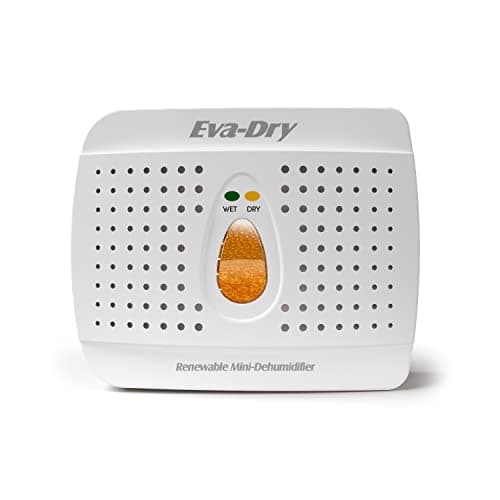 Eva-Dry E-333 RenewableSafes, sealed closets, boats | Best for most safes | 7.2 | $14.97 - View on Amazon |
| 2 | 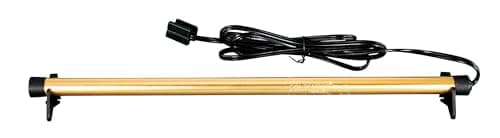 Lockdown GoldenRod Dehumidifier RodA powered safe or cabinet where you can run a cord and leave it on permanently | Best if you have power | 7.8 | $44.99 - View on Amazon |
| 3 | 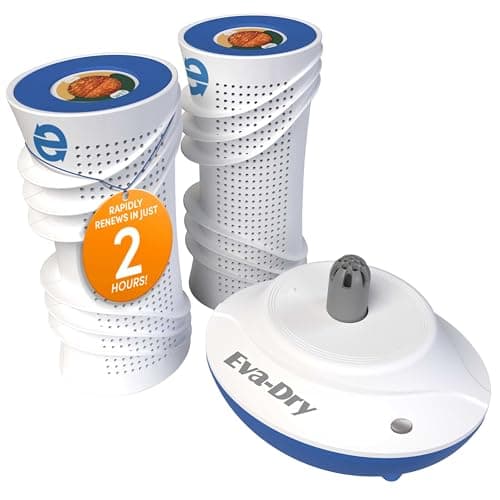 Eva-Dry EDV-365 Air Dry SystemA larger safe or an unpowered cabinet you can visit every few weeks | Best for a large safe | 8.6 | $69.95 - View on Amazon |
#1 - Best for most safes
Eva-Dry E-333 Renewable
Safes, sealed closets, boats
No power, no tank, no fan - a silica desiccant you plug in for a few hours to dry out and then put back. For a gun safe or a sealed closet this is often the honest answer.
#ad Price as of October 18, 2026, from Amazon. Prices change. How we make money.
Published specifications
| Specification | Value | Source |
|---|---|---|
| Type | Renewable silica gel desiccant, recharged by plugging in | Eva-Dry published specification |
What is good about it
- Zero running cost while it is working - it draws power only during the recharge cycle
- Nothing to empty, nothing to break, and no standing water to grow anything in
What is not
- Capacity is tiny; this handles a sealed cubic foot or two, not a room
- You have to remember to recharge it, and nothing reminds you
Who should skip this
Skip this for anything with a door that opens regularly. Desiccant works in sealed spaces; in a closet you open daily it never gets ahead of the moisture coming in.
How it scored
- Running cost10.0
- Fit for sealed spaces9.0
- Capacity2.0
- Maintenance burden6.0
Overall 7.2 / 10. This is our editorial score from published specifications and computed running cost. It is not a test result, and it is deliberately not marked up as a rating in this page’s structured data.
#2 - Best if you have power
Lockdown GoldenRod Dehumidifier Rod
A powered safe or cabinet where you can run a cord and leave it on permanently
The best-selling product in this category and it is not a dehumidifier. It is a sealed heating element that removes no water at all - it warms the air so the relative humidity falls. For a sealed steel box that is often the right answer anyway.
#ad Price as of October 18, 2026, from Amazon. Prices change. How we make money.
Published specifications
| Specification | Value | Source |
|---|---|---|
| How it works | Sealed electric heating element; warms air so relative humidity falls | Lockdown published description |
| Surface temperature | Under 150F | Lockdown published specification |
| Sizes and coverage | 12 in / ~100 cu ft; 18 in / ~200 cu ft; 24 in / ~300 cu ft; 36 in / ~500 cu ft | Lockdown published specification |
| Power draw by size | 12 W / 18 W / 25 W / 38 W respectively | Lockdown published specification |
| Water removed | None - see cons | Lockdown published description |
| Installation | Mounts horizontally at the bottom of the enclosure; brackets and screws included | Lockdown published specification |
| Cord | 6 ft with a removable plug for routing through a wall or partition | Lockdown published specification |
What it costs to run
About $19 a year for the 12 in model, rising to about $61 for the 36 in.
12 W / 1000 x 24 hours x 365 days = 105 kWh = $19.28 a year at 18.34 cents/kWh. The 36 in model at 38 W is 333 kWh = $61.05. Unlike a desiccant, this is a permanent load: the rod only works while it is powered, so there is no duty cycle to average down.
What is good about it
- No desiccant to recharge, no beads to watch and nothing to empty - it is fit-and-forget in a way nothing else here is
- Publishes a size-to-volume chart and a wattage for every length, which is more specification than most of this category offers
- Raising the internal temperature a few degrees also keeps the steel above the dew point, which is what actually prevents condensation on guns
- A removable plug means the cord can be routed through an existing hole without enlarging it
- Made in USA, and the heating element is sealed rather than exposed
What is not
- It removes no moisture whatsoever. It lowers relative humidity by warming the air, so the water is still in the safe - it is simply further from condensing
- It needs mains power permanently. In a safe with no cord route, it is not an option at all
- Running cost is continuous by design: the 12 in model is about $19 a year and the 36 in about $61 a year, every year
- If the safe is in an unheated garage that swings below freezing, a few degrees of warming may not be enough margin
- Heating a sealed box containing ammunition is a trade some owners will not want to make, and we would not argue them out of it
- The published coverage figures are volume-based estimates, not tested extraction rates - there is no extraction rate to test
Who should skip this
Skip this if you cannot get a cord into the safe, or if you want the water actually removed rather than relocated. A renewable desiccant does the latter with no power at all.
How it scored
- Fit-and-forget9.5
- Published specifications8.0
- Actually removes water1.0
- Works without power1.0
Overall 7.8 / 10. This is our editorial score from published specifications and computed running cost. It is not a test result, and it is deliberately not marked up as a rating in this page’s structured data.
#3 - Best for a large safe
Eva-Dry EDV-365 Air Dry System
A larger safe or an unpowered cabinet you can visit every few weeks
Two silica cylinders and a blower base, so one works while the other dries out. It is the only product here that both removes real water and needs no power inside the enclosure.
#ad Price as of October 18, 2026, from Amazon. Prices change. How we make money.
Published specifications
| Specification | Value | Source |
|---|---|---|
| Coverage | Up to 400 cu ft per cylinder; 800 cu ft total if used in two separate spaces | Eva-Dry published specification |
| Moisture capacity | Up to 6 oz per cylinder | Eva-Dry published specification |
| Medium | Crystallized silica gel beads, non-toxic | Eva-Dry published specification |
| Saturation indicator | Beads change from orange to green when full | Eva-Dry published specification |
| Recharge | About 2 hours on the blower base | Eva-Dry published specification |
| Power needed inside the enclosure | None - the base is used outside it | Eva-Dry published specification |
| Warranty | 1 year on the blower base, 5 years on the cylinders | Eva-Dry published specification |
What it costs to run
Effectively nothing - the blower base only draws power during a recharge.
There is no continuous load. The cylinders work unpowered inside the enclosure and the base runs for about 2 hours per recharge cycle. Against the GoldenRod's permanent $19 to $61 a year, this is the cheaper option to run by a wide margin - the cost is your attention instead.
What is good about it
- Removes actual water rather than relocating it, and needs no power inside the safe
- Two cylinders plus a base means continuous protection - one is working while the other dries
- Two hours to recharge against the overnight-or-longer wait on single-unit renewable dehumidifiers
- The orange-to-green indicator tells you when it is saturated, which is the one thing most desiccants get wrong
- Five-year cylinder warranty, and silica gel does not degrade with cycling the way some media does
- Covers up to 400 cu ft per cylinder, which is a large gun safe rather than a pistol box
What is not
- 6 oz per cylinder is about 177 ml. That is the right order of magnitude for a sealed safe and nowhere near a room
- It needs you to remember. A saturated cylinder is doing nothing, and nothing warns you except the color
- Roughly four times the price of the single E-333 unit, and for a small safe the E-333 does the same job
- The blower base needs a socket and bench space somewhere outside the enclosure
- The 400 cu ft figure is a manufacturer coverage estimate, not a tested extraction rate at stated conditions
Who should skip this
Skip this if the safe is small - a single E-333 is a quarter of the price and adequate. Skip it too if you will not reliably check the color indicator; a powered rod is the honest choice for someone who wants to forget about it.
How it scored
- Actually removes water9.0
- Works without power9.5
- Running cost10.0
- Fit-and-forget5.0
Overall 8.6 / 10. This is our editorial score from published specifications and computed running cost. It is not a test result, and it is deliberately not marked up as a rating in this page’s structured data.
How we ranked these
We have not tested these units. Nobody here owns one. What we did was compile each manufacturer’s published specifications, check the coverage claims against AHAM’s room-sizing rule, and compute what each one costs to run for a year at the current US average electricity price. Every figure on this page is attributed to whoever published it, and the arithmetic is shown so you can redo it.
How we rank these sets out the full method, including what would change a ranking.
Questions people ask
+−Do gun safe dehumidifier rods actually work?
They work at preventing rust, but not by dehumidifying. A rod is a sealed heating element that warms the air a few degrees; warmer air holds more moisture before condensing, so relative humidity falls and the steel stays above the dew point. No water is removed. If your goal is specifically to take moisture out of the safe, a renewable desiccant is the device that does that.
+−What size dehumidifier rod do I need for my gun safe?
Measure the internal volume in cubic feet. Published guidance is a 12 in rod for about 100 cu ft, 18 in for 200, 24 in for 300 and 36 in for 500. Most freestanding domestic safes are well under 100 cu ft internally, so the smallest rod is usually right - these are volume estimates rather than tested rates.
+−Is a rechargeable dehumidifier better than a rod for a gun safe?
It depends on power. With no socket available the desiccant is the only thing that works. With power, the rod never needs attention while the desiccant stops silently when saturated - so the rod suits someone who wants to forget about it and the desiccant suits someone who will check the color indicator.
+−What humidity should a gun safe be kept at?
The EPA’s general indoor guidance - below 60% relative humidity, ideally 30-50% - is the sensible target, and it is what we would aim for inside a safe. Verify it with a small hygrometer rather than assuming; safes are often drier than their owners expect and occasionally far wetter.
+−Can I use DampRid in a gun safe?
It will absorb moisture, but it leaves a container of corrosive calcium chloride brine inside a sealed box of metal you are trying to protect from corrosion. For that reason specifically we would use a rechargeable silica gel unit instead, even though the underlying chemistry is doing a similar job.
+−Will a dehumidifier rod make my safe hot?
Manufacturers specify a surface temperature under 150F, and the air inside ends up only a few degrees above the surrounding room. That is the design intent - a few degrees is all that is needed to drop relative humidity. If heating a sealed container holding ammunition is something you would rather avoid, the desiccant route achieves the moisture goal with no heat at all.