Roundup
Best Air Purifiers for Offices and Dorm Rooms
Both are small rooms full of other people's air, in buildings where you are not allowed to change anything. That constraint, not the square footage, is what should pick the machine.
By Scooter M. · Published · Last updated
How this page is funded: the buy links below are affiliate links. If you buy through one, we earn a commission at no extra cost to you. It does not change the order of the picks or what we say about them. Full disclosure.
The short answer
Size it by smoke CADR against the room you are actually in, and avoid anything that produces ozone. A dorm room is typically 100 to 200 sq ft, a private office about the same, and AHAM’s rule puts that at a smoke CADR of roughly 70 to 130 CFM. That is a modest, inexpensive machine. The genuine constraints in both spaces are not size - they are noise you cannot escape, air you share with other rooms, and institutional rules that frequently ban ozone-generating devices outright.
Why these two rooms belong on one page
A dorm room and a small office look like different problems and behave like the same one. In both, you occupy a small volume for many hours a day, you cannot modify the building, the ventilation is somebody else’s decision, and the air arriving has usually been somewhere else first - a corridor, a shared duct, the room next door.
That shapes the purchase in ways a bedroom guide does not. The unit has to be quiet enough to think or sleep beside, small enough to sit on a desk or under one, portable enough to leave with you at the end of term or the end of a job, and compliant with rules you did not write.
How we judged these
- Published smoke CADR against a stated model. Without it there is no way to size a unit to a room. This eliminated most of the cheap desk purifiers - several in-stock candidates were correctly priced and simply published no CADR against a model number we could verify.
- Noise at the speed you would actually run it. In a room you sit in for eight hours, the top speed is theoretical.
- Filter-only. No ozone generators and no units whose main claim is ionization.
- Cost to keep running, not just to buy. Filters for a year, plus electricity, on a machine that runs most of the day.
Sizing a small room honestly
AHAM’s guidance is that a purifier’s smoke CADR should be about two-thirds of the room’s floor area in square feet. Their published example is 132 CFM for a 200 sq ft room. Applied to the rooms on this page:
| Space | Typical size | Smoke CADR you need |
|---|---|---|
| Single dorm room | 100-150 sq ft | About 67-100 CFM |
| Shared dorm room | 150-220 sq ft | About 100-147 CFM |
| Private office | 100-200 sq ft | About 67-133 CFM |
| Small shared office | 250-350 sq ft | About 167-233 CFM |
Two things follow. A great many desk-sized purifiers are well under 67 CFM and are therefore too small for even a single dorm room, whatever the box says. And the numbers on packaging - “cleans 743 sq ft per hour” and similar - are one-air-change figures, typically about five times the honest coverage. The arithmetic is in CADR explained.
The three, sized against the rule
| Unit | Smoke CADR | Honest room size | Carbon stage | Best fit |
|---|---|---|---|---|
| Levoit Vital 200S | See product card | See product card | Yes | Single or shared dorm, private office |
| GermGuardian AC4825E | 99 CFM | About 149 sq ft | Thin coating | Single dorm room, desk-side |
| Coway AP-1512HH | See product card | See product card | Yes | Shared office, larger study room |
The GermGuardian is here for one reason: at its price it publishes all three AHAM CADR figures against a model number printed in the listing title, which almost nothing else in the budget tier does. It is genuinely a 149 sq ft machine, which is a single dorm room and not a shared one, and its carbon stage is a thin coating rather than a bed - fine for general stuffiness, not for a roommate’s cooking.
The part of office air a purifier does not fix
If the complaint is that the room feels stuffy and people get drowsy after lunch, a purifier will not help, and it is worth knowing that before spending money. Stuffiness in an occupied room is usually a ventilation problem, and the measurement that reveals it is carbon dioxide, not particles. A filter recirculates the same air; carbon dioxide passes straight through it.
A purifier is the right tool for particles and, with real carbon, for odors. For “this room is airless by 3pm”, the tool is a CO2 monitor and, if the number is high, a conversation with whoever controls the building. New office furniture and fresh carpet are a third case again - that is off-gassing, covered in VOCs and off-gassing, and it needs a genuine carbon bed rather than a coating.
What we would actually do
For a dorm room, the Vital 200S is the one we would buy - enough capacity to run on a low, quiet speed in a small room, a real carbon stage for the corridor smells that come with shared living, and small enough to move out in a car boot at the end of the year.
On a tight budget, the GermGuardian does a verifiable job in a single room and publishes the numbers to prove it; just do not ask it to handle cooking odors. For a shared office of two or three people, the Coway has the capacity and the carbon to deal with a space that size, and the running costs spread across more people than any other purchase on this page.
Quick picks
Ranked on published specifications and computed running cost. Tap any row for the full write-up, including who should skip it.
| # | Product | Best for | Score | Price |
|---|---|---|---|---|
| 1 | 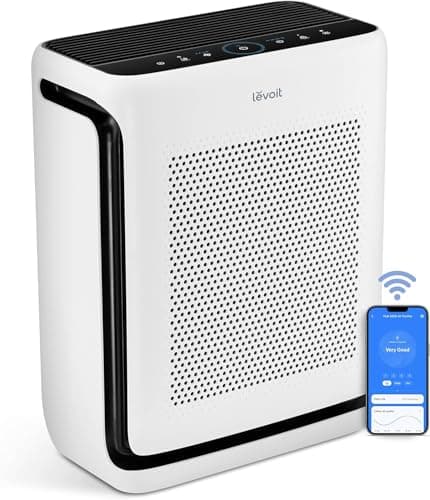 Levoit Vital 200SHomes with shedding pets | Best overall | 8.0 | $169.99 - View on Amazon |
| 2 | 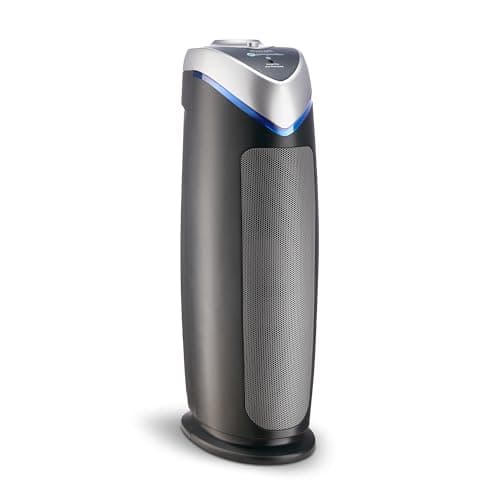 GermGuardian AC4825EA small room, a dorm or a desk-side space on a tight budget | Best on a budget | 7.6 | $80.74 - View on Amazon |
| 3 | 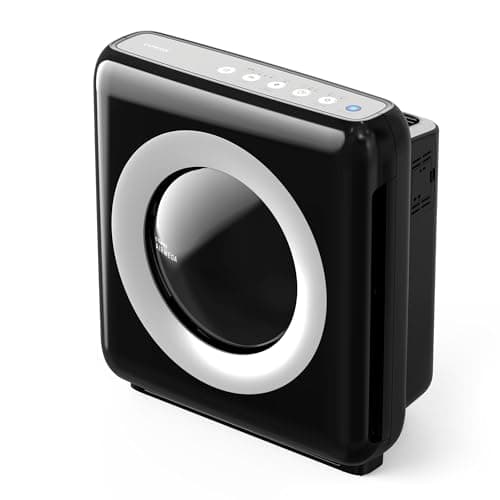 Coway Airmega AP-1512HH MightyRunning continuously in a medium room | Best for a shared office | 8.7 | $154.98 - View on Amazon |
#1 - Best overall
Levoit Vital 200S
Homes with shedding pets
The highest CADR we carry, built around a washable pre-filter and a wide intake - the right shape for a house with animals in it, because hair loads a filter far faster than dust does.
#ad Price as of October 18, 2026, from Amazon. Prices change. How we make money.
Published specifications
| Specification | Value | Source |
|---|---|---|
| CADR | 250 CFM | Levoit published specification |
| Coverage | 388 sq ft at 4.8 air changes/hr (1,862 sq ft at 1 ACH) | Levoit published specification |
| Rated power | 50 W | Levoit published specification |
| Noise | 23-54 dB | Levoit published specification |
| Filtration | 3-stage: washable pre-filter, HEPA, activated carbon. Pet allergy, toxin absorber and smoke remover carbon filters sold for the same body | Levoit published specification |
| Dimensions | 15.6 x 8.5 x 19.8 in | Levoit published specification |
What it costs to run
About $40 a year in electricity at 12 hours a day, before filters.
50 W / 1000 x 12 hours x 365 days = 219 kWh. At 18.34 cents/kWh that is $40.16 a year at rated power, and less on the lower fan speeds. That is roughly $10 a year more than the Core 400S for 19 CFM more CADR - worth it in a house with animals, hard to justify without them.
What is good about it
- 250 CFM is the highest CADR of anything we carry, and it covers about 375 sq ft under AHAM's two-thirds rule
- The washable pre-filter is the part that matters with pets - hair is what kills HEPA filters early
- Levoit publishes coverage at both 1 ACH and 4.8 ACH, and the 388 sq ft figure lines up closely with the AHAM arithmetic
- Four different carbon filters fit the same chassis, so the unit adapts to pets, smoke or off-gassing without replacing the body
What is not
- 50 W for 250 CFM is a worse clean-air-per-watt ratio than the Core 400S manages at 38 W for 231 CFM
- We could not find a published filter replacement interval for this model, so we are not quoting one
- Levoit does not publish power draw per fan speed, so continuous-running cost cannot be computed precisely
- The pet-specific carbon filter is a separate purchase and is not always in stock - check it is available before buying the body for that reason
Who should skip this
Skip this if you have no animals and no odor problem. Without pets you are paying for a wide pre-filter and a carbon option you will not use, and the Core 400S delivers comparable clean air on 12 W less.
How it scored
- Pre-filter design for hair9.0
- Clean air per watt7.0
- Honest coverage claim9.0
- Filter economics8.0
Overall 8.0 / 10. This is our editorial score from published specifications and computed running cost. It is not a test result, and it is deliberately not marked up as a rating in this page’s structured data.
#2 - Best on a budget
GermGuardian AC4825E
A small room, a dorm or a desk-side space on a tight budget
The cheapest air purifier we could find that publishes an AHAM-verified smoke CADR against a printed model number. That combination is rarer at this price than it should be, and it is the only reason this unit is here.
#ad Price as of October 18, 2026, from Amazon. Prices change. How we make money.
Published specifications
| Specification | Value | Source |
|---|---|---|
| CADR - smoke | 99 CFM | GermGuardian published specification |
| CADR - dust | 118 CFM | GermGuardian published specification |
| CADR - pollen | 125 CFM | GermGuardian published specification |
| Room size at the AHAM rule | About 149 sq ft | Our arithmetic from the published smoke CADR |
| Noise | 40-55 dBA | GermGuardian published specification |
| Fan speeds | 3 | GermGuardian published specification |
| Filter | True HEPA plus activated carbon, replace every 6-8 months | GermGuardian published specification |
| Dimensions and weight | 22 x 10.25 x 6.75 in, 8.55 lb | GermGuardian published specification |
What it costs to run
About $24 a year in electricity at 8 hours a day on high.
55 W / 1000 x 8 hours x 365 days = 160.6 kWh. At 18.34 cents/kWh that is $29.45 a year on high. On the low speed most people actually use it is meaningfully less; filters are the larger running cost at this price point, not electricity.
What is good about it
- Publishes all three AHAM CADR figures against the model number printed in the listing title, which most units at this price do not
- True HEPA, not HEPA-type - the distinction matters and the cheap end of this category is full of the latter
- Activated carbon stage included rather than sold as an upgrade
- 8.55 lb and 22 inches tall, so it moves between rooms without planning
What is not
- GermGuardian advertises 743 sq ft per hour. At AHAM's two-thirds smoke rule the honest figure is about 149 sq ft - a fifth of the headline
- 55 dBA on high is audible in a quiet room; this is not a unit you sleep next to on full speed
- The carbon stage is a thin coating on the filter wrap, not a deep carbon bed, so it handles light odors rather than sustained cooking or smoke
- Filters every 6-8 months is a faster cadence than the better units, and it erodes the price advantage over three years
- The UV-C lamp is a marketing feature at this air speed and we do not count it in the ranking
Who should skip this
Skip this if the room is over about 150 sq ft, if you need it silent overnight, or if the problem is cooking smoke or a smoker in the house - none of those are jobs a thin carbon coating wins.
How it scored
- Published data at the price9.0
- Clean air per dollar8.5
- Odor handling5.0
Overall 7.6 / 10. This is our editorial score from published specifications and computed running cost. It is not a test result, and it is deliberately not marked up as a rating in this page’s structured data.
#3 - Best for a shared office
Coway Airmega AP-1512HH Mighty
Running continuously in a medium room
The most efficient unit here at low speed - 3.7 W on speed one - which matters enormously if you leave a purifier running all day and almost not at all if you do not.
#ad Price as of October 18, 2026, from Amazon. Prices change. How we make money.
Published specifications
| Specification | Value | Source |
|---|---|---|
| CADR (smoke) | 233 CFM | Coway published specification |
| CADR (dust) | 246 CFM | Coway published specification |
| CADR (pollen) | 240 CFM | Coway published specification |
| Coverage | 361 sq ft at 4.8 air changes/hr (1,748 sq ft at 1 ACH) | Coway published specification |
| Power draw by speed | 0.3 W standby / 3.7 W speed 1 / 8.7 W speed 2 / 75.3 W speed 3 | Coway published specification |
| Filtration | Pre-filter, odor filter, Green True HEPA, bipolar device | Coway published specification |
What it costs to run
About $6 a year running 24/7 on speed one, or $121 a year running 24/7 on speed three.
Speed 1: 3.7 W / 1000 x 24 x 365 = 32.4 kWh = $5.94 a year. Speed 3: 75.3 W / 1000 x 24 x 365 = 659.6 kWh = $120.97 a year. That twenty-fold spread is the most important number on this page, and it is why we chase per-speed figures instead of accepting a single rated wattage.
What is good about it
- Coway publishes power draw per fan speed, which almost nobody does and which is the only way to compute a real running cost
- 3.7 W on speed one is remarkable - cheaper to run continuously than most nightlights
- Coverage published at 1, 2 and 4.8 air changes per hour, so you can size it honestly
What is not
- 75.3 W on speed three is the highest draw here; how the auto mode behaves decides your bill
- The bipolar device is a stage we would rather do without; check it can be disabled
Who should skip this
Skip this if you only run a purifier for an hour or two at a time. Its whole advantage is low-speed efficiency over long hours, and short bursts on high speed give that straight back.
How it scored
- Clean air per watt9.5
- Honest coverage claim9.5
- Quiet operation8.0
- Filter economics7.5
Overall 8.7 / 10. This is our editorial score from published specifications and computed running cost. It is not a test result, and it is deliberately not marked up as a rating in this page’s structured data.
How we ranked these
We have not tested these units. Nobody here owns one. What we did was compile each manufacturer’s published specifications, check the coverage claims against AHAM’s room-sizing rule, and compute what each one costs to run for a year at the current US average electricity price. Every figure on this page is attributed to whoever published it, and the arithmetic is shown so you can redo it.
How we rank these sets out the full method, including what would change a ranking.
Questions people ask
+−What size air purifier do I need for a dorm room?
A typical single dorm room of 100-150 sq ft needs a smoke CADR of roughly 67-100 CFM under AHAM’s two-thirds rule. That is a small, inexpensive unit. Be careful with desk-sized purifiers - many are well below that figure and are marketed on a coverage number measured at one air change per hour.
+−Are air purifiers allowed in dorm rooms?
Filter-based purifiers usually are; ozone generators and sometimes ionizers frequently are not. Check your residence hall’s appliance policy before buying, and prefer a filter unit regardless - the EPA does not consider ozone generators an appropriate way to clean indoor air.
+−Will an air purifier help a stuffy office?
Not if the stuffiness is poor ventilation, which it usually is. A purifier recirculates and filters the same air, and carbon dioxide - the thing that actually builds up in an occupied room - passes straight through a filter. Measure CO2 first; if it sits above about 1,000 ppm, the problem is fresh air supply, not filtration.
+−Is a desk air purifier worth it?
Only if it publishes a CADR you can check, and most do not. A unit rated well below the two-thirds figure for the room is cleaning a small bubble of air near itself rather than the space you are sitting in. If the room is 120 sq ft, buy a 120 sq ft machine and put it on the floor, not a 30 sq ft machine and put it by your keyboard.
+−Can I take an office purifier home at the weekend?
Yes, and it is a reasonable way to justify the spend - all three units here are light enough to carry. Bear in mind that a machine sized for a 150 sq ft office is undersized for an open-plan living room, so it will be working at the edge of its range at home.