Roundup
Best Air Purifiers for VOCs
This is the one application where the HEPA rating everyone shops for is irrelevant, and the only specification that matters is one almost nobody publishes: how many pounds of carbon are in the box.
By Scooter M. · Published · Last updated
How this page is funded: the buy links below are affiliate links. If you buy through one, we earn a commission at no extra cost to you. It does not change the order of the picks or what we say about them. Full disclosure.
The short answer
Ventilate first, then buy carbon by weight - and accept that this category forces a genuine trade-off. VOCs are gas-phase molecules. HEPA media captures particles and does essentially nothing to gases, so the HEPA grade is not the specification here. Only activated carbon adsorbs them, capacity is finite and roughly proportional to carbon mass, and the units with serious carbon publish almost nothing else. The one unit we found with up to 15 lb of carbon publishes no CADR, no wattage and no coverage figure at all. Every unit that does publish a CADR has carbon measured in grams.
Why HEPA is the wrong thing to compare on
A VOC is a molecule in the gas phase - formaldehyde from engineered wood, styrene from plastics, solvents from paint and adhesives. Gas molecules are orders of magnitude smaller than the particles filter media is built to intercept, and they pass through HEPA as though it were not there. This is set out properly in HEPA vs carbon filters.
Activated carbon works by a different mechanism: adsorption, where molecules stick to an enormous internal pore surface. That gives it two properties that decide everything on this page. Its capacity is finite - a saturated filter stops working - and that capacity scales with how much carbon is present. Which makes carbon mass the specification, and makes "includes an activated carbon filter" on a listing almost meaningless.
How we judged these
- Carbon mass, or the nearest published proxy. A stated weight beats a stated stage. Where no weight is published, we looked for whether the carbon is a separately replaceable part - the reliable sign there is more than a coating.
- Is the carbon on its own replacement schedule? Against a continuous gas source the carbon saturates long before the HEPA media is loaded. Being able to replace one without the other changes the running cost materially.
- Is there a published CADR to size the room? Still necessary, because VOC sources also emit particles and a purifier you cannot size is a guess.
- Honest fit over capability. These three are not interchangeable machines, so they are ranked by which job each genuinely wins rather than pretending one is a scaled version of another.
The three, and the trade-off between them
| Medify MA-40 | Winix 5510 | Austin Air HealthMate Plus | |
|---|---|---|---|
| Carbon | Active carbon composite layer | Separate AOC filter | Up to 15 lb, 780+ cu in |
| Carbon weight published | No | No | Yes |
| Carbon on its own schedule | No | Yes, 12 months | Yes, 5 years |
| Smoke CADR | 245 CFM (certified) | 253 CFM (Winix) | Not published |
| Coverage | 380 sq ft (certified) | 392 sq ft (Winix) | Not published |
| Annual energy | 261 kWh (certified) | Not published | Not published |
| Ozone | 0.00 ppb (certified) | Not published | Not published |
| Filter life | 3,000 hours | 12 months | 5 years |
Read that table left to right and the tension is obvious. Moving right, the carbon gets dramatically better and the published performance data disappears entirely. The Medify is the only one of the three with a federally certified CADR, efficiency figure and ozone measurement - and the least carbon. The Austin Air has roughly a thousand times the Medify’s carbon mass and publishes no performance figure at all.
There is no unit in this category that gives you both. That is the honest state of the market and it is why this page has three picks for three different situations rather than a winner.
The specification Austin Air does not publish
We checked Austin Air’s own specification page and it publishes the filter composition, the HEPA media area, the dimensions and the weight. It does not publish airflow, wattage, coverage area or an AHAM CADR, and the model is not in the ENERGY STAR certified room air cleaners database either - so there is no independent clean-air-per-watt or annual energy figure to fall back on.
Retail listings circulate a 400 CFM figure for it. That is an airflow number describing the fan, not a CADR describing clean air delivered, and the two are not interchangeable - a point we make about every manufacturer in CADR explained. We are not going to convert one into the other or quote it as though Austin Air published it.
On a site that sizes every purifier by smoke CADR, that makes this unit unsizeable. We are still listing it, because for a genuine gas-phase problem the carbon mass is the thing that decides the outcome and nothing else here comes close. But a reader buying it for pollen or dust would be paying several hundred dollars for carbon they do not need and giving up the one number that would let them check the machine fits the room.
Can you tell whether it is working?
Partly, and the honest answer is less than you would like. Consumer monitors report a TVOC figure derived from a metal-oxide sensor: it responds to the total burden of organic gases rather than identifying any particular one, it drifts, and it reacts enthusiastically to cleaning products and cooking. It is useful for watching a direction of travel in one room over days. It is not useful for deciding whether formaldehyde specifically is at a level that matters.
The more reliable signal is your nose plus the calendar. Off-gassing from a new item decays over weeks to months; a smell that is not fading after a season is a continuing source and the answer is finding it, not filtering it harder. If the complaint is stuffiness rather than smell, that is ventilation and the instrument is a CO2 monitor, because carbon dioxide passes straight through carbon as well as HEPA.
Which one for your situation
- New furniture, fresh paint, a renovated room - a finite source that will decay. The Medify MA-40 is the sensible buy: a real carbon composite layer, a certified 245 CFM CADR so you can size it, 0.00 ppb ozone, and it remains a competent particle purifier once the off-gassing has finished.
- A recurring gas load - cooking, a smoker, a workshop next door - buy the carbon you can replace independently. The Winix 5510’s separate AOC filter on a published 12-month schedule is the better arrangement, and it moves the most air of the three.
- A persistent, serious gas-phase problem you have already tried to ventilate away - this is the only case where the Austin Air makes sense, and you are buying 15 lb of carbon and accepting that you cannot size the machine.
What we would actually do
Open the windows. For off-gassing from something new, ventilate hard for a week or two and most of the problem solves itself for nothing - that really is the highest-value action available and no machine on this page competes with it.
Then buy the Medify for a decaying source and the Winix if the source is permanent and you want carbon you can swap on its own. Reach for the Austin Air only when the problem is genuinely gases, genuinely persistent, and ventilation has already failed - and go in knowing you are trading every verifiable performance figure for carbon mass. That is a defensible trade in a narrow set of circumstances and a bad one everywhere else.
Quick picks
Ranked on published specifications and computed running cost. Tap any row for the full write-up, including who should skip it.
| # | Product | Best for | Score | Price |
|---|---|---|---|---|
| 1 | 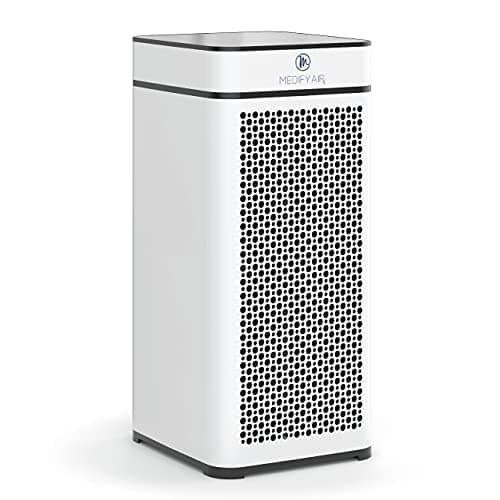 Medify MA-40A room up to about 380 sq ft where you want carbon as well as particle filtration | Best balance | 8.1 | $212.99 - View on Amazon |
| 2 | 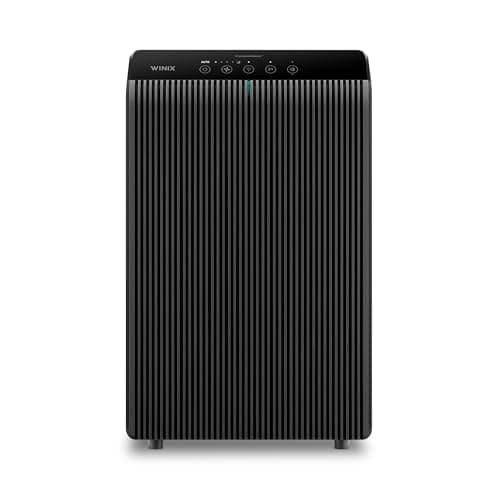 Winix 5510A room up to about 390 sq ft where odor control matters as much as particles | Best separate carbon filter | 8.2 | $179.99 - View on Amazon |
| 3 | 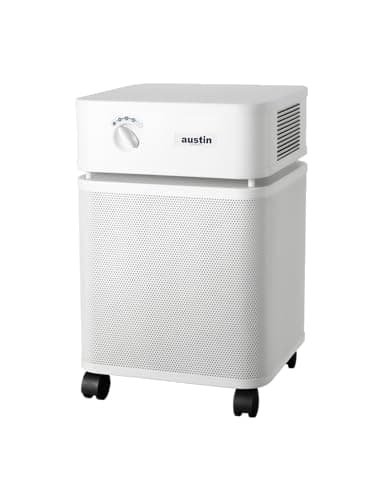 Austin Air HealthMate Plus B450A room with a genuine, ongoing gas-phase problem and a budget to match | Most carbon, fewest numbers | 8.0 | $895.00 - View on Amazon |
#1 - Best balance
Medify MA-40
A room up to about 380 sq ft where you want carbon as well as particle filtration
A capable mid-price unit with a real carbon composite stage and a federal certification you can check - which is useful, because Medify's own CADR claim and the certified figure do not agree.
#ad Price as of October 18, 2026, from Amazon. Prices change. How we make money.
Published specifications
| Specification | Value | Source |
|---|---|---|
| CADR - smoke (federal certification) | 245 CFM | ENERGY STAR certified room air cleaners database |
| CADR (manufacturer claim) | 330 - see cons | Medify published specification |
| Coverage | 380 sq ft | ENERGY STAR certified room air cleaners database |
| Clean air per watt | 5.53 CFM/W | ENERGY STAR certified room air cleaners database |
| Annual energy use | 261 kWh/yr | ENERGY STAR certified room air cleaners database |
| Ozone emissions | 0.00 ppb | ENERGY STAR certified room air cleaners database |
| Rated power | 54 W | Medify published specification |
| Noise | 46-66 dBA | Medify published specification |
| Filtration | 3-layer: pre-filter, H13 True HEPA, active carbon composite | Medify published specification |
| Filter life | 3,000 hours | Medify published specification |
| Dimensions and weight | 22 x 9.9 x 10.9 in, 15.6 lb | Medify published specification |
What it costs to run
About $48 a year on ENERGY STAR's certified annual energy figure.
ENERGY STAR publishes 261 kWh a year for the MA-40. At 18.34 cents/kWh that is $47.87 a year. Medify's own 54 W rating cross-checks it at 12 hours a day: 54 / 1000 x 12 x 365 = 237 kWh = $43.37, so the two figures agree closely. Filters at 3,000 hours are the larger running cost.
What is good about it
- ENERGY STAR certified, so its clean air per watt (5.53), annual energy (261 kWh) and ozone (0.00 ppb) are all independently published
- H13 media and an active carbon composite layer rather than carbon dust on the filter wrap
- Certified at 0.00 ppb ozone despite shipping with a switchable ionizer feature
- A published 3,000-hour filter life, which converts to a budgetable annual cost - many competitors publish nothing
- 245 CFM of certified smoke CADR covers a genuine 380 sq ft living room
What is not
- Medify advertises a CADR of 330 and some retailers list 380, while the federal certification for the MA-40 reports 245 smoke CADR. Size the room on 245
- Its Amazon listing claims 1,793 sq ft in one hour - a one-air-change figure, about 4.7 times the certified 380 sq ft coverage
- 46 dBA is its minimum, not a whisper setting. This is a noticeably louder unit at low speed than a Levoit or Blueair of similar size
- It includes an ionizer. We would leave it off, and a unit without one is a cleaner answer
- 5.53 CFM/W is mid-pack - the Blueair units we list are 8.84 and 9.59 for comparable rooms
- 3,000 hours is about four months of continuous running, so the filter cadence is faster than the 9-to-12 months better units manage
Who should skip this
Skip this if you need quiet - 46 dBA minimum rules it out of a bedroom for light sleepers. Skip it too if you want the efficiency leader rather than the carbon.
How it scored
- Carbon stage8.0
- Certified data available9.0
- Honesty of claimed CADR5.0
- Quiet operation5.0
Overall 8.1 / 10. This is our editorial score from published specifications and computed running cost. It is not a test result, and it is deliberately not marked up as a rating in this page’s structured data.
#2 - Best separate carbon filter
Winix 5510
A room up to about 390 sq ft where odor control matters as much as particles
The purchasable successor to the discontinued 5500-2, and on paper the better air mover of the two units on this page. It is also the one whose running cost and ozone output you cannot look up, because Winix has not certified it with ENERGY STAR.
#ad Price as of October 18, 2026, from Amazon. Prices change. How we make money.
Published specifications
| Specification | Value | Source |
|---|---|---|
| CADR - smoke | 253 CFM | Winix published specification |
| CADR - dust | 252 CFM | Winix published specification |
| CADR - pollen | 247 CFM | Winix published specification |
| Coverage | 392 sq ft, AHAM Verifide | Winix published specification |
| Filtration | 4-stage: washable pre-filter, True HEPA, AOC carbon filter, PlasmaWave | Winix published specification |
| Filter replacement | 12 months, HEPA and AOC carbon | Winix published specification |
| Fan speeds | 5 | Winix published specification |
| Noise | 23.5 dB on the slowest speed; Winix does not publish a maximum | Winix published specification |
| Rated power | Not published by Winix, and the model is not ENERGY STAR certified | Winix published specification / ENERGY STAR certified room air cleaners database |
| Ozone emissions | Not published - see cons | ENERGY STAR certified room air cleaners database |
| Dimensions and weight | 13.59 x 8.27 x 22.17 in, 13.3 lb | Winix published specification |
What is good about it
- 253 CFM smoke CADR is about 10% more air than the Core 400S moves, for slightly less money
- Winix publishes a 12-month replacement interval for both the HEPA and the carbon filter - Levoit publishes no interval for the Core 400S at all
- The carbon is a separate AOC filter with its own part number and schedule, not a coating on the HEPA wrap, which is what actually matters for odors
- AHAM Verifide at 392 sq ft, and that figure is close to the honest two-thirds-of-CADR number rather than an inflated one
- Washable pre-filter, so the consumable stages last closer to their rated life
- Five fan speeds gives finer control than most units at this price
What is not
- Not ENERGY STAR certified, so there is no published wattage and no certified annual energy figure. On a machine designed to run continuously, that is the specification we care most about and it does not exist
- PlasmaWave is an ionizing stage, and Winix's published specification does not state whether it can be switched off on this model
- No ozone emissions figure is published for it, because that figure comes from the ENERGY STAR certification it does not have
- Winix does not publish a maximum noise level - only the 23.5 dB minimum
- Its own Amazon listing advertises 1,881 sq ft while Winix's specification sheet says 392 sq ft. Both are real numbers answering different questions, and the larger one is not a coverage figure you can use
- At 13.3 lb it is the heavier of the two, and it is a tower rather than a cylinder, so it needs wall clearance
Who should skip this
Skip this if you want to know what the machine costs to run before you buy it, or if you would rather not own an ionizing stage you cannot confirm is switchable. Both of those point to the Core 400S instead.
How it scored
- Clean air delivered9.0
- Odor handling9.0
- Published running cost2.0
- Filter transparency9.0
Overall 8.2 / 10. This is our editorial score from published specifications and computed running cost. It is not a test result, and it is deliberately not marked up as a rating in this page’s structured data.
#3 - Most carbon, fewest numbers
Austin Air HealthMate Plus B450
A room with a genuine, ongoing gas-phase problem and a budget to match
The only unit we have found with enough activated carbon to take gases seriously - up to 15 lb of it, against a few grams in a consumer carbon coating. It is also the only purifier we list that publishes no CADR, no wattage and no coverage figure at all.
#ad Price as of October 18, 2026, from Amazon. Prices change. How we make money.
Published specifications
| Specification | Value | Source |
|---|---|---|
| Carbon and mineral media | Over 780 cubic inches, up to 15 lb of activated carbon, impregnated carbon and mineral | Austin Air published specification |
| HEPA media | 60 sq ft of True Medical Grade HEPA | Austin Air published specification |
| Stages | 4 | Austin Air published specification |
| Filter life | Five years under normal residential conditions | Austin Air published specification |
| CADR | Not published - see cons | No AHAM-verified figure found; not in the ENERGY STAR certified database |
| Airflow (CFM) | Not published by Austin Air | Austin Air published specification |
| Power consumption | Not published by Austin Air | Austin Air published specification |
| Coverage | Not published by Austin Air | Austin Air published specification |
| Dimensions and weight | 14.5 x 14.5 x 23 in, 47 lb | Austin Air published specification |
What is good about it
- Up to 15 lb of carbon and mineral media. Adsorption capacity is finite and roughly proportional to mass, so this is a different order of machine for gases than anything with a carbon coating
- The carbon is impregnated rather than plain, which is the arrangement used for gases that plain carbon handles poorly
- 60 sq ft of HEPA media in a sealed steel body - no plastic housing to leak around the filter
- A five-year filter life genuinely changes the running cost arithmetic against units on a 6-to-12 month cycle
- Built to be serviced rather than replaced, which at this price it needs to be
What is not
- Austin Air publishes no CADR, no airflow figure, no wattage and no coverage area. On a site that sizes every purifier by smoke CADR, this unit cannot be sized at all
- It is not in the ENERGY STAR certified room air cleaners database, so there is no independent clean-air-per-watt or annual-energy figure either
- Retail listings circulate a 400 CFM airflow number. Airflow is not CADR - it describes the fan, not the clean air delivered - and Austin Air does not publish it
- Several times the price of any other purifier on this site, and far above the bracket we normally recommend
- 47 lb. This is furniture; it does not move between rooms
- For a particle problem - pollen, dust, dander, smoke - a unit with a published CADR at a fifth of the price is the better buy, and we would say so
Who should skip this
Skip this unless the problem is genuinely gases. If you are buying for pollen, dust or pet dander, you are paying several hundred dollars for carbon you do not need and giving up the one specification that would let you size the machine.
How it scored
- Carbon capacity for gases10.0
- Filter life9.5
- Published specifications1.5
- Value for a particle problem3.0
Overall 8.0 / 10. This is our editorial score from published specifications and computed running cost. It is not a test result, and it is deliberately not marked up as a rating in this page’s structured data.
How we ranked these
We have not tested these units. Nobody here owns one. What we did was compile each manufacturer’s published specifications, check the coverage claims against AHAM’s room-sizing rule, and compute what each one costs to run for a year at the current US average electricity price. Every figure on this page is attributed to whoever published it, and the arithmetic is shown so you can redo it.
How we rank these sets out the full method, including what would change a ranking.
Questions people ask
+−Do air purifiers remove VOCs?
Only the activated carbon stage does, and only until it saturates. HEPA media captures particles and does essentially nothing to gas-phase molecules. Since adsorption capacity is finite and roughly proportional to carbon mass, how well a unit removes VOCs over time comes down to how much carbon it contains - which most manufacturers do not publish.
+−How much activated carbon do I need for VOCs?
More than a coating provides. A consumer unit with carbon bonded to the HEPA wrap carries a few grams; the heavy-carbon unit on this page publishes up to 15 lb across more than 780 cubic inches. Against a continuous source the small quantity saturates in weeks. The practical test when comparing two units: if the carbon has its own part number and replacement schedule, there is meaningfully more of it.
+−Will an air purifier remove formaldehyde?
A carbon stage adsorbs it, with the same finite-capacity caveat, and impregnated carbon is the media usually specified for gases that plain carbon handles poorly. But formaldehyde from engineered wood is a continuing emission over months, so filtration is working against an active source. Ventilation and time do more, and a purifier is the third line of defense rather than the first.
+−Why do heavy-carbon air purifiers not publish a CADR?
AHAM’s CADR test measures particle removal, which is not what these machines are sold for, and certification costs money. The consequence for a buyer is real though: the unit with the most carbon on this page publishes no CADR, no wattage and no coverage area, so it cannot be sized to a room on any published figure.
+−Can a TVOC monitor tell me if my purifier is working?
Roughly, and only in one room over days. Consumer TVOC readings come from metal-oxide sensors that report a total organic-gas burden rather than identifying compounds, drift over time, and spike on cleaning sprays and cooking. Useful for a trend, not for judging whether a specific compound is at a level that matters.
+−Is an air purifier or ventilation better for VOCs?
Ventilation, clearly, and it is free. Replacing indoor air with outdoor air dilutes gases regardless of what they are, while a carbon filter has a finite capacity that is being consumed. Filter when you cannot ventilate - bad outdoor air, winter, a sealed apartment - not instead of ventilating.
Sources
- EPA - Volatile Organic Compounds' Impact on Indoor Air Quality
- EPA - Air Cleaners and Air Filters in the Home (Guide to Air Cleaners in the Home)
- EPA - Improving Indoor Air Quality
- AHAM Verifide - Air Filtration Standards (AC-1)
- ENERGY STAR - Certified Room Air Cleaners product database
- U.S. Energy Information Administration - Electric Power Monthly, Table 5.6.A