Comparison
Will an Air Purifier Fix Mold?
Tens of thousands of people search for the best air purifier for mold every month. Most of them are in the wrong aisle, and almost nobody tells them so.
By Scooter M. · Published · Last updated
How this page is funded: the buy links below are affiliate links. If you buy through one, we earn a commission at no extra cost to you. It does not change the order of the picks or what we say about them. Full disclosure.
The short answer
No. An air purifier removes mold spores from the air passing through its filter. It does nothing about the mold itself, because mold grows on moisture and a purifier does not change moisture. Stop the water, dry the material within 24 to 48 hours as the EPA advises, bring relative humidity below 60%, and remove the growth. A purifier is a reasonable fourth step and a useless first one.
This page exists because the search results for “best air purifier for mold” are almost uniformly product roundups, and a product roundup cannot give you this answer without arguing itself out of a sale. We are going to give it anyway, and then tell you what to buy instead.
What the EPA actually says
The EPA is unambiguous that this is a moisture problem: “controlling indoor moisture will control the growth of indoor mold.” It states that indoor relative humidity should be kept below 60 percent - ideally between 30 and 50 percent, and that wet building materials and furnishings “must be dried or allowed to dry quickly (within 24-48 hours) in order to avoid mold growth.”
Nothing in that is about air filtration, because filtration is not the lever. A filter downstream of a colony is bailing a boat without plugging the hole.
| Device | Effect on mold growth | Effect on airborne spores |
|---|---|---|
| Dehumidifier | Direct. Below 60% RH the growth conditions are removed. | Indirect - fewer colonies eventually means fewer spores. |
| Air purifier (HEPA) | None whatsoever. | Real, for the air passing through it, while it runs. |
| Ventilation | Direct, if outdoor air is drier than indoor air. | Dilutes them, and it is free. |
| Fixing the water source | The actual fix. Everything else manages symptoms. | Removes the source entirely. |
The order that works
- Find the water. A leak, a failed seal, condensation on a cold surface, groundwater through a foundation, or an appliance venting into the room. Until you know which, nothing else is more than management.
- Stop it and dry the material. The EPA’s 24-48 hour window is the number to work against - beyond it, mold growth on wet materials becomes likely.
- Bring humidity below 60%. This is where a dehumidifier earns its place, and it is a genuine ongoing job in a basement that will never be as dry as the rest of the house.
- Remove the existing growth. Cleaning or removing affected material. Small areas are a domestic job; large areas are not.
- Then, if you like, filter. Once the source is dealt with, a HEPA purifier reduces airborne spore load in the room, which is worth having.
Why the marketing goes the other way
An air purifier is a $150 impulse purchase that arrives in two days. Finding a foundation leak is a Saturday, a contractor, and possibly a large bill. The search volume follows the easy answer: “air purifiers for mold” and “best air purifiers for mold” together represent over 20,000 searches a month in measured data, while the search for what actually fixes it is a small fraction of that. The market is answering the question people asked rather than the one they have.
If the smell is the problem
A musty smell is produced by the growth, not by spores in the air, so a HEPA filter does very little for it. A carbon stage adsorbs some of the volatile compounds involved, which is a genuine but partial effect - the smell returns as soon as the filter saturates, because the source is still producing. See musty smell in the house for the full sequence.
This page is about the environment - humidity, particles, ventilation - and what changes it. It is not medical advice and we hold no medical qualification. If symptoms are persistent, severe or getting worse, that is a question for a clinician rather than a purchase.
Buy a dehumidifier if...
- Your basement or bathroom measures above 60% relative humidity
- There is a musty smell that returns after airing out
- You have fixed the obvious water source and the space still will not dry
Buy an air purifier if...
- The moisture problem is already dealt with and you want to reduce spore load
- You are about to disturb existing growth during clean-up
- You have allergy symptoms that persist in a room that is now genuinely dry
Buy neither if...
There is active water ingress. Both devices will run continuously, cost you money, and lose. Find the water first - that is not a sales-avoidance line, it is the actual sequence the EPA sets out.
What we would buy for this
Chosen from the same registry as our roundups, on published specifications and computed running cost.
Midea Cube 35-Pint
Basements without a floor drain
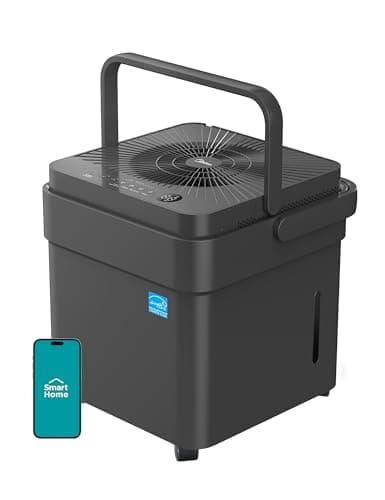
The adjustable 4.25-gallon bucket is the point. Most dehumidifiers get switched off because emptying a 2-gallon bucket twice a day is miserable; this one buys you a couple of days.
#ad Price as of October 18, 2026, from Amazon. Prices change. How we make money.
Published specifications
| Specification | Value | Source |
|---|---|---|
| Capacity | 35 pints per day | Midea published specification |
| Capacity (federal test) | 35.82 pints per day | ENERGY STAR certified products database |
| Coverage | Up to 3,500 sq ft | Midea published specification |
| Efficiency (IEF) | 2.01 L/kWh | ENERGY STAR certified products database |
| Annual energy use | 378 kWh/yr | ENERGY STAR certified products database |
| Bucket fill level | Adjustable, up to 4.25 gallons | Midea user manual |
| Fan speeds | 2 (High, Low) | Midea user manual |
| Dimensions | 14.76 x 14.57 x 14.45 in, 39.62 lb | Midea published specification |
| Certification | ENERGY STAR certified | ENERGY STAR certified products database |
What it costs to run
About $69 a year on ENERGY STAR's certified annual energy figure.
ENERGY STAR publishes 378 kWh a year for this model. At 18.34 cents/kWh that is $69.33 a year. That figure is calculated on the program's standardized test basis, not measured in your basement: a genuinely damp space where it cycles constantly will use more. Against the 50-pint Cube's 515 kWh ($94.45) it is the cheaper machine to own, which is the argument for sizing honestly rather than buying headroom.
What is good about it
- An adjustable bucket that holds up to 4.25 gallons - the difference between a unit you keep using and one you unplug in week three
- An IEF of 2.01 L/kWh removes about 18% more water per kWh than the 20-pint Cube's 1.70
- Nests down into a smaller shape for storage, which matters for an appliance you only use half the year
What is not
- The 3,500 sq ft coverage claim assumes conditions no real basement has; treat it as a ceiling, not a specification
- 35 pints is not enough for a genuinely wet basement with standing water
- Midea does not publish a rated wattage for this model, so we quote ENERGY STAR's certified annual energy figure instead
- No built-in pump on this model - without a floor drain you are either emptying the bucket or routing a gravity hose
Who should skip this
Skip this if your basement is wet rather than damp - visible water, white efflorescence on the walls, a musty smell that returns within a day of airing out. That is a drainage problem, and a 35-pint unit will run permanently and never win.
How it scored
- Tank interval10.0
- Capacity for the money8.5
- Efficiency per liter removed9.0
- Storage footprint9.0
Overall 8.7 / 10. This is our editorial score from published specifications and computed running cost. It is not a test result, and it is deliberately not marked up as a rating in this page’s structured data.
Frigidaire FFAD5033W1 50-Pint
Wet basements that need real capacity
A conventional 50-pint unit that publishes its Integrated Energy Factor, which is the one dehumidifier figure that actually predicts your bill.
#ad We do not hold a current price for this product, so we do not show one. How we make money.
Published specifications
| Specification | Value | Source |
|---|---|---|
| Capacity | 50 pints per day | Frigidaire published specification |
| Rated power | 545 W at 120 V | Frigidaire published specification |
| Integrated Energy Factor | 1.8 L/kWh | Frigidaire published specification |
| Bucket capacity | 2.1 gallons | Frigidaire published specification |
| Humidity setpoint range | 35% to 85% RH | Frigidaire published specification |
| Noise | 47 / 49 / 51 dBA by fan speed | Frigidaire published specification |
| Certification | Energy Star rated | Frigidaire published specification |
| Continuous drain | Yes | Frigidaire published specification |
What it costs to run
About $180-200 a year on a humidistat - and far less if you fix the water first.
545 W / 1000 x 10 hours x 365 days = 1,989 kWh = $364.79 a year at continuous duty. In practice a dehumidifier on a humidistat cycles rather than running flat out, so a realistic damp-basement figure is roughly half that, $180-200. Either way it dwarfs every purifier on this site, which is exactly why finding the water source matters more than choosing the unit.
What is good about it
- Publishes an Integrated Energy Factor of 1.8 L/kWh, which lets you compute cost per liter removed instead of guessing
- Continuous drain means you never empty a bucket, which is the single reason most dehumidifiers end up unplugged
- A 35% RH floor on the setpoint is low enough for a genuinely damp basement
What is not
- 545 W is a real load - a dehumidifier is by far the most expensive appliance discussed on this site
- 41 lb and nearly 25 inches tall; this is not a discreet object
Who should skip this
Skip this if your damp problem is one closet or one bathroom. A 50-pint compressor unit in a closet is enormously more machine than the job needs.
How it scored
- Capacity for the money9.0
- Published efficiency data9.5
- Set-and-forget drainage9.0
- Running cost6.0
Overall 8.5 / 10. This is our editorial score from published specifications and computed running cost. It is not a test result, and it is deliberately not marked up as a rating in this page’s structured data.
Levoit Core 400S
Living rooms and open-plan spaces
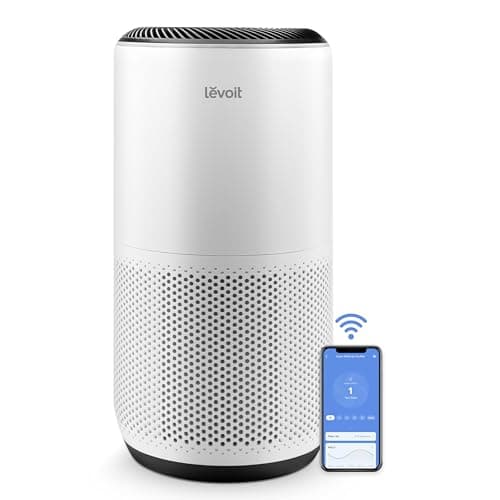
The one to buy if you want a purifier that genuinely covers a living room, and one of the few spec sheets in this bracket that publishes coverage at a useful air-change rate rather than only the flattering one.
#ad Price as of October 18, 2026, from Amazon. Prices change. How we make money.
Published specifications
| Specification | Value | Source |
|---|---|---|
| CADR | 231 CFM | Levoit published specification |
| Coverage | 358 sq ft at 4.8 air changes/hr (1,718 sq ft at 1 ACH) | Levoit published specification |
| Rated power | 38 W | Levoit published specification |
| Noise | 22-52 dB | Levoit published specification |
| Filtration | 3-stage: pre-filter, HEPA, activated carbon | Levoit published specification |
| Dimensions | 10.8 x 10.8 x 20.5 in, 11 lb | Levoit published specification |
What it costs to run
About $25-30 a year in electricity at 12 hours a day, before filters.
38 W / 1000 x 12 hours x 365 days = 166.4 kWh. At 18.34 cents/kWh that is $30.52 a year at rated power - and the unit only draws its full 38 W on the top fan speed, so a mid setting lands nearer $25. Add the replacement filter, which you should price before you buy rather than after.
What is good about it
- Levoit publishes coverage at both 1 ACH and 4.8 ACH, which is unusually straight - most brands quote only the flattering 1 ACH number
- 38 W is low for this CADR, which is what keeps the running cost down
- 22 dB on its lowest setting is quiet enough to sleep beside
- Carbon, pet-allergy and smoke-specific replacement filters are sold for the same body
What is not
- We could not find a published filter replacement interval in Levoit's specification, so we are not quoting one
- The 1,718 sq ft headline is a single air change per hour, which is not a useful rate for allergies
Who should skip this
Skip this if your room is under 200 sq ft. The Core 300S covers that at lower power and lower cost, and the extra CADR buys you nothing in a small bedroom.
How it scored
- Clean air per watt9.0
- Honest coverage claim9.5
- Quiet operation8.5
- Filter economics7.5
Overall 8.6 / 10. This is our editorial score from published specifications and computed running cost. It is not a test result, and it is deliberately not marked up as a rating in this page’s structured data.
ThermoPro TP49 Hygrometer
Anyone about to buy a humidifier or a dehumidifier
An inexpensive digital hygrometer is the highest-value purchase on this entire site, because it is the one that tells you whether to buy anything else.
#ad We do not hold a current price for this product, so we do not show one. How we make money.
Published specifications
| Specification | Value | Source |
|---|---|---|
| Function | Digital temperature and relative humidity readout with a comfort indicator | ThermoPro published specification |
What is good about it
- Cheap enough to buy three and put one in the bedroom, one in the basement and one in the living room, which is what you actually want
- Gives you the reading that decides between a humidifier and a dehumidifier - a decision people routinely get backwards
What is not
- Consumer hygrometers are typically accurate to within a few percentage points, which is fine for the 30-50% question and not fine for anything precise
- No logging, so you see now rather than overnight
Who should skip this
Skip this only if you already own a hygrometer. There is no household we would tell not to measure.
How it scored
- Value for the decision it informs10.0
- Accuracy for the 30-50% question8.0
- Logging and history2.0
Overall 9.0 / 10. This is our editorial score from published specifications and computed running cost. It is not a test result, and it is deliberately not marked up as a rating in this page’s structured data.
How we ranked these
We have not tested these units. Nobody here owns one. What we did was compile each manufacturer’s published specifications, check the coverage claims against AHAM’s room-sizing rule, and compute what each one costs to run for a year at the current US average electricity price. Every figure on this page is attributed to whoever published it, and the arithmetic is shown so you can redo it.
How we rank these sets out the full method, including what would change a ranking.
Questions people ask
+−Do air purifiers help with mold spores?
With spores already airborne, yes - a HEPA filter captures particles in that size range from the air that passes through it. With the mold itself, no. The distinction matters because a colony keeps producing spores, so filtration without fixing the moisture is permanent maintenance rather than a fix.
+−Air purifier or dehumidifier for mold?
Dehumidifier, and it is not close. Mold requires moisture; remove it and growth stops. That is the EPA’s own framing - control indoor moisture and you control indoor mold. It is also why we would spend the money on a hygrometer rather than a test kit: mold test kits vs air monitors.
+−What humidity level stops mold growing?
The EPA states that indoor relative humidity should be kept below 60 percent, ideally between 30 and 50 percent. Below 60% is the operative ceiling for mold risk, and it is the number to set a dehumidifier against.
+−Will an air purifier get rid of a musty smell?
Partly and temporarily, and only if it has a substantial activated carbon stage - the smell is gaseous, and HEPA does not touch gases. As soon as the carbon saturates the smell returns, because the source has not changed. The same limit applies to the larger machines the remediation trade uses - air scrubber vs air purifier.
+−How fast can mold grow after water damage?
The EPA advises that wet materials must be dried “within 24-48 hours” to avoid mold growth. That window is the reason speed matters more than equipment after a leak, and the reason the fix order in damp house symptoms starts with finding the water.
+−Do I need a HEPA purifier or does any filter work?
If you are filtering spores, filter quality matters, and CADR is the figure to compare on rather than a filter name - AHAM’s guidance is to choose a smoke CADR of about two-thirds the room’s square footage. See CADR explained.