Roundup
Best Air Purifiers for a Bedroom
The room where the specification that matters is the one measured at the speed you will actually use.
By Scooter M. · Published · Last updated
How this page is funded: the buy links below are affiliate links. If you buy through one, we earn a commission at no extra cost to you. It does not change the order of the picks or what we say about them. Full disclosure.
The bedroom is the highest-value room to treat - eight unbroken hours behind a closed door - and the one where the usual specifications mislead most.
Is an air purifier the right fix for this?
Before buying: morning symptoms in a bedroom are produced by at least three different things, and only one of them is filtration.
| What else you notice | Likely cause | The fix |
|---|---|---|
| Static shocks, cracked lips, worse in winter | Air too dry | Humidifier - Dry Air |
| Clammy room, worse in summer, humidity above 50% | Dust mites | Lower the humidity and change the bedding - dust mites in the bedroom |
| Year-round, pets in the room, dust visible in sunlight | Airborne allergen | An air purifier - this page |
A hygrometer settles which of the three you have, and it costs less than one replacement filter. If you have not measured, that is the first purchase - which device do I need.
What size you actually need
AHAM’s two-thirds rule: required smoke CADR is about two-thirds the room’s area, with their published example of 132 CFM for 200 sq ft.
| Bedroom | Minimum smoke CADR | Comment |
|---|---|---|
| 100 sq ft box room | 67 CFM | Anything here is ample |
| 150 sq ft standard | 100 CFM | Levoit Core 300S at 141 CFM, comfortably |
| 200 sq ft | 132 CFM (AHAM's example) | Core 300S just clears it |
| 250 sq ft master | 167 CFM | Core 400S, Coway or Winix |
| 350 sq ft with an en-suite open | 233 CFM | Coway at 233 CFM; close the en-suite door instead if you can |
The two specifications that actually decide a bedroom unit
- Noise at the lowest speed. This is the number that determines whether the unit gets used. 22 dB is genuinely unobtrusive; both Levoit Core models publish 22 dB at their lowest setting. A unit you turn off at bedtime has a real CADR of zero.
- Power at the speed you will run it. Rated wattage is measured at maximum. Coway publishes per-speed figures - 3.7 W on speed one against 75.3 W on speed three - and that spread is the difference between $6 and $121 a year at 24/7 running.
This page is about the environment - humidity, particles, ventilation - and what changes it. It is not medical advice and we hold no medical qualification. If symptoms are persistent, severe or getting worse, that is a question for a clinician rather than a purchase.
When to buy nothing at all
- You have not measured the humidity. Two of the three common causes of morning symptoms are humidity, and a purifier addresses neither.
- The bedding has not been washed hot or covered. For dust mite allergen that does more than filtration.
- The pet sleeps on the bed. Keeping the animal off bedding outperforms a purifier, and it is free.
Quick picks
Ranked on published specifications and computed running cost. Tap any row for the full write-up, including who should skip it.
| # | Product | Best for | Score | Price |
|---|---|---|---|---|
| 1 |  Levoit Core 300SBedrooms up to about 220 sq ft Levoit Core 300SBedrooms up to about 220 sq ft | Most bedrooms | 8.8 | Check price on Amazon |
| 2 | 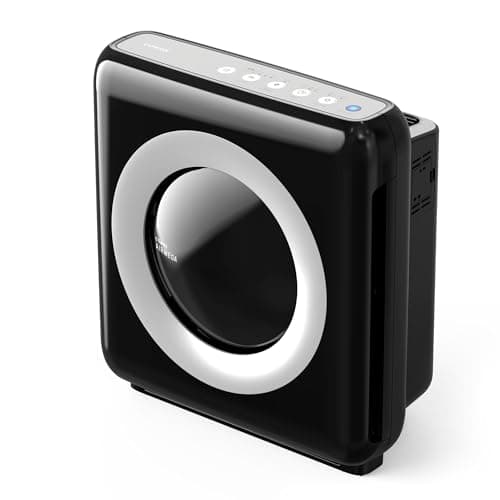 Coway Airmega AP-1512HH MightyRunning continuously in a medium room Coway Airmega AP-1512HH MightyRunning continuously in a medium room | Large bedrooms | 8.7 | $154.98 - View on Amazon |
| 3 | 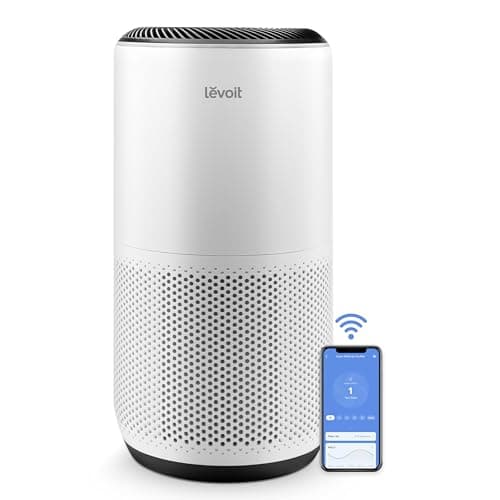 Levoit Core 400SLiving rooms and open-plan spaces Levoit Core 400SLiving rooms and open-plan spaces | Over 250 sq ft | 8.6 | $189.97 - View on Amazon |
| 4 |  ThermoPro TP49 HygrometerAnyone about to buy a humidifier or a dehumidifier ThermoPro TP49 HygrometerAnyone about to buy a humidifier or a dehumidifier | Ruling out humidity first | 9.0 | Check price on Amazon |
#1 - Most bedrooms
Levoit Core 300S
Bedrooms up to about 220 sq ft
The right size for an actual bedroom. 23 W and 22 dB on low means you can run it all night without noticing it on the bill or on the pillow.
#ad We do not hold a current price for this product, so we do not show one. How we make money.
Published specifications
| Specification | Value | Source |
|---|---|---|
| CADR | 141 CFM (240 m3/h) | Levoit published specification |
| Coverage | 219 sq ft at 4.8 air changes/hr (1,051 sq ft at 1 ACH) | Levoit published specification |
| Rated power | 23 W | Levoit published specification |
| Noise | 22-50 dB | Levoit published specification |
| Filtration | 3-stage | Levoit published specification |
| Dimensions | 8.7 x 8.7 x 14.2 in, 5.95 lb | Levoit published specification |
What it costs to run
About $15-18 a year in electricity at 12 hours a day.
23 W / 1000 x 12 hours x 365 days = 100.7 kWh. At 18.34 cents/kWh that is $18.47 a year at rated power, and less on the lower fan speeds you would actually use overnight.
What is good about it
- 141 CFM clears AHAM's two-thirds rule for any room up to 211 sq ft, which covers most bedrooms
- 23 W is the lowest draw of anything we list with this much CADR
- Small enough to sit on a nightstand rather than take a corner of the floor
What is not
- Not enough for a living room - the useful 4.8 ACH figure is 219 sq ft, not the 1,051 sq ft headline
- No published filter replacement interval in the specification we could find
Who should skip this
Skip this if the room is over about 220 sq ft, or if you are trying to cover an open-plan downstairs. It will run flat out and still lose.
How it scored
- Clean air per watt9.5
- Honest coverage claim9.5
- Quiet operation9.0
- Filter economics7.5
Overall 8.8 / 10. This is our editorial score from published specifications and computed running cost. It is not a test result, and it is deliberately not marked up as a rating in this page’s structured data.
#2 - Large bedrooms
Coway Airmega AP-1512HH Mighty
Running continuously in a medium room
The most efficient unit here at low speed - 3.7 W on speed one - which matters enormously if you leave a purifier running all day and almost not at all if you do not.
#ad Price as of October 18, 2026, from Amazon. Prices change. How we make money.
Published specifications
| Specification | Value | Source |
|---|---|---|
| CADR (smoke) | 233 CFM | Coway published specification |
| CADR (dust) | 246 CFM | Coway published specification |
| CADR (pollen) | 240 CFM | Coway published specification |
| Coverage | 361 sq ft at 4.8 air changes/hr (1,748 sq ft at 1 ACH) | Coway published specification |
| Power draw by speed | 0.3 W standby / 3.7 W speed 1 / 8.7 W speed 2 / 75.3 W speed 3 | Coway published specification |
| Filtration | Pre-filter, odor filter, Green True HEPA, bipolar device | Coway published specification |
What it costs to run
About $6 a year running 24/7 on speed one, or $121 a year running 24/7 on speed three.
Speed 1: 3.7 W / 1000 x 24 x 365 = 32.4 kWh = $5.94 a year. Speed 3: 75.3 W / 1000 x 24 x 365 = 659.6 kWh = $120.97 a year. That twenty-fold spread is the most important number on this page, and it is why we chase per-speed figures instead of accepting a single rated wattage.
What is good about it
- Coway publishes power draw per fan speed, which almost nobody does and which is the only way to compute a real running cost
- 3.7 W on speed one is remarkable - cheaper to run continuously than most nightlights
- Coverage published at 1, 2 and 4.8 air changes per hour, so you can size it honestly
What is not
- 75.3 W on speed three is the highest draw here; how the auto mode behaves decides your bill
- The bipolar device is a stage we would rather do without; check it can be disabled
Who should skip this
Skip this if you only run a purifier for an hour or two at a time. Its whole advantage is low-speed efficiency over long hours, and short bursts on high speed give that straight back.
How it scored
- Clean air per watt9.5
- Honest coverage claim9.5
- Quiet operation8.0
- Filter economics7.5
Overall 8.7 / 10. This is our editorial score from published specifications and computed running cost. It is not a test result, and it is deliberately not marked up as a rating in this page’s structured data.
#3 - Over 250 sq ft
Levoit Core 400S
Living rooms and open-plan spaces
The one to buy if you want a purifier that genuinely covers a living room, and one of the few spec sheets in this bracket that publishes coverage at a useful air-change rate rather than only the flattering one.
#ad Price as of October 18, 2026, from Amazon. Prices change. How we make money.
Published specifications
| Specification | Value | Source |
|---|---|---|
| CADR | 231 CFM | Levoit published specification |
| Coverage | 358 sq ft at 4.8 air changes/hr (1,718 sq ft at 1 ACH) | Levoit published specification |
| Rated power | 38 W | Levoit published specification |
| Noise | 22-52 dB | Levoit published specification |
| Filtration | 3-stage: pre-filter, HEPA, activated carbon | Levoit published specification |
| Dimensions | 10.8 x 10.8 x 20.5 in, 11 lb | Levoit published specification |
What it costs to run
About $25-30 a year in electricity at 12 hours a day, before filters.
38 W / 1000 x 12 hours x 365 days = 166.4 kWh. At 18.34 cents/kWh that is $30.52 a year at rated power - and the unit only draws its full 38 W on the top fan speed, so a mid setting lands nearer $25. Add the replacement filter, which you should price before you buy rather than after.
What is good about it
- Levoit publishes coverage at both 1 ACH and 4.8 ACH, which is unusually straight - most brands quote only the flattering 1 ACH number
- 38 W is low for this CADR, which is what keeps the running cost down
- 22 dB on its lowest setting is quiet enough to sleep beside
- Carbon, pet-allergy and smoke-specific replacement filters are sold for the same body
What is not
- We could not find a published filter replacement interval in Levoit's specification, so we are not quoting one
- The 1,718 sq ft headline is a single air change per hour, which is not a useful rate for allergies
Who should skip this
Skip this if your room is under 200 sq ft. The Core 300S covers that at lower power and lower cost, and the extra CADR buys you nothing in a small bedroom.
How it scored
- Clean air per watt9.0
- Honest coverage claim9.5
- Quiet operation8.5
- Filter economics7.5
Overall 8.6 / 10. This is our editorial score from published specifications and computed running cost. It is not a test result, and it is deliberately not marked up as a rating in this page’s structured data.
#4 - Ruling out humidity first
ThermoPro TP49 Hygrometer
Anyone about to buy a humidifier or a dehumidifier
An inexpensive digital hygrometer is the highest-value purchase on this entire site, because it is the one that tells you whether to buy anything else.
#ad We do not hold a current price for this product, so we do not show one. How we make money.
Published specifications
| Specification | Value | Source |
|---|---|---|
| Function | Digital temperature and relative humidity readout with a comfort indicator | ThermoPro published specification |
What is good about it
- Cheap enough to buy three and put one in the bedroom, one in the basement and one in the living room, which is what you actually want
- Gives you the reading that decides between a humidifier and a dehumidifier - a decision people routinely get backwards
What is not
- Consumer hygrometers are typically accurate to within a few percentage points, which is fine for the 30-50% question and not fine for anything precise
- No logging, so you see now rather than overnight
Who should skip this
Skip this only if you already own a hygrometer. There is no household we would tell not to measure.
How it scored
- Value for the decision it informs10.0
- Accuracy for the 30-50% question8.0
- Logging and history2.0
Overall 9.0 / 10. This is our editorial score from published specifications and computed running cost. It is not a test result, and it is deliberately not marked up as a rating in this page’s structured data.
How we ranked these
We have not tested these units. Nobody here owns one. What we did was compile each manufacturer’s published specifications, check the coverage claims against AHAM’s room-sizing rule, and compute what each one costs to run for a year at the current US average electricity price. Every figure on this page is attributed to whoever published it, and the arithmetic is shown so you can redo it.
How we rank these sets out the full method, including what would change a ranking.
Questions people ask
+−How quiet does a bedroom air purifier need to be?
Quiet enough that you leave it on, which is individual. As a reference, the Levoit Core 300S and 400S both publish 22 dB at their lowest setting, and that is at the unobtrusive end. Check the manufacturer’s low-speed figure rather than the range.
+−Should the purifier be near the bed?
Near enough to treat the air you are breathing, but not blowing directly at your face - constant airflow across the face is drying. A few feet away with clear space around the intake is the sensible arrangement.
+−Will an air purifier help me sleep better?
If airborne allergen is disturbing your sleep, reducing it is a reasonable environmental change. We are not going to make a sleep-quality claim beyond that - it is not something we can measure and it is not something we would assert without measuring.
+−Do air purifiers help with dust mites?
Very little. Dust mite allergen is comparatively heavy and settles within minutes of being disturbed, so it spends little time in the air where a filter could catch it. Humidity below 50% and bedding management are the levers - dust mites in the bedroom.
+−Can I use one purifier for the bedroom and living room?
Only by moving it, and it will be treating whichever room it is in at the time. Air does not move meaningfully between closed rooms, so if both rooms matter you need two units - or you accept that the bedroom is the one that counts.