Roundup
Best Winix Air Purifiers
Winix is the brand whose best-known models have no certified energy or ozone figure at all. Five Winix purifiers are in the ENERGY STAR database, three of those are buyable, and ranked on clean air per watt the whole brand fits inside a band half a point wide.
By Scooter M. · Published · Last updated
How this page is funded: the buy links below are affiliate links. If you buy through one, we earn a commission at no extra cost to you. It does not change the order of the picks or what we say about them. Full disclosure.
The short answer
Buy the C610 if you want the cheapest certified Winix to run, the T810 if you want the most clean air, and the AT40 only if you are screening on ozone. But read this first, because it is the real finding: Winix has five air purifiers in the ENERGY STAR certified database, and the models it sells most - the 5500-2, 5510, 5520, 5530, A230, AM90 and 9800 - are not among them. Two of the five certified models cannot be bought. So Winix’s certified, purchasable range is three machines, and ranked on clean air per watt they span 5.72 to 6.26 CFM/W - the narrowest and lowest band of any brand we have ranked. Not one Winix meets ENERGY STAR Most Efficient.
Why this brand roundup reads differently from the other three
We have done this exercise for Levoit, Blueair and Coway, and each time the method was the same: pull every row that brand has in the ENERGY STAR certified room air cleaners database, divide certified smoke CADR by watts, and rank on the result. The database publishes clean air delivered per watt, certified annual energy and an ozone figure in parts per billion for every certified model, which is the only way to compare machines inside a brand without taking marketing copy at face value.
With Winix the method produces an unusual answer, and the unusual part is what is missing. We queried the full V3.0 dataset - 247 certified room air cleaners - and searched it for every Winix model number we could find on sale. Here is what came back:
| Winix model | In the certified database? | Clean air per watt | Certified ozone |
|---|---|---|---|
| C610 | Yes | 6.26 CFM/W - best in brand | 1.00 ppb |
| C710 | Yes - but not purchasable | 6.26 CFM/W | 1.00 ppb |
| T810 | Yes | 6.14 CFM/W | 1.35 ppb - worst in brand |
| AT40 | Yes | 5.72 CFM/W | 0.00 ppb - only zero in brand |
| Tower XQ | Yes - but not purchasable | 5.59 CFM/W - worst in brand | 1.00 ppb |
| 5500-2, 5510, 5520, 5530 | No | No certified figure exists | No certified figure exists |
| A230, AM90, 9800, T820, T830, C545 | No | No certified figure exists | No certified figure exists |
That bottom half of the table is the practical point of this page. If you are looking at a Winix 5510 or a 5530 - and those are the ones that dominate the listings - then there is no certified wattage, no certified annual energy and no published ozone figure for the machine you are about to buy. That is not an accusation. It is an absence, and the honest consequence is that you cannot compare those models to anything on running cost or ozone, including to each other.
How we ranked the three you can buy
Same criteria as every other brand page here, in this order:
- Certified clean air per watt (smoke CADR divided by watts). A purifier is a machine you leave running, so this is the figure that decides what it costs you over years rather than at checkout.
- Certified smoke CADR and the room size it honestly covers at 4.8 air changes per hour - the basis explained on CADR explained, not the inflated one-air-change figure on the box.
- Certified ozone in ppb, because it is published for every certified model and costs nothing to prefer.
- Whether the published specification is internally consistent, which on this brand turned out to matter more than usual.
We have not tested any of these units. Every figure on this page is either from the ENERGY STAR certified database or from Winix’s own published specification, and where those two disagree we say so rather than picking the flattering one.
The finding we did not expect: Winix’s own filings disagree with its own pages
This came out of cross-checking each certified row against Winix’s product page for the same model, and it is the most useful thing on this page for a buyer.
| Model | In the ENERGY STAR filing | On Winix's product page |
|---|---|---|
| C610 | Filter type: HEPA-Type | “99.99% True HEPA Filter” |
| AT40 | Filter type: HEPA-Type; technology types list Fan and Filter with no PlasmaWave | “99.999% True HEPA”; PlasmaWave listed as a feature |
| T810 | Filter type: HEPA; smoke CADR 270, dust 272, pollen 277; room 419 sq ft | “99.99% True HEPA”; smoke CADR 272, dust 265, pollen 267; room 418 sq ft in the table and 410 in a graphic |
Two of the three buyable models are filed with ENERGY STAR as HEPA-Type while their retail pages advertise True HEPA. That distinction is not cosmetic - it is an entire page on this site, because “HEPA-type” is an unregulated marketing term while True HEPA names a 99.97%-at-0.3-micron standard. We cannot tell you which description fits the filter in the box. What we can tell you is that Winix has published both, and that the T810 is the one model where the two sources agree.
The AT40’s technology-type row is the other one we could not resolve. Its certified record lists “Fan and Filter” with no PlasmaWave and reports 0.00 ppb ozone, while Winix’s own page lists PlasmaWave as a feature and publishes an 8-hour time-weighted-average ozone of 0.12 ppbv in a 30 m³ chamber. Those are two different test protocols, so they are not strictly comparable, and both point the same way: the AT40 is the lowest-ozone Winix on either source’s numbers. We are not going to assert that it has no ionizing stage, because one of Winix’s two published descriptions says it does.
Where Winix sits against the other three brands
All four of these ranges come from the same certified dataset and the same arithmetic, so they are directly comparable:
| Brand | Certified models | Clean air per watt | Most Efficient | Zero ozone |
|---|---|---|---|---|
| Winix | 5 | 5.59 - 6.26 CFM/W | 0 of 5 | 1 of 5 |
| Levoit | 10 | 4.86 - 9.26 CFM/W | 2 of 10 | 8 of 10 |
| Coway | 19 rows, 14 distinct units | 5.41 - 10.33 CFM/W | 3 of 19 rows | 19 of 19 |
| Blueair | 20 | 5.43 - 16.08 CFM/W | 12 of 20 | 0 of 20 |
Read the Winix row against the others and the brand’s position is clear. Its best model does 6.26 CFM/W; Levoit’s best does 9.26, Coway’s 10.33 and Blueair’s 16.08. The entire Winix range fits in a band 0.67 wide, which means choosing between Winix models on efficiency is almost pointless - the brand has one efficiency level. That is genuinely useful: with Levoit the model you pick changes your electricity bill substantially, and with Winix it does not. Pick on CADR, ozone and price instead.
It also means that if clean air per watt is your deciding number, Winix is not the brand - and we would rather say that on a Winix page than pretend otherwise. The counterweight is that Winix publishes a 12-month replacement interval for both its filter stages, which Levoit does not do for the Core 400S at all.
The one Winix question this site already answers elsewhere
If you arrived here deciding between a Winix and a Levoit rather than between two Winix models, that is a different page: Levoit Core 400S vs Winix 5510 takes the two head to head, and the certification gap documented above is exactly why that comparison lands the way it does. The 5510 moves more air than the Core 400S on Winix’s published figures, and the Core 400S is the only one of the two whose running cost and ozone output you can look up.
And if the thing that matters to you is the ionizing stage rather than the brand, the certified ozone figures here are a small part of a bigger argument - what the EPA and CARB actually publish about ionizing, UV and ozone stages is the page for that.
What we would actually buy
The C610, if Winix is settled and you want the cheapest of them to run. 6.26 CFM/W and 235 kWh a year are the best certified figures in the brand, it is the smallest and lightest of the three at 8.35 lb, and Winix and ENERGY STAR agree exactly on its 384 sq ft coverage. Accept the HEPA-Type question and the 1.00 ppb ozone.
The T810, if you want the most clean air a buyable Winix delivers - 270 CFM certified over 419 sq ft - and you want a filter grade both sources agree is true HEPA. It costs about four dollars a year more than the C610 for nine percent more air. It is also the brand’s highest ozone figure on both published measures, which is the trade.
The AT40, only if the zero matters to you. It is the single Winix at 0.00 ppb certified, every one of its CADR figures matches between the two sources, and it ships with two years of filters. You pay for that with the worst efficiency of the three, about $7 a year. And if zero ozone is a hard requirement rather than a preference, note that all 19 certified Coway rows report 0.00 ppb - a brand-wide guarantee beats a single model, and our asthma roundup is built on exactly that screen.
Not the Tower XQ or the C710, both certified and neither purchasable. The C710’s certified figures are identical to the C610’s on every measure - same 248 smoke CADR, same 384 sq ft, same 6.26 CFM/W, same 235 kWh - so it is the same machine under a second model number, and the C610 is the one on sale. The Tower XQ is the brand’s largest certified unit at 461 CFM and 715 sq ft, but it was certified in 2018, it is the least efficient Winix at 5.59 CFM/W and 486 kWh a year, and we could not find it purchasable. Both are named here for completeness rather than recommended.
Quick picks
Ranked on published specifications and computed running cost. Tap any row for the full write-up, including who should skip it.
| # | Product | Best for | Score | Price |
|---|---|---|---|---|
| 1 | 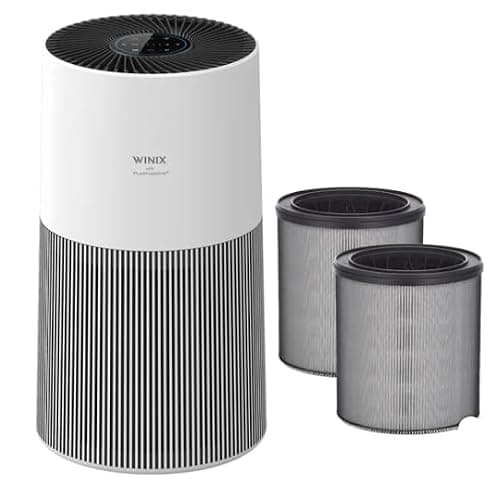 Winix C610A room up to about 384 sq ft where running cost decides it | Best Winix overall | 7.6 | $129.99 - View on Amazon |
| 2 | 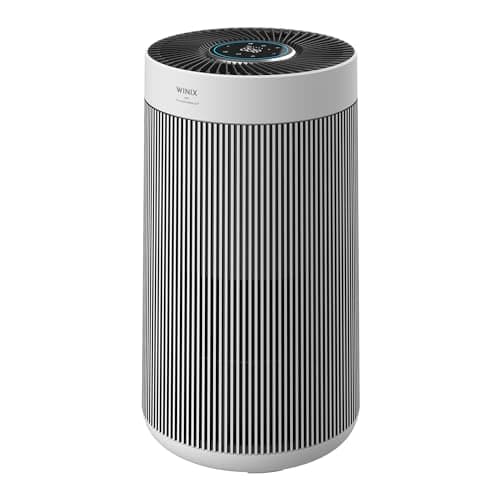 Winix T810The largest room a buyable Winix can honestly cover | Most clean air | 7.8 | $175.99 - View on Amazon |
| 3 | 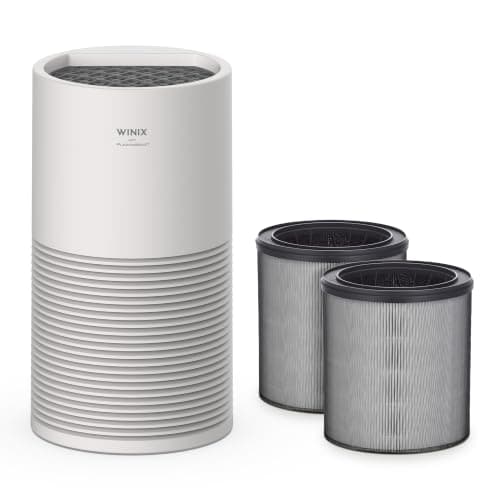 Winix AT40Anyone screening on ozone who has already decided on Winix | The only zero-ozone Winix | 7.7 | $192.92 - View on Amazon |
#1 - Best Winix overall
Winix C610
A room up to about 384 sq ft where running cost decides it
The most efficient air purifier Winix currently has in the ENERGY STAR certified database, and the cheapest of the three to run. The catch is that Winix's own certification filing calls its filter HEPA-Type while its retail page calls it True HEPA.
#ad Price as of October 24, 2026, from Amazon. Prices change. How we make money.
Published specifications
| Specification | Value | Source |
|---|---|---|
| CADR - smoke | 248 CFM | ENERGY STAR certified room air cleaners database (V3.0) |
| CADR - dust / pollen | 252 / 262 CFM | ENERGY STAR certified room air cleaners database (V3.0) |
| Coverage | 384 sq ft at 4.8 air changes/hr - Winix and ENERGY STAR agree exactly | Winix published specification / ENERGY STAR certified database |
| Clean air per watt | 6.26 CFM/W - the highest of the five certified Winix models | ENERGY STAR certified database, smoke CADR per watt |
| Annual energy | 235 kWh/yr - the lowest of the three buyable certified Winix units | ENERGY STAR certified database |
| Ozone emissions | 1.00 ppb certified. Winix separately publishes an 8-hour TWA of 0.33 ppbv in a 30 m3 chamber | ENERGY STAR certified database / Winix published specification |
| Filter type | ENERGY STAR filing says "HEPA-Type"; Winix's own page says "99.99% True HEPA". Both are published - see cons | ENERGY STAR certified database / Winix published specification |
| Filter life | 12 months True HEPA, 12 months activated carbon; ships with two filter sets | Winix published specification |
| Noise | 22 dB minimum; Winix does not publish a maximum | Winix published specification |
| ENERGY STAR Most Efficient | No - and no Winix model meets it | ENERGY STAR certified database |
| Dimensions and weight | 10.42 x 10.42 x 18.54 in, 8.35 lb | Winix published specification |
What it costs to run
About $43 a year in electricity on the certified annual energy figure.
235 kWh/yr certified x 18.34 cents/kWh = $43.10 a year. That is the lowest of the three buyable certified Winix units, and the reason this model ranks first here. Add two filter sets a year at the 12-month interval Winix publishes.
What is good about it
- 6.26 CFM/W is the best clean-air-per-watt figure Winix has certified, and it is a certified figure rather than a marketing one
- 235 kWh/yr is the lowest certified annual energy of the three Winix units you can actually buy
- Winix publishes a 12-month replacement interval for both the HEPA and the carbon stage, which Levoit does not do for the Core 400S
- The 384 sq ft coverage figure is identical in Winix's own AHAM Verifide claim and in the ENERGY STAR record, at the honest 4.8 air changes per hour
- 8.35 lb and under 19 inches tall - the smallest and lightest of the three
What is not
- Winix filed this model with ENERGY STAR as "HEPA-Type" while its own product page advertises "99.99% True HEPA". We cannot tell you which describes the filter in the box, and the distinction is the whole subject of our HEPA page
- 1.00 ppb certified ozone rather than zero, which rules it out if you are screening on ozone for asthma
- PlasmaWave is an ionizing stage and Winix's specification does not state whether it can be switched off on this model
- Winix publishes no wattage, so the only efficiency figures that exist for it are the certified ones - there is nothing to cross-check them against
- Only a minimum noise level is published, so there is no way to know what it does on its top speed
- 6.26 CFM/W is still below the best Levoit (9.26), Coway (10.33) and Blueair (16.08) figures - it is the best Winix, not a class leader
Who should skip this
Skip this if you are screening on ozone, if you specifically need a filter whose grade both sources agree on, or if clean air per watt is your deciding number - three other brands on this site certify substantially better figures.
How it scored
- Clean air per watt6.5
- Published running cost9.0
- Filter transparency4.5
- Ozone5.0
Overall 7.6 / 10. This is our editorial score from published specifications and computed running cost. It is not a test result, and it is deliberately not marked up as a rating in this page’s structured data.
#2 - Most clean air
Winix T810
The largest room a buyable Winix can honestly cover
The most clean air of any Winix you can buy, and the only one whose filter grade both Winix and its ENERGY STAR filing agree on. It is also the highest-ozone model in the brand on both published measures.
#ad Price as of October 24, 2026, from Amazon. Prices change. How we make money.
Published specifications
| Specification | Value | Source |
|---|---|---|
| CADR - smoke | 270 CFM certified; Winix's own page publishes 272 CFM - see cons | ENERGY STAR certified database / Winix published specification |
| CADR - dust / pollen | 272 / 277 CFM certified; Winix publishes 265 / 267 | ENERGY STAR certified database / Winix published specification |
| Coverage | 419 sq ft certified; Winix claims AHAM Verifide at 418 sq ft, both at 4.8 ACH | ENERGY STAR certified database / Winix published specification |
| Clean air per watt | 6.14 CFM/W | ENERGY STAR certified database, smoke CADR per watt |
| Annual energy | 259 kWh/yr | ENERGY STAR certified database |
| Ozone emissions | 1.35 ppb certified - the highest of the five certified Winix models. Winix separately publishes an 8-hour TWA of 0.38 ppbv in a 30 m3 chamber, also its highest | ENERGY STAR certified database / Winix published specification |
| Filter type | HEPA in the ENERGY STAR filing and "99.99% True HEPA" on Winix's page - the two sources agree here, which they do not on the AT40 or C610 | ENERGY STAR certified database / Winix published specification |
| Technology types | The only Winix row that lists "Fan and Filter, PlasmaWave" - the others list Fan and Filter alone | ENERGY STAR certified database |
| Filter life | 12 months True HEPA, 12 months activated carbon | Winix published specification |
| Noise | 23.8 dB minimum; Winix does not publish a maximum | Winix published specification |
| ENERGY STAR Most Efficient | No | ENERGY STAR certified database |
| Dimensions and weight | 11.3 x 11.3 x 20.4 in, 10.2 lb | Winix published specification |
What it costs to run
About $48 a year in electricity on the certified annual energy figure.
259 kWh/yr certified x 18.34 cents/kWh = $47.50 a year. That is about $4 a year more than the C610 for 9% more clean air, which is the trade this model offers. Add two filter sets a year.
What is good about it
- 270 CFM certified smoke CADR is the most clean air of any Winix you can currently buy, and it covers a certified 419 sq ft
- Both sources call the filter true HEPA - the ENERGY STAR filing says "HEPA" and Winix says "99.99% True HEPA" - so unlike the AT40 and C610 there is nothing to reconcile
- It is the one Winix row where the ionizing stage is actually disclosed in the certified technology types, so you know what you are buying
- 6.14 CFM/W is within 2% of the best Winix figure while moving 9% more air than the C610
- Winix publishes a 12-month interval for both consumable stages
What is not
- 1.35 ppb is the highest certified ozone in the Winix range, and Winix's own 8-hour TWA figure of 0.38 ppbv is also its highest - both measures point the same way
- Winix's own product page contradicts the certified CADR figures: it publishes 272 smoke where the certification says 270, and 265 dust where certification says 272
- Winix's page is internally inconsistent on room size too, stating 418 sq ft in the specification table and 410 sq ft in a graphic on the same page
- No wattage and no maximum noise level is published, so there is nothing to cross-check the certified energy figure against
- At 11.3 inches square and 20.4 inches tall it is the largest of the three, and it needs wall clearance as a tower rather than a cylinder
- Not ENERGY STAR Most Efficient, like every other Winix
Who should skip this
Skip this if you are screening on ozone - it is the worst Winix on that measure and our asthma page would route you to a zero-ozone unit instead. Skip it too if you want the cheapest of the three to run.
How it scored
- Clean air delivered8.5
- Clean air per watt6.5
- Filter transparency8.5
- Ozone3.5
Overall 7.8 / 10. This is our editorial score from published specifications and computed running cost. It is not a test result, and it is deliberately not marked up as a rating in this page’s structured data.
#3 - The only zero-ozone Winix
Winix AT40
Anyone screening on ozone who has already decided on Winix
The only Winix in the certified database that reports zero ozone, which is the single reason to choose it. You pay for that with the worst clean air per watt of the three, and its filter grade carries the same HEPA-Type discrepancy as the C610.
#ad Price as of October 24, 2026, from Amazon. Prices change. How we make money.
Published specifications
| Specification | Value | Source |
|---|---|---|
| CADR - smoke | 265 CFM - Winix and ENERGY STAR agree exactly | ENERGY STAR certified database / Winix published specification |
| CADR - dust / pollen | 259 / 244 CFM - both sources agree | ENERGY STAR certified database / Winix published specification |
| Coverage | 411 sq ft certified; Winix claims AHAM Verifide at 410 sq ft, at 4.8 ACH | ENERGY STAR certified database / Winix published specification |
| Clean air per watt | 5.72 CFM/W - the lowest of the three buyable certified Winix units | ENERGY STAR certified database, smoke CADR per watt |
| Annual energy | 272 kWh/yr - the highest of the three | ENERGY STAR certified database |
| Ozone emissions | 0.00 ppb certified - the only zero in the Winix range. Winix separately publishes an 8-hour TWA of 0.12 ppbv in a 30 m3 chamber, also the lowest of the three | ENERGY STAR certified database / Winix published specification |
| Filter type | ENERGY STAR filing says "HEPA-Type"; Winix's own page says "99.999% True HEPA". Both are published - see cons | ENERGY STAR certified database / Winix published specification |
| Technology types | Certified as "Fan and Filter" with no PlasmaWave listed, yet Winix lists PlasmaWave as a feature on its own page. We could not reconcile this - see cons | ENERGY STAR certified database / Winix published specification |
| Filter life | 12 months True HEPA, 12 months activated carbon; ships with two years of filters | Winix published specification |
| Noise | 22.04 dB minimum; Winix does not publish a maximum | Winix published specification |
| Certifications claimed | AHAM, ENERGY STAR V3.0, UL, CARB, Prop 65 | Winix published specification |
| Dimensions and weight | 10.24 x 10.24 x 19 in, 10.2 lb | Winix published specification |
What it costs to run
About $50 a year in electricity on the certified annual energy figure.
272 kWh/yr certified x 18.34 cents/kWh = $49.89 a year. That is roughly $7 a year more than the C610 for 17 CFM more smoke CADR and a zero ozone figure - which is what the zero actually costs on this brand.
What is good about it
- The only Winix in the certified database at 0.00 ppb ozone, and Winix's own 8-hour TWA figure of 0.12 ppbv is the lowest of the three as well - both measures agree
- Every CADR figure matches exactly between Winix's page and the certified record, which is not true of the T810
- Winix lists CARB certification for this model specifically, which is the list the EPA points buyers at
- Ships with two years of filters, so the first replacement cycle is already paid for
- 265 CFM certified smoke CADR for a certified 411 sq ft is genuinely useful coverage
What is not
- 5.72 CFM/W is the worst clean air per watt of the three, and 272 kWh/yr is the highest annual energy - the zero-ozone figure costs you about $7 a year against the C610
- Filed with ENERGY STAR as "HEPA-Type" while Winix advertises "99.999% True HEPA" - the same unresolved discrepancy as the C610
- The certified technology types list no PlasmaWave while Winix's page lists it as a feature. We report both rather than guessing which configuration was tested
- Winix publishes no wattage, so the certified figures are the only efficiency data that exists
- No maximum noise level is published
- Not ENERGY STAR Most Efficient, like every other Winix
Who should skip this
Skip this if running cost is the deciding number - the C610 does 6.26 CFM/W against this unit's 5.72 for less money. And if zero ozone is genuinely your requirement, every one of the 19 certified Coway units reports 0.00 ppb, which is a brand-wide guarantee rather than a single model.
How it scored
- Ozone10.0
- Clean air delivered8.0
- Clean air per watt5.0
- Filter transparency4.5
Overall 7.7 / 10. This is our editorial score from published specifications and computed running cost. It is not a test result, and it is deliberately not marked up as a rating in this page’s structured data.
How we ranked these
We have not tested these units. Nobody here owns one. What we did was compile each manufacturer’s published specifications, check the coverage claims against AHAM’s room-sizing rule, and compute what each one costs to run for a year at the current US average electricity price. Every figure on this page is attributed to whoever published it, and the arithmetic is shown so you can redo it.
How we rank these sets out the full method, including what would change a ranking.
Questions people ask
+−Which Winix air purifier is the best?
+−Is the Winix 5500-2 or 5510 ENERGY STAR certified?
+−Does Winix use a true HEPA filter?
+−Which Winix has no ionizer or ozone?
+−Can PlasmaWave be turned off?
+−Is any Winix ENERGY STAR Most Efficient?
+−How much does a Winix cost to run?
+−Should I buy a Winix or a Coway, Levoit or Blueair?
Sources
- ENERGY STAR Certified Room Air Cleaners V3.0 - the full certified dataset (247 rows, queried 24 October 2026)
- ENERGY STAR - Certified Room Air Cleaners product database
- Winix - C610 Air Purifier specification
- Winix - T810 Air Purifier specification
- Winix - AT40 Air Purifier specification
- AHAM Verifide - Air Filtration Standards (AC-1)
- U.S. Energy Information Administration - Electric Power Monthly, Table 5.6.A