Roundup
Best Honeywell Air Purifiers
Honeywell is the cleanest brand in this category on the specifications that matter - every certified model is true HEPA, zero ozone and filtration only. It is also the brand that proves the ENERGY STAR Most Efficient badge does not mean what buyers think it means.
By Scooter M. · Published · Last updated
How this page is funded: the buy links below are affiliate links. If you buy through one, we earn a commission at no extra cost to you. It does not change the order of the picks or what we say about them. Full disclosure.
The short answer
Buy the HPA4300B. It is the most efficient purifier Honeywell certifies, it is zero-ozone filtration with no ionizing stage, and it does not carry the ENERGY STAR Most Efficient badge - which is the point of this page. All six certified Honeywell models are filed as true HEPA rather than HEPA-Type, all six report 0.00 ppb ozone, and all six are Fan and Filter only. On both counts Honeywell is the cleanest of the five brands we have ranked. But the Most Efficient badge lands on the HPA125B, whose 6.1 efficiency figure is the worst in the brand, while the HPA4300B’s 7.4 - the best - misses out. That is not a mistake. The badge is scored within size class, and we can show you the thresholds.
Honeywell is the clean one, and that is a data point rather than a slogan
We have now run the same query for five brands: pull every row the brand has in the ENERGY STAR certified room air cleaners database, and compare. Honeywell comes out of that comparison better than any of the others on the specifications that are hardest to fake:
| Brand | Certified | Zero ozone | Filed as HEPA-Type | Has a non-filter stage |
|---|---|---|---|---|
| Honeywell | 6 | 6 of 6 | 0 of 6 | 0 of 6 |
| Coway | 19 rows | 19 of 19 | 16 of 19 | 0 of 19 |
| Levoit | 10 | 8 of 10 | 7 of 10 | 0 of 10 |
| Winix | 5 | 1 of 5 | 3 of 5 | 1 of 5 |
| Blueair | 20 | 0 of 20 | 19 of 20 | 5 of 20 |
Read the third and fourth columns together, because that is the pair that matters. Coway matches Honeywell on ozone - every certified Coway is 0.00 ppb - but 16 of its 19 rows are filed as HEPA-Type, the unregulated wording we spend a whole page on in HEPA filters explained. Blueair is the efficiency leader in this category and not one of its 20 certified models reports zero ozone. Honeywell is the only brand of the five where every certified model is true HEPA, zero ozone and filtration only.
Honeywell’s own manual is equally plain about what is inside: a “3-in-1 HEPA Filter with Bonus 4th Layer Pre-Filter”, whose layers it lists as an outer pre-filter for “hair, dust, and pet fur” that is “removable, reusable, and vacuumable”, a second pre-filter, a “Genuine HEPA Filter”, and an activated carbon layer that “Helps reduce common household odors”. No ionizer, no plasma, no lamp.
Now the badge problem, which is the real finding
Here is Honeywell’s certified range sorted by efficiency. The badge column is the one to look at:
| Model | IEF (CFM/W) | PM2.5 CADR | Certified room | Annual energy | Most Efficient? |
|---|---|---|---|---|---|
| HPA4300B | 7.4 - best in brand | 233 CFM | 355 sq ft | 185 kWh (about $34) | No |
| HPA6000B | 7.3 | 259 CFM | 398 sq ft | 207 kWh (about $38) | No |
| HPA4100B | 6.9 | 113 CFM | 169 sq ft | 95 kWh (about $17) | Yes |
| HPA4200B | 6.3 | 148 CFM | 223 sq ft | 137 kWh (about $25) | No |
| HPA125B | 6.1 - worst in brand | 75 CFM | 110 sq ft | 72 kWh (about $13) | Yes |
| HPA120*** | 6.1 | 75 CFM | 110 sq ft | 72 kWh (about $13) | Yes |
The two most efficient models in the brand have no badge. The two leastefficient do. If you shopped this range by looking for the Most Efficient logo, you would buy a 6.1 and skip a 7.4 - and pay more per unit of clean air for the privilege.
| PM2.5 CADR band | Models | Qualifiers | Lowest IEF that qualified | Highest IEF that did NOT |
|---|---|---|---|---|
| Under 100 CFM | 47 | 34 | 5.40 | 5.30 |
| 100 - 150 | 48 | 18 | 6.60 | 6.50 |
| 150 - 200 | 37 | 2 | 8.60 | 8.40 |
| 200 - 300 | 45 | 3 | 8.80 | 8.40 |
| 300 - 450 | 61 | 8 | 8.80 | 7.90 |
| Over 450 | 9 | 4 | 10.20 | 7.80 |
The bar nearly doubles from one end of the range to the other: a small unit can earn the badge at 5.40, while a large one needs 10.20. And in every band the gap between the worst qualifier and the best non-qualifier is a tenth or two, which is the signature of a threshold rather than a judgment.
Run Honeywell through that and every oddity resolves. The HPA125B’s 6.1 sits in the under-100 band where 5.40 is enough, so it qualifies. The HPA4100B’s 6.9 clears the 6.60 bar for the 100-150 band, so it qualifies. The HPA4200B’s 6.3 is in the same band and misses by three tenths. And the HPA4300B’s 7.4 - the best figure in the brand - lands in the 200-300 band where qualifiers start at 8.80, so it fails by a mile. Same brand, same filter technology, same zero ozone. Different size classes.
This is the same structure we documented for dehumidifiers on energy efficient dehumidifiers, where the Most Efficient thresholds are set within capacity class and there is no qualifying model at all in the 26-35 pint band. It is worth knowing that the pattern holds for air cleaners too, because the badge is on far more purifier listings than dehumidifier ones.
How we ranked the three below
- Certified efficiency, on IEF and on this site’s usual smoke CADR per watt. Both put the HPA4300B first in the brand.
- Certified smoke CADR and the room it honestly covers at 4.8 air changes per hour - the basis explained on CADR explained, not the one-air-change figure on the box.
- Whether the unit can actually be bought. This narrowed the field hard, and the next section explains how far.
- Zero ozone and no ionizing stage, which on Honeywell is every model, so it separates nothing within the brand and a great deal outside it.
We have not tested any of these units. Every figure is from the certified database, from Honeywell’s own manual, or from the product listing, and each spec row says which.
The availability problem, stated plainly
Of the six certified models we could verify purchasable listings for only two: the HPA4300B and the HPA125B. We searched for each certified model number through the retail catalog and found no listing naming the HPA4100B, the HPA4200B, the HPA6000B or the HPA120 series. They may be sold somewhere; we are not going to recommend a machine we could not confirm you can buy.
That is a shame mostly because of the HPA4100B, which is the one Honeywell whose badge is genuinely earned on competitive footing - 6.9 IEF against a 6.60 bar in its band - and the only one where the logo and the efficiency point the same way.
The mirror image of that problem is also worth naming. The Honeywell purifiers that are everywhere in the listings - the HPA300, HPA304, HPA3100, HPA5100W and HPA5300B - appear nowhere in the certified database. The classic HPA300 in particular is one of the best-known air purifiers in America and has no certified efficiency, annual energy or ozone figure at all. That is the same pattern we found on the Winix page, where none of the best-selling models is certified either. It is becoming the rule rather than the exception in this category.
One more duplicate worth flagging: HPA120*** and HPA125** certify identically on every single measure - same 71/79/79 CADR, same 110 sq ft, same 6.1 IEF, same 72 kWh, same 0.00 ppb. Two model families, one machine. The HPA125B is the one we found on sale.
The one thing Honeywell does not sell you
Not one of the six certified Honeywell models is connected-capable. No Wi-Fi, no app, and on the HPA125B no automatic mode either - its certified record lists automatic mode as “None”. Against Winix at 5 of 5 connected, Levoit at 7 of 10 and Blueair at 11 of 20, Honeywell is the brand that has largely stayed out of it.
Whether that is a loss depends on something we worked through separately: on a purifier the app is close to irrelevant and the auto mode is the feature that matters, because a sensor deciding your fan speed is deciding your electricity bill. The HPA4300B does have a particle sensor and auto mode with a color-coded display - Honeywell’s manual notes the real-time indicator is “HPA4200/4300 SERIES ONLY” - so you get the part that counts without the part that does not. Do you need a smart air purifier has the arithmetic.
What we would actually buy
The HPA4300B, for any room up to its certified 355 sq ft. It is the most efficient machine Honeywell certifies on both metrics, about $34 a year to run, zero certified ozone, filtration only, filed as true HEPA, and Honeywell publishes both the filter part number and its interval - HRFY3 every 9-12 months, with the pre-filters vacuumed every three months. The absence of a Most Efficient badge is the strongest reason to trust it rather than a reason to doubt it.
The HPA125B, but only for a desk or a nightstand. At about $13 a year it is the cheapest certified purifier to run on this entire site - though that is because it is small rather than because it is efficient, and per unit of clean air it is the least efficient Honeywell. 110 sq ft certified is the honest ceiling. Note that we could not verify a filter interval for it: Honeywell’s documentation for this series returned a 403 on every attempt, so we are leaving that figure blank rather than estimating it.
The Coway Airmega 350, if your room is bigger than Honeywell can serve. Honeywell’s certified range stops at 398 sq ft and we could not buy that model; the Airmega 350 is certified at 360 CFM smoke CADR over 558 sq ft at 0.00 ppb ozone, and it is purchasable. It is not a Honeywell and it is not Most Efficient either - 6.12 smoke CFM/W and 344 kWh a year, which is about $63 - but it covers 200 sq ft more than anything in this brand’s buyable range. The Coway roundup has the rest of that range.
Quick picks
Ranked on published specifications and computed running cost. Tap any row for the full write-up, including who should skip it.
| # | Product | Best for | Score | Price |
|---|---|---|---|---|
| 1 | 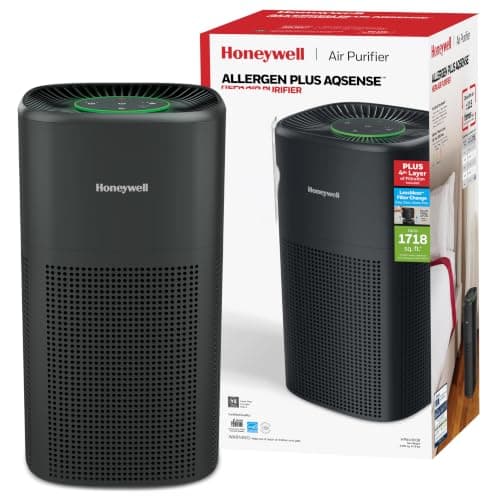 Honeywell HPA4300B Allergen PlusA room up to about 355 sq ft, with no ionizing stage to switch off | Best Honeywell overall | 8.3 | $159.17 - View on Amazon |
| 2 | 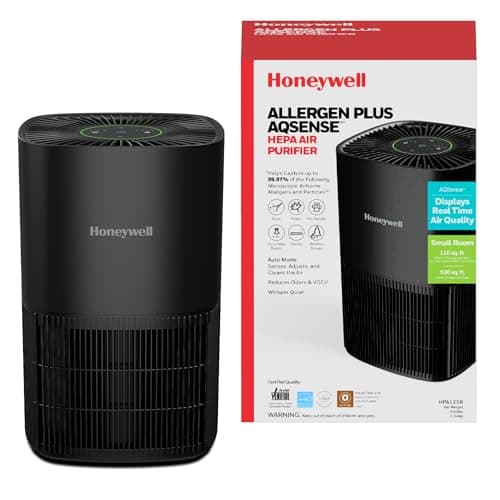 Honeywell HPA125B Allergen Plus TabletopA nightstand, a desk or a small bedroom under about 110 sq ft | Best for a desk or nightstand | 7.2 | $99.99 - View on Amazon |
| 3 | 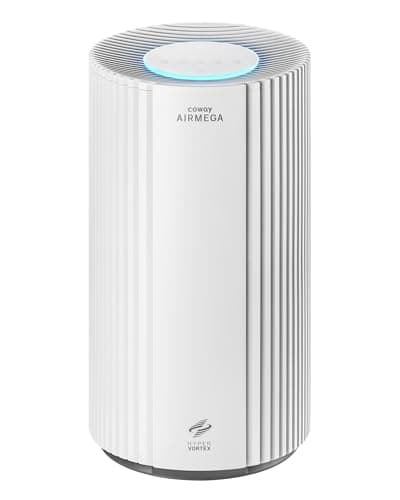 Coway Airmega 350A living room or open-plan space up to about 558 sq ft | The room Honeywell cannot reach | 8.4 | $339.00 - View on Amazon |
#1 - Best Honeywell overall
Honeywell HPA4300B Allergen Plus
A room up to about 355 sq ft, with no ionizing stage to switch off
The most efficient air purifier Honeywell has certified, and the cheapest of its certified range to run for the air it moves. It does NOT carry the ENERGY STAR Most Efficient badge, and the reason is the most useful thing on this page.
#ad Price as of October 24, 2026, from Amazon. Prices change. How we make money.
Published specifications
| Specification | Value | Source |
|---|---|---|
| CADR - smoke | 229 CFM | ENERGY STAR certified room air cleaners database (V3.0) |
| CADR - dust / pollen | 238 / 245 CFM | ENERGY STAR certified room air cleaners database (V3.0) |
| CADR - PM2.5 | 233 CFM - the figure the ENERGY STAR badge is actually scored on | ENERGY STAR certified room air cleaners database (V3.0) |
| Coverage | 355 sq ft certified at 4.8 air changes/hr. The listing advertises 1,718 sq ft, which is the same machine at one air change per hour | ENERGY STAR certified database / product listing |
| Integrated Energy Factor | 7.4 CFM/W - the highest of the six certified Honeywell models | ENERGY STAR certified database |
| Clean air per watt (smoke) | 7.39 CFM/W - also the highest in the brand on this site's usual metric | ENERGY STAR certified database, smoke CADR per watt |
| Annual energy | 185 kWh/yr | ENERGY STAR certified database |
| Ozone emissions | 0.00 ppb - as is every certified Honeywell | ENERGY STAR certified database |
| ENERGY STAR Most Efficient | No - despite being the most efficient Honeywell. Thresholds are set within size class; see cons | ENERGY STAR certified database |
| Filter type | Filed as HEPA, not HEPA-Type. Honeywell's manual calls the stage a "Genuine HEPA Filter" inside a 3-in-1 cartridge with a bonus 4th outer pre-filter | ENERGY STAR certified database / Honeywell HPA4000 Series owner's manual |
| Filter life | Replace the 3-in-1 main filter (part HRFY3) every 9-12 months; vacuum the pre-filters every 3 months. Other layers cannot be cleaned | Honeywell HPA4000 Series owner's manual |
| Technology types | Fan and Filter only - no ionizer, no plasma stage, no UV lamp | ENERGY STAR certified database |
| Sensor and connectivity | AQSense particle sensor with auto mode and a color-coded real-time air quality display (HPA4200/4300 series only). No Wi-Fi | Honeywell HPA4000 Series owner's manual / ENERGY STAR certified database |
What it costs to run
About $34 a year in electricity on the certified annual energy figure.
185 kWh/yr certified x 18.34 cents/kWh = $33.93 a year. Add one HRFY3 cartridge every 9-12 months at Honeywell's published interval. The pre-filter vacuuming is free and is what keeps the cartridge on schedule.
What is good about it
- The best clean-air-per-watt figure in Honeywell's certified range on both metrics - 7.4 IEF and 7.39 smoke CFM/W - and it is a certified figure rather than a marketing one
- 185 kWh/yr works out to about $34 a year, which is low for 229 CFM of smoke CADR
- 0.00 ppb certified ozone, and the certified technology types are Fan and Filter only - there is no ionizing stage to find and switch off
- Filed with ENERGY STAR as HEPA rather than HEPA-Type, which is not true of most of this category
- Honeywell publishes a filter part number and interval (HRFY3, every 9-12 months) plus a 3-month pre-filter vacuum schedule, so the consumable cost is knowable before you buy
- A vacuumable outer pre-filter means hair and coarse dust do not load the expensive cartridge directly
What is not
- It does NOT carry ENERGY STAR Most Efficient even though it is the most efficient Honeywell. The badge is scored within size class, so this unit's 7.4 IEF misses the bar for its 233 PM2.5 CADR band while a 6.1 IEF Honeywell half its size qualifies. The badge is not a comparison you can make across sizes
- The listing advertises 1,718 sq ft against a certified 355 sq ft. Both numbers are real; only the smaller one is at a useful air-change rate
- At 229 CFM smoke CADR it is mid-range, not a large-room machine - Honeywell's certified range tops out at 398 sq ft and nothing in it reaches an open-plan floor
- No Wi-Fi and no app, so no runtime-based filter reminder beyond the unit's own reset light
- Honeywell does not publish a noise figure or a wattage we could retrieve, so the certified energy figure is the only power data that exists for it
- The 3-in-1 design means the HEPA and carbon layers are replaced together on the same schedule, even if only one is spent
Who should skip this
Skip this if the room is over about 355 sq ft - no certified Honeywell covers an open-plan space, and a Coway or Levoit does. Skip it too if you are shopping by the Most Efficient badge, because this unit does not have one and is nonetheless the most efficient machine Honeywell certifies.
How it scored
- Clean air per watt8.0
- Ozone10.0
- Filter transparency9.0
- Room coverage ceiling6.0
Overall 8.3 / 10. This is our editorial score from published specifications and computed running cost. It is not a test result, and it is deliberately not marked up as a rating in this page’s structured data.
#2 - Best for a desk or nightstand
Honeywell HPA125B Allergen Plus Tabletop
A nightstand, a desk or a small bedroom under about 110 sq ft
A genuinely cheap-to-run tabletop unit at about $13 a year, zero certified ozone and no ionizing stage. It carries the ENERGY STAR Most Efficient badge while having the WORST efficiency figure in Honeywell's certified range, which tells you exactly what that badge means.
#ad Price as of October 24, 2026, from Amazon. Prices change. How we make money.
Published specifications
| Specification | Value | Source |
|---|---|---|
| CADR - smoke | 71 CFM | ENERGY STAR certified room air cleaners database (V3.0) |
| CADR - dust / pollen | 79 / 79 CFM | ENERGY STAR certified room air cleaners database (V3.0) |
| CADR - PM2.5 | 75 CFM - the figure the ENERGY STAR badge is scored on | ENERGY STAR certified room air cleaners database (V3.0) |
| Coverage | 110 sq ft certified at 4.8 air changes/hr. The listing advertises 530 sq ft, which is the same machine at one air change per hour | ENERGY STAR certified database / product listing |
| Integrated Energy Factor | 6.1 CFM/W - the LOWEST of the six certified Honeywell models | ENERGY STAR certified database |
| Clean air per watt (smoke) | 5.82 CFM/W - also the lowest in the brand on this site's usual metric | ENERGY STAR certified database, smoke CADR per watt |
| Annual energy | 72 kWh/yr - the lowest in the brand, because it is the smallest machine | ENERGY STAR certified database |
| Ozone emissions | 0.00 ppb | ENERGY STAR certified database |
| ENERGY STAR Most Efficient | Yes - awarded on a 6.1 IEF, where the brand's 7.4 IEF model misses out. Size class, not efficiency; see cons | ENERGY STAR certified database |
| Filter type | Filed as HEPA, not HEPA-Type. The listing describes a 3-in-1 filter | ENERGY STAR certified database / product listing |
| Filter life | Not quoted. Honeywell's documentation for this series returned HTTP 403 on every attempt, so we could not verify an interval and will not estimate one | Honeywell documentation unavailable - see cons |
| Technology types | Fan and Filter only - no ionizer, no plasma stage, no UV lamp | ENERGY STAR certified database |
| Sensor and connectivity | Automatic mode listed as "None", and not connected-capable. This is a manual-speed machine | ENERGY STAR certified database |
| Identical certified twin | HPA120*** certifies identically on every measure - same 71/79/79 CADR, same 110 sq ft, same 6.1 IEF, same 72 kWh. Two model families, one machine | ENERGY STAR certified database |
What it costs to run
About $13 a year in electricity on the certified annual energy figure.
72 kWh/yr certified x 18.34 cents/kWh = $13.20 a year. That is the lowest certified running cost of any purifier on this site - but it is low because the machine is small, not because it is efficient. Per unit of clean air it is the least efficient Honeywell. Filter cost is unknown to us, because Honeywell's documentation for this series was not retrievable.
What is good about it
- About $13 a year to run on the certified figure, which is the cheapest certified purifier running cost on this site
- 0.00 ppb certified ozone and Fan and Filter only - nothing is added to the air and there is no stage to disable
- Filed as HEPA rather than HEPA-Type
- Genuinely small, and 110 sq ft certified is honest coverage for a nightstand or desk rather than a room claim it cannot meet
- The certified 110 sq ft and the listing's 530 sq ft reconcile exactly at 4.8 air changes per hour, so the marketing figure is inflated in the standard way rather than in an unusual one
What is not
- The Most Efficient badge on this unit is NOT a statement that it is efficient. It has the worst IEF in Honeywell's range at 6.1, against 7.4 for the HPA4300B which has no badge, and it qualifies only because the threshold for its small size class is lower. Buying it because of the badge is the mistake this page exists to prevent
- 71 CFM smoke CADR is small. At AHAM's two-thirds rule that is a room of about 110 sq ft and no more - it will not do a living room
- No auto mode and no sensor: the certified record lists automatic mode as None, so you set the speed yourself
- We could not verify a filter replacement interval. Honeywell's own pages and series manuals for this model returned 403, so the consumable schedule is unknown to us and we are not going to invent one
- No Wi-Fi, no app, no filter-life tracking beyond whatever is on the unit
- Honeywell does not publish a noise figure we could retrieve, which matters for a unit designed to sit on a nightstand
Who should skip this
Skip this for any real room. It is a 110 sq ft machine and the honest use is a desk or a nightstand. And skip it if the Most Efficient badge is why you were considering it, because the badge reflects its size class rather than its efficiency.
How it scored
- Ozone10.0
- Running cost in absolute terms9.5
- Clean air per watt5.0
- Published filter schedule2.0
Overall 7.2 / 10. This is our editorial score from published specifications and computed running cost. It is not a test result, and it is deliberately not marked up as a rating in this page’s structured data.
#3 - The room Honeywell cannot reach
Coway Airmega 350
A living room or open-plan space up to about 558 sq ft
The sensible Coway. 360 CFM of certified smoke CADR for a 558 sq ft room at 0.00 ppb ozone, and it beats the Airmega 400 on clean air per watt while costing roughly half as much. The headline coverage figure on the box is about five times the usable one.
#ad Price as of October 24, 2026, from Amazon. Prices change. How we make money.
Published specifications
| Specification | Value | Source |
|---|---|---|
| CADR - smoke | 352 CFM | Coway published specification |
| CADR - dust | 376 CFM | Coway published specification |
| CADR - pollen | 450 CFM | Coway published specification |
| Coverage | 2,640 sq ft at 1 air change/hr; 1,320 sq ft at 2 air changes/hr | Coway published specification |
| CADR (federal certification) - smoke / dust / pollen | 360 / 376 / 450 CFM at 558 sq ft | ENERGY STAR certified room air cleaners database |
| Clean air per watt | 6.12 CFM/W | ENERGY STAR certified room air cleaners database |
| Annual energy use | 344 kWh/yr | ENERGY STAR certified room air cleaners database |
| Ozone emissions | 0.00 ppb | ENERGY STAR certified room air cleaners database |
| Rated power | 62 W | Coway published specification |
| Noise | 21.5 to 54.7 dB(A) | Coway published specification |
| Filtration | Vacuumable pre-filter + HEPA + activated carbon, as one 3-in-1 cartridge; three variants (Fresh Starter+, Allergen+, Intense Smoke+) fit the same chassis | Coway published specification |
| Filter replacement | 1+ year on the 3-in-1 custom filter set | Coway published specification |
| Dimensions and weight | 12 x 12 x 23 in, 17.19 lb | Coway published specification |
What it costs to run
About $63 a year on ENERGY STAR's certified annual energy figure.
ENERGY STAR publishes 344 kWh a year for this model. At 18.34 cents/kWh that is $63.09 a year. Coway's own 62 W rating cross-checks it: 62 W / 1000 x 24 hours x 365 = 543 kWh at full power, so the certified figure implies it spends most of its time well below the rated draw. Per square foot covered that is 0.616 kWh a year, against the Airmega ProX at 0.375.
What is good about it
- Certified 0.00 ppb ozone, like every other certified Coway - there is no ionizing stage to switch off because there is no ionizing stage
- 6.12 CFM/W beats the more expensive Airmega 400 at 6.02, and uses 22 fewer kWh a year doing it
- 360 CFM of certified smoke CADR genuinely covers 558 sq ft at the 4.8 air changes an hour AHAM uses
- Three interchangeable 3-in-1 cartridges fit the same body, so the unit can be re-aimed at smoke or allergens without replacing it
- 21.5 dB at its lowest setting is quiet enough for a room you sleep in
- A published filter interval of a year or more, which makes the annual cost computable
What is not
- 344 kWh a year is about $63 - more than double what a Blueair of similar coverage needs, because Coway buys its zero ozone with a denser filter and a harder-working fan
- Coway's published smoke CADR (352 CFM) and the federal certification (360 CFM) disagree slightly, so two official numbers exist for the same machine
- The listing leads with 2,640 sq ft, which is the one-air-change-per-hour figure and about five times the certified 558 sq ft
- Even Coway's own second figure - 1,320 sq ft at 2 air changes - is more than double the certified coverage
- Not ENERGY STAR Most Efficient. Only 3 of Coway's 14 certified models are, and this is not one of them
- The pre-filter, HEPA and carbon are a single cartridge, so a saturated carbon layer means replacing the HEPA too
- 62 W is a lot of fan for the output compared with electrostatic designs, and the running cost reflects that
Who should skip this
Skip this if the room is under about 250 sq ft - the Airmega 50 costs a quarter as much and covers it. Skip it if annual running cost is the deciding factor, because an electrostatic design will roughly halve it, though not at 0.00 ppb ozone.
How it scored
- No ozone-producing stage10.0
- Room size covered8.5
- Clean air per watt6.0
- Honest coverage labeling4.0
Overall 8.4 / 10. This is our editorial score from published specifications and computed running cost. It is not a test result, and it is deliberately not marked up as a rating in this page’s structured data.
How we ranked these
We have not tested these units. Nobody here owns one. What we did was compile each manufacturer’s published specifications, check the coverage claims against AHAM’s room-sizing rule, and compute what each one costs to run for a year at the current US average electricity price. Every figure on this page is attributed to whoever published it, and the arithmetic is shown so you can redo it.
How we rank these sets out the full method, including what would change a ranking.
Questions people ask
+−Which Honeywell air purifier is the best?
+−Does ENERGY STAR Most Efficient mean an air purifier is more efficient?
+−Is the Honeywell HPA300 ENERGY STAR certified?
+−Do Honeywell air purifiers use a true HEPA filter?
+−Do Honeywell air purifiers have an ionizer or produce ozone?
+−How often do you change a Honeywell air purifier filter?
+−Does any Honeywell air purifier have Wi-Fi or an app?
+−How big a room will a Honeywell air purifier cover?
Sources
- ENERGY STAR Certified Room Air Cleaners V3.0 - the full certified dataset (247 rows, queried 24 October 2026)
- Honeywell - HPA4000 Series air purifier owner's manual (HPA4100 / HPA4200 / HPA4300 series, Kaz Incorporated)
- ENERGY STAR - Most Efficient (the stricter tier above basic certification)
- ENERGY STAR - Certified Room Air Cleaners product database
- Coway - Airmega 350 specification
- AHAM Verifide - Air Filtration Standards (AC-1)
- U.S. Energy Information Administration - Electric Power Monthly, Table 5.6.A