Guide
Will a Humidifier Stop Static Shocks?
Static is the one dry-air symptom you can feel the instant it starts, and the only one this site treats as a free measuring instrument. Here is what raising the humidity actually fixes, and the one thing people buy a humidifier for that it will not do.
By Scooter M. · Published · Last updated
How this page is funded: the buy links below are affiliate links. If you buy through one, we earn a commission at no extra cost to you. It does not change the order of the picks or what we say about them. Full disclosure.
The short answer
Yes for the shocks you feel. Get the floor you actually walk around into the EPA’s 30-50% band and household static largely stops; below 30% it gets noticeably worse. Because static happens at every door handle rather than in one room, this is the dry-air problem where you size for the floor and not the bedroom - our pick is the Levoit Superior 6000S, an evaporative unit that physically cannot overshoot, with the OasisMist 1000S if it is really one room. Buy a hygrometer first. And one thing we will not sell you: a humidifier is not electronics protection. The standards body that exists to control static says plainly that humidity control is not an ANSI/ESD S20.20 requirement.
The part everybody gets right
Static shocks are seasonal, and the reason is the same single fact that drives this whole hub: cold air holds very little moisture, so heating it collapses the relative humidity. That is why the shocks arrive within a few weeks of the heating going on and vanish in spring, and why they are worse in a cold snap than in a mild November.
This site already treats static as the most useful free instrument you own. If you are getting zapped by door handles, you have been told something about your indoor humidity without paying for a reading - which is exactly why why is my house so dry lists it first among the tells. The practical consequence is simple: get the number back into the EPA’s stated band of 30 to 50 percent relative humidity and the problem mostly goes away.
| Reading | What to expect | What to do |
|---|---|---|
| Under 25% | Shocks from door handles, the car, the cat, and clothes clinging out of the dryer. This is the range where static is a daily nuisance | A humidifier has real work to do - size it for the floor |
| 25 to 30% | Intermittent shocks, worse on the coldest days and on synthetic carpet | Free fixes first; a humidifier if the number will not lift |
| 30 to 50% | Static is not normally a complaint in this band. If you are still being shocked, the humidity is not your variable | Look at flooring and footwear below. Or check which device, if any |
| Above 50% | Static will not be your problem. Something else may be | Bring it down instead |
The part almost every page gets wrong
The usual explanation is that a film of adsorbed water raises surface conductivity so charge bleeds away instead of building up. It is plausible, it is everywhere, and it is less settled than the confidence suggests.
A 2022 experimental study of triboelectric charging in particle-laden duct flows measured the relationship directly and found it was not a straight line: the electrostatic charge “first increases with the humidity and then decreases when the humidity becomes higher”. We want to be precise about what that is and is not. It is an industrial experiment pushing PMMA particles through a duct, not a measurement of a living room, and we are not going to pretend otherwise. What it establishes is narrower and still useful: “more humidity always means less static” is not a law of nature, and in the research literature the direction depends on the materials and the humidity range.
So the honest position is the one this site takes everywhere: we will state the observation, which is solid and which you can confirm yourself in a week with a hygrometer, and decline to assert a mechanism that the people who study it have not settled. A dry house in winter produces static shocks. Bringing it into the healthy band stops them. Why, in detail, is a harder question than it looks.
If you are trying to protect electronics, we are the wrong shop
This is worth saying plainly because it is a common reason people search for a humidifier in the first place. The things that actually control electrostatic discharge around electronics are grounding and dissipative materials: a grounded mat, a wrist strap, dissipative flooring and footwear, and handling procedures. Those are what S20.20 is about, and they work at 12% humidity precisely because they do not depend on the air.
We do not sell any of that and we are not going to pretend a humidifier substitutes for it. If you build PCs, reseat RAM or handle bare components, buy the grounding kit and treat room humidity as a comfort decision made separately. If you simply dislike being zapped by the fridge door, carry on - the rest of this page is for you.
The free fixes, which matter more here than on any other page in this hub
On dry skin or a dry throat the room is most of the story. With static, a large part of the charge is being generated by what you are walking on and what you are wearing, and those are free to change:
- Footwear. Rubber and synthetic soles insulate you from the floor so charge has nowhere to go until you touch metal. Leather soles, or going barefoot on a hard floor, change the outcome without touching the humidity.
- Flooring. Synthetic carpet is the generator in most houses. You are unlikely to replace it for this, but it does explain why one room is worse than the rest and why the hallway is where you get caught.
- Discharge through an object. Touch the door frame or the car with a key or a coin first. The spark still happens; it just does not happen through your fingertip. This costs nothing and it is the single most effective trick on the page.
- Stop exporting moisture you already made. Run the bathroom extractor long enough to clear the steam and then stop. In winter that moisture is worth keeping.
- Seal the drafts. Every cubic foot of cold air you pull in has to be heated, and heating it is what dries it. Drafty houses are dry houses, and this fix has no running cost.
Why static is a whole-floor problem when the other symptoms are not
This is the part that changes the purchase, and it is why our picks here differ from the ones on dry skin or dry eyes.
Those are exposure problems: your skin is dry where you sit, your eyes are dry at the desk or overnight, and treating that one room is both cheaper and more effective than treating the house. Static is not like that. You get shocked at the front door, on the stairs, at the fridge, getting out of the car. The charge builds as you move across floors, so a humidifier doing excellent work in a closed bedroom will not stop you being zapped in the hall.
So size for the floor you move through rather than the room you sleep in - which means output, not the square-footage claim on the box. The method is on what size humidifier do I need, and the honest summary is that one unit will not hold several closed rooms at target whatever the packaging says, because a shut door is effectively a wall to humidity.
Which humidifier, and the one feature that matters here
Because the static fix wants a sustained level across a floor in the coldest part of the year - which is exactly when the windows are least forgiving - the feature that matters is whether the unit can overshoot.
An evaporative unit passes air over a wet wick, and evaporation slows on its own as a space approaches its capacity. It physically cannot push a floor past what the building can carry, and the minerals in your water stay in the wick instead of settling on every surface as white dust. For a whole-floor job in January that self-limiting behavior is the whole argument, and it is why our first pick is an evaporative machine rather than the one with the biggest claimed coverage.
An ultrasonic unit is quieter and will run for days on a fill, which is a genuine advantage if the problem is really one large room. It will keep misting into an already-damp space unless it has a humidity sensor holding a setpoint, so pick one that does, and use distilled water or accept the dust. Warm mist adds nothing for static specifically and is the most expensive thing in the category to run - the comparison is here.
What a humidifier will not do
- It will not protect your electronics, for the reasons in the callout above. That is a grounding problem and humidity is the weakest available lever.
- It will not beat your flooring and footwear if the humidity is already in band. A room reading 45% that still shocks you is telling you the charge is coming from the floor.
- It will not fix a hall from inside a bedroom. A shut door is a wall to humidity, and static is generated wherever you walk.
- It cannot run high enough in a hard freeze with single glazing to end the problem without wetting the windows. That is a window constraint, not a machine constraint.
- It will create a worse problem if you overshoot. Above the top of the band you have traded static for condensation, dust mites and mold - and the EPA’s ceiling of 60 percent exists for that reason.
- It will become its own problem if you do not clean it. A neglected tank in a room you occupy is the subject of humidifier mold and cleaning, and the routine is not optional.
What we would actually do
Put a logging hygrometer in the hallway or living room - the space you move through, not a closed bedroom - and leave it a few days. Under 30% and a humidifier is a reasonable purchase, sized for the floor and ideally evaporative so it cannot overshoot while the windows are cold. Between 30 and 50% and the humidity is not your variable: change your shoes, carry a key to touch metal with, and save the money.
And if the reason you searched for this was a computer rather than a doorknob, buy the grounding kit instead. That is the recommendation the static-control standard actually supports, and it is the one we would give even though we do not sell it.
What we would buy for this
Chosen from the same registry as our roundups, on published specifications and computed running cost.
Levoit Superior 6000S
Whole floors, and anyone tired of refilling
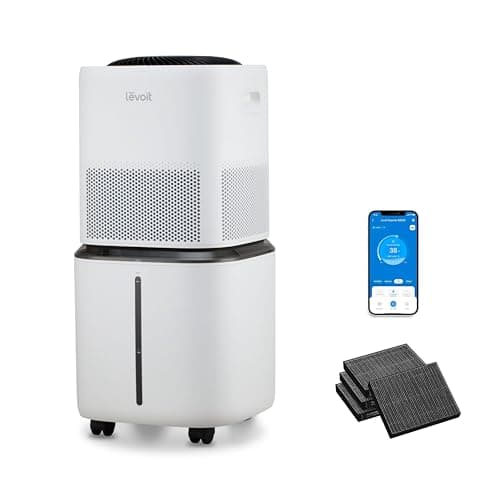
A 6-gallon evaporative unit at 30 W. If you have spent a winter refilling a small humidifier twice a day, this is the one that ends that.
#ad Price as of October 30, 2026, from Amazon. Prices change. How we make money.
Published specifications
| Specification | Value | Source |
|---|---|---|
| Tank capacity | 6 gal / 22.7 L | Levoit published specification |
| Coverage | 3,000 sq ft | Levoit published specification |
| Rated power | 30 W | Levoit published specification |
| Run time | Up to 72 hours on the low fan setting | Levoit published specification |
| Max output | 1,500 mL/h | Levoit published specification |
What it costs to run
About $12-13 a year in electricity across a heating season at 12 hours a day.
30 W / 1000 x 12 hours x 365 days = 131.4 kWh = $24.10 a year run year-round, so roughly $12-13 across a six-month heating season. On any evaporative unit the filters, not the electricity, are the larger cost.
What is good about it
- 30 W against 3,000 sq ft of claimed coverage is the best power-to-output ratio of any humidifier we list
- Evaporative, so it self-limits the same way the Honeywell does - it will not flood a room
- 72 hours per fill means refilling twice a week rather than twice a day
What is not
- It is a large object and it looks like one
- The 3,000 sq ft coverage claim assumes air moves freely between those rooms, which in a real house with doors it does not
Who should skip this
Skip this if you only need one bedroom humidified. A 6-gallon tank in a 120 sq ft room is a lot of standing water to keep clean for no additional benefit.
How it scored
- Cannot over-humidify10.0
- Refill interval9.5
- Power efficiency9.5
- Cleaning burden6.5
Overall 8.6 / 10. This is our editorial score from published specifications and computed running cost. It is not a test result, and it is deliberately not marked up as a rating in this page’s structured data.
Levoit OasisMist 1000S
A bedroom or office you want to refill once a week, not an open-plan floor
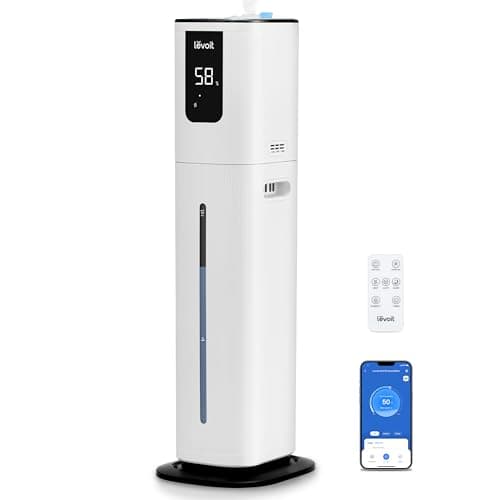
A 10-liter tower that runs up to 100 hours on low. Read that carefully: the long run time comes from a low sustained output, which makes it a superb refill interval and a weak large-room humidifier.
#ad Price as of October 30, 2026, from Amazon. Prices change. How we make money.
Published specifications
| Specification | Value | Source |
|---|---|---|
| Tank capacity | 2.6 gal / 10 L | Levoit published specification |
| Coverage | 300-600 sq ft | Levoit published specification |
| Rated power | 27.5 W | Levoit published specification |
| Noise | Under 28 dB | Levoit published specification |
| Run time | Up to 100 hours on the low mist setting | Levoit published specification |
| Type | Ultrasonic, cool mist only, with a humidity sensor and auto mode | Levoit published specification |
| Dimensions | 8.4 x 10.0 x 28.7 in | Levoit published specification |
What it costs to run
About $22 a year in electricity at 12 hours a day.
27.5 W / 1000 x 12 hours x 365 days = 120.5 kWh. At 18.34 cents/kWh that is $22.09 a year at rated power, and less on the low mist setting most people would actually use. Add distilled water if your tap water is hard, which for an ultrasonic unit is the real recurring cost.
What is good about it
- 27.5 W is the lowest rated power of any humidifier we carry, so it is cheap to leave running
- A humidity sensor with auto mode means it can hold a setpoint rather than misting blindly, which partly offsets the usual ultrasonic weakness
- Under 28 dB and a tall, narrow footprint - it fits beside a bed or a desk without taking floor space
What is not
- Levoit does not publish a maximum mist output for this model, so we cannot quote one; the tank-over-run-time arithmetic (10 L over 100 h) implies only about 0.63 gallons a day on low, less than the LV600S
- Ultrasonic, so it aerosolizes whatever minerals are in the tank - the EPA's white-dust caution applies, and it wants distilled water
- The 300-600 sq ft coverage claim is not measured to any external standard and, at that sustained output, is optimistic for the upper end
Who should skip this
Skip this if you are trying to humidify a whole floor or an open-plan space. Its strength is a week between refills in one closed room; asked to fight a large, leaky volume it will run continuously and move the number very little.
How it scored
- Cannot over-humidify5.5
- Refill interval10.0
- Power efficiency9.5
- Sustained output for a large room5.0
Overall 7.8 / 10. This is our editorial score from published specifications and computed running cost. It is not a test result, and it is deliberately not marked up as a rating in this page’s structured data.
Govee H5075 Bluetooth Hygrometer
Diagnosing a problem that changes overnight
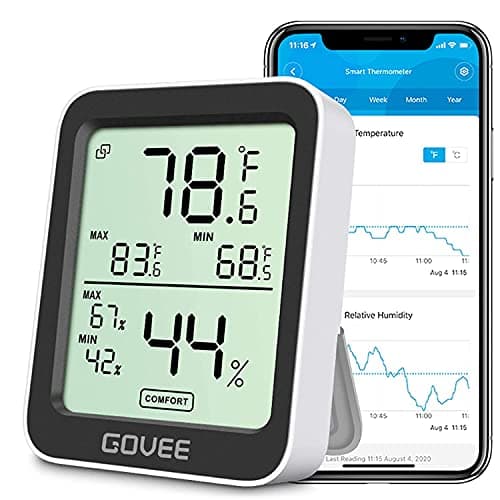
The one that logs. If your problem is that the house is dry at night but fine during the day, a hygrometer you have to walk over and read will never tell you that.
#ad Price as of October 30, 2026, from Amazon. Prices change. How we make money.
Published specifications
| Specification | Value | Source |
|---|---|---|
| Function | Bluetooth temperature and humidity sensor with app-based logging and data export | Govee published specification |
What is good about it
- Logging is the feature. Overnight humidity swings are invisible to a spot reading, and they explain most morning symptoms
- Data export means you can check whether the humidifier actually changed anything, rather than assuming
What is not
- Bluetooth range is room-scale; a basement sensor will not reach a phone upstairs
- Requires an app and an account, which is a genuine cost for some people
Who should skip this
Skip this if you just want a number on a wall. The logging is the whole premium, and it is wasted if you will not look at it.
How it scored
- Logging and history9.5
- Value for the decision it informs9.0
- Range and placement freedom6.0
Overall 8.6 / 10. This is our editorial score from published specifications and computed running cost. It is not a test result, and it is deliberately not marked up as a rating in this page’s structured data.
How we ranked these
We have not tested these units. Nobody here owns one. What we did was compile each manufacturer’s published specifications, check the coverage claims against AHAM’s room-sizing rule, and compute what each one costs to run for a year at the current US average electricity price. Every figure on this page is attributed to whoever published it, and the arithmetic is shown so you can redo it.
How we rank these sets out the full method, including what would change a ranking.
Questions people ask
+−What humidity level stops static electricity?
+−Does a humidifier protect my computer from static damage?
+−Will a humidifier stop static shocks from carpet?
+−Why do I get static shocks in winter but not summer?
+−Can a humidifier make static worse?
+−Do I need a whole-house humidifier for static, or will one room do?
+−How high can I set the humidity to stop static?
+−Is static electricity in the house dangerous?
Sources
- EOS/ESD Association, Inc. - Humidity FAQ: humidity requirements for an ESD control program
- Xu W, Grosshans H - Experimental study of humidity influence on triboelectric charging of particle-laden duct flows (2022), arXiv:2206.04345
- EPA - Indoor Air Facts No. 8: Use and Care of Home Humidifiers
- EPA - Biological Pollutants' Impact on Indoor Air Quality
- U.S. Energy Information Administration - Electric Power Monthly, Table 5.6.A