Roundup
Best Medify Air Purifiers
Medify's whole proposition is the filter grade - H13, medical-grade, True HEPA. Its own federal certification filings describe all four certified models differently, and that is the most useful thing a Medify buyer can know before paying.
By Scooter M. · Published · Last updated
How this page is funded: the buy links below are affiliate links. If you buy through one, we earn a commission at no extra cost to you. It does not change the order of the picks or what we say about them. Full disclosure.
The short answer
Buy the MA-40 if you want a Medify, and know before you do that all four certified Medify models are filed with ENERGY STAR as “HEPA-Type” rather than HEPA. That matters more on this brand than on any other, because the filter grade is what Medify sells - its manuals say “TRUE HEPA H13” and its listings say medical-grade. Both descriptions are Medify’s own. Beyond that: the brand has the lowest efficiency range of any brand we have ranked (4.77 to 6.10 CFM/W), only two of its four certified models can be bought, its flagship MA-112 is not certified at all, and the one unit carrying ENERGY STAR Most Efficient has the brand’s second-worst efficiency figure. If the filter grade is genuinely why you were buying Medify, the Honeywell HPA4300B is filed as HEPA and is more efficient.
Why the filter grade is the whole story on this brand
Every brand roundup on this site is built the same way: pull every row the brand has in the ENERGY STAR certified room air cleaners database, and compare what is published rather than what is claimed. On Levoit the interesting column was efficiency. On Winix it was which models are certified at all. On Honeywell it was the Most Efficient badge.
On Medify it is the filter type field, because Medify is the one brand here whose marketing rests on it. The listings lead with H13 and medical-grade; the MA-14 manual labels its second stage “TRUE HEPA H13 FILTER”. And here is what the same company filed with the certification program:
| Model | Filter type as FILED | IEF | Smoke CADR | Certified room | Most Efficient? |
|---|---|---|---|---|---|
| MA-50 V3.0 | HEPA-Type | 6.3 - best in brand | 264 CFM | 409 sq ft | No |
| MA-40 V4.0 | HEPA-Type | 5.6 | 245 CFM | 380 sq ft | No |
| MA-14 | HEPA-Type | 5.5 | 75 CFM | 116 sq ft | Yes |
| MA-15 | HEPA-Type | 5.0 - worst in brand | 71 CFM | 110 sq ft | No |
Four for four. For comparison, from the same dataset and the same field: Honeywell is 0 of 6 filed as HEPA-Type, Winix 3 of 5, Levoit 7 of 10, Coway 16 of 19 and Blueair 19 of 20. So Medify is not an outlier in using the wording - most of this category does - but it is the only brand on this site that advertises on the distinction it then does not file under.
The efficiency picture, which is the weakest we have published
All five brand roundups here rank on the same metric from the same dataset, so these numbers are directly comparable:
| Brand | Certified models | Clean air per watt | Zero ozone | Filed HEPA-Type |
|---|---|---|---|---|
| Medify | 4 | 4.77 - 6.10 CFM/W | 4 of 4 | 4 of 4 |
| Winix | 5 | 5.59 - 6.26 | 1 of 5 | 3 of 5 |
| Honeywell | 6 | 5.82 - 7.39 | 6 of 6 | 0 of 6 |
| Levoit | 10 | 4.86 - 9.26 | 8 of 10 | 7 of 10 |
| Coway | 19 rows | 5.41 - 10.33 | 19 of 19 | 16 of 19 |
| Blueair | 20 | 5.43 - 16.08 | 0 of 20 | 19 of 20 |
Medify’s best certified model does 6.10 CFM/W. That is below Honeywell’s best (7.39), Levoit’s (9.26), Coway’s (10.33) and Blueair’s (16.08), and its worst figure - the MA-15 at 4.77 - is the lowest single number of any brand we have ranked. Where Medify does well is ozone: all four certified models report 0.00 ppb and all four list their certified technology types as Fan and Filter only, which puts it alongside Honeywell and Coway on the measure that costs nothing to prefer.
The badge is on the wrong model again
Exactly the pattern we documented on Honeywell, repeated. The only Medify carrying ENERGY STAR Most Efficient is the MA-14, on an IEF of 5.5 - while the MA-50 at 6.3, the most efficient machine in the range, has no badge.
The reason is that the qualifying level rises with the size of the machine. Grouping all 247 certified air cleaners by PM2.5 CADR, the lowest IEF that earned the badge was 5.40 in the under-100 band and 8.80 in the 200-300 band. The MA-14’s 80 PM2.5 CADR puts it in the first group, where its 5.5 clears the bar with a tenth to spare. The MA-50’s 272 puts it in the second, where 6.3 is nowhere near 8.80. Same brand, same filter technology, same zero ozone, different size class - and the full threshold table is on the Honeywell page.
The practical instruction is the same as it was there: inside one size class the badge is a real signal, and across sizes it is not a comparison at all. On Medify specifically, it means the badge is pointing you at the smallest machine in the range.
How we ranked, and the availability problem
- Can it be bought? This cut the field in half before anything else, and it is the first criterion on every brand page here.
- Certified smoke CADR and the room it honestly covers at 4.8 air changes per hour - the basis on CADR explained, not the one-air-change figure on the box.
- Certified clean air per watt, because a purifier is a machine you leave running.
- Consistency between what is filed and what is advertised. On this brand that is a live question rather than a formality.
Of the four certified models we could verify purchasable listings for only two: the MA-40 and the MA-14. The MA-50 V3.0 has a listing but returned no price when we checked it, so we are not recommending it, and the MA-15 we could not find on sale at all.
Running the model numbers through the database the other way produces the finding this category keeps giving us: the MA-112, Medify’s flagship and the most expensive unit it lists, is not in the certified database. Neither are the MA-10, MA-18, MA-22, MA-25 or MA-35. So the big machine - the one with the largest coverage claim and the highest price - has no certified efficiency, annual energy or ozone figure at all. That was true of Winix’s best-sellers and of Honeywell’s HPA300, and it is true here.
The ionizer question, reported rather than resolved
Both buyable Medify models have a switchable ionizer - the MA-14’s manual shows an ionizer button and indicator on the control panel, and our product data has long noted the same for the MA-40. Yet the certified technology types for all four models list Fan and Filter with no ionizing stage, and all four certify at 0.00 ppb ozone.
We could not reconcile that, and we are not going to guess which configuration was tested. Both facts are published; the honest reading is that the certified ozone figure is reassuring and that we would switch the ionizer off anyway, because the mechanical filtration is the part with a measurement standard behind it. The broader argument about these stages is on UV and ozone air purifiers.
Where a Medify is genuinely the right answer
It would be easy to read the above as a brand to avoid, and that is not our conclusion. The MA-40 has a real activated carbon composite layer rather than carbon dust on a filter wrap, which is a meaningful difference if your problem is odors or gases rather than particles - that is the subject of best air purifiers for VOCs, where a Medify appears for exactly that reason. Both units certify at zero ozone. And Medify publishes a rated power, a noise figure, dimensions and a weight in its own manuals, which is more than several larger brands manage.
What you should not do is pay a premium for the filter grade specifically, or buy the MA-14 because of the badge, or size any room from the listing’s coverage claim.
What we would actually buy
The MA-40, if Medify is settled. 245 CFM of certified smoke CADR over 380 sq ft, 0.00 ppb ozone, a genuine carbon composite stage, and about $48 a year to run on the certified annual energy. The honest cons are on its card below and they are not small: Medify advertises a CADR of 330 against the certified 245, its listing claims 1,793 sq ft against the certified 380, and at 46 dBA minimum it is louder at low speed than a Levoit or Blueair of similar size.
The MA-14, for a desk or a nightstand and nothing larger - 116 sq ft certified, about $16 a year, and the cheapest way into the brand. Buy it for the size and the price, not for the Most Efficient logo, and be aware that the only noise figure Medify publishes for it is 55 dB(A), which is loud for something this small.
The Honeywell HPA4300B, if the filter grade is the reason you were looking at Medify at all. It is filed as HEPA rather than HEPA-Type, certifies at 0.00 ppb, does 7.39 CFM/W against Medify’s best of 6.10, costs about $34 a year, and Honeywell publishes both the filter part number and its interval. It is not a Medify and it does not have the carbon stage - that trade is the whole decision.
Quick picks
Ranked on published specifications and computed running cost. Tap any row for the full write-up, including who should skip it.
| # | Product | Best for | Score | Price |
|---|---|---|---|---|
| 1 | 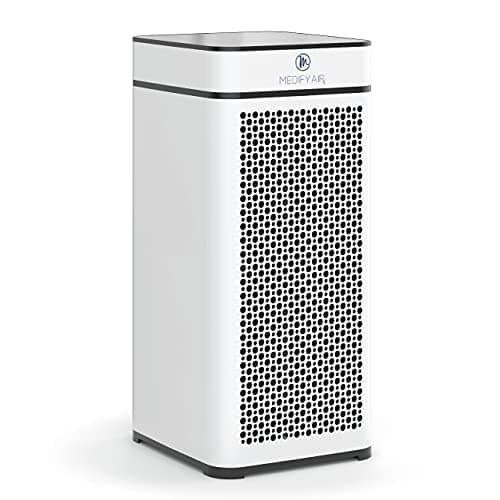 Medify MA-40A room up to about 380 sq ft where you want carbon as well as particle filtration | Best Medify overall | 8.1 | $249.99 - View on Amazon |
| 2 | 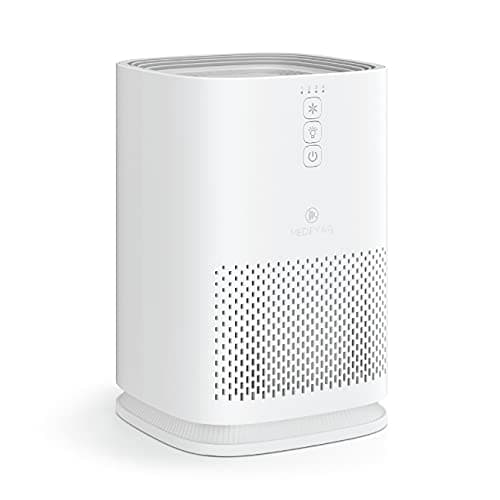 Medify MA-14A desk or a small bedroom, if you accept that it is audible | Small rooms, and the badge lesson | 7.0 | $88.99 - View on Amazon |
| 3 | 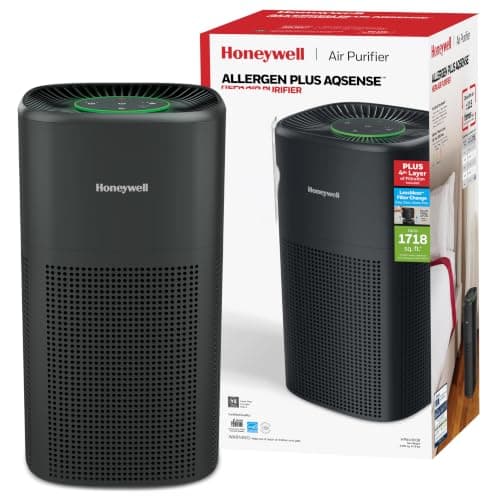 Honeywell HPA4300B Allergen PlusA room up to about 355 sq ft, with no ionizing stage to switch off | If the filter grade is the point | 8.3 | $159.99 - View on Amazon |
#1 - Best Medify overall
Medify MA-40
A room up to about 380 sq ft where you want carbon as well as particle filtration
A capable mid-price unit with a real carbon composite stage and a federal certification you can check - which is useful, because Medify's own CADR claim and the certified figure do not agree.
#ad Price as of October 31, 2026, from Amazon. Prices change. How we make money.
Published specifications
| Specification | Value | Source |
|---|---|---|
| CADR - smoke (federal certification) | 245 CFM | ENERGY STAR certified room air cleaners database |
| CADR (manufacturer claim) | 330 - see cons | Medify published specification |
| Coverage | 380 sq ft | ENERGY STAR certified room air cleaners database |
| Clean air per watt | 5.53 CFM/W | ENERGY STAR certified room air cleaners database |
| Annual energy use | 261 kWh/yr | ENERGY STAR certified room air cleaners database |
| Ozone emissions | 0.00 ppb | ENERGY STAR certified room air cleaners database |
| Rated power | 54 W | Medify published specification |
| Noise | 46-66 dBA | Medify published specification |
| Filtration | 3-layer: pre-filter, H13 True HEPA, active carbon composite | Medify published specification |
| Filter life | 3,000 hours | Medify published specification |
| Dimensions and weight | 22 x 9.9 x 10.9 in, 15.6 lb | Medify published specification |
What it costs to run
About $48 a year on ENERGY STAR's certified annual energy figure.
ENERGY STAR publishes 261 kWh a year for the MA-40. At 18.34 cents/kWh that is $47.87 a year. Medify's own 54 W rating cross-checks it at 12 hours a day: 54 / 1000 x 12 x 365 = 237 kWh = $43.37, so the two figures agree closely. Filters at 3,000 hours are the larger running cost.
What is good about it
- ENERGY STAR certified, so its clean air per watt (5.53), annual energy (261 kWh) and ozone (0.00 ppb) are all independently published
- H13 media and an active carbon composite layer rather than carbon dust on the filter wrap
- Certified at 0.00 ppb ozone despite shipping with a switchable ionizer feature
- A published 3,000-hour filter life, which converts to a budgetable annual cost - many competitors publish nothing
- 245 CFM of certified smoke CADR covers a genuine 380 sq ft living room
What is not
- Medify advertises a CADR of 330 and some retailers list 380, while the federal certification for the MA-40 reports 245 smoke CADR. Size the room on 245
- Its Amazon listing claims 1,793 sq ft in one hour - a one-air-change figure, about 4.7 times the certified 380 sq ft coverage
- 46 dBA is its minimum, not a whisper setting. This is a noticeably louder unit at low speed than a Levoit or Blueair of similar size
- It includes an ionizer. We would leave it off, and a unit without one is a cleaner answer
- 5.53 CFM/W is mid-pack - the Blueair units we list are 8.84 and 9.59 for comparable rooms
- 3,000 hours is about four months of continuous running, so the filter cadence is faster than the 9-to-12 months better units manage
Who should skip this
Skip this if you need quiet - 46 dBA minimum rules it out of a bedroom for light sleepers. Skip it too if you want the efficiency leader rather than the carbon.
How it scored
- Carbon stage8.0
- Certified data available9.0
- Honesty of claimed CADR5.0
- Quiet operation5.0
Overall 8.1 / 10. This is our editorial score from published specifications and computed running cost. It is not a test result, and it is deliberately not marked up as a rating in this page’s structured data.
#2 - Small rooms, and the badge lesson
Medify MA-14
A desk or a small bedroom, if you accept that it is audible
The cheapest Medify and the only one carrying ENERGY STAR Most Efficient - which it earns on the second-worst efficiency figure in the brand, because the badge is scored within size class. Useful on a desk, and a good lesson in reading labels.
#ad Price as of October 31, 2026, from Amazon. Prices change. How we make money.
Published specifications
| Specification | Value | Source |
|---|---|---|
| CADR - smoke | 75 CFM | ENERGY STAR certified room air cleaners database (V3.0) |
| CADR - dust / pollen | 85 / 90 CFM | ENERGY STAR certified room air cleaners database (V3.0) |
| CADR - PM2.5 | 80 CFM - the figure the ENERGY STAR badge is scored on | ENERGY STAR certified room air cleaners database (V3.0) |
| Coverage | THREE published figures: 116 sq ft certified at 4.8 air changes/hr; Medify's own manual says "up to 200 sq. ft."; the retail listing says 470 sq ft per hour. See cons | ENERGY STAR certified database / Medify MA-14 use and care manual / product listing |
| Integrated Energy Factor | 5.5 CFM/W | ENERGY STAR certified database |
| Clean air per watt (smoke) | 5.17 CFM/W - second-lowest of the four certified Medify models | ENERGY STAR certified database, smoke CADR per watt |
| Annual energy | 86 kWh/yr | ENERGY STAR certified database |
| Ozone emissions | 0.00 ppb - as is every certified Medify | ENERGY STAR certified database |
| ENERGY STAR Most Efficient | Yes - the only certified Medify with the badge, awarded on a 5.5 IEF where the brand's 6.3 IEF model misses it. Size class, not efficiency | ENERGY STAR certified database |
| Filter type | ENERGY STAR filing says "HEPA-Type"; Medify's own manual calls stage 2 a "TRUE HEPA H13 FILTER". Both are published - see cons | ENERGY STAR certified database / Medify MA-14 use and care manual |
| Filter life | Medify states replacement at "4 months or after [N] hours of use (whichever comes first)" - the hours figure did not extract cleanly from the manual PDF, so plan on the 4 months | Medify MA-14 use and care manual |
| Rated power | 26 W | Medify MA-14 use and care manual |
| Noise | 55 dB(A) - a single figure, not a range | Medify MA-14 use and care manual |
| Technology types | Certified as "Fan and Filter" with no ionizer listed, yet the manual shows an IONIZER BUTTON and indicator. Certified ozone is 0.00 ppb. We could not reconcile this - see cons | ENERGY STAR certified database / Medify MA-14 use and care manual |
| Controls | Three fan speeds, 8-hour timer, sleep mode, child lock, switchable ionizer, filter indicator. Automatic mode is certified as None and it is not connected-capable | Medify MA-14 use and care manual / ENERGY STAR certified database |
| Warranty | Lifetime, conditional on replacing filters on schedule | Medify MA-14 use and care manual |
| Dimensions and weight | 12.20 x 8.26 x 8.26 in, 5.3 lb | Medify MA-14 use and care manual |
What it costs to run
About $16 a year in electricity on the certified annual energy figure.
86 kWh/yr certified x 18.34 cents/kWh = $15.77 a year. Medify's own 26 W rating cross-checks that closely at continuous running: 26 / 1000 x 24 x 365 = 228 kWh, so the certified figure implies it is not expected to run flat out. Filters on a 4-month cadence are the larger cost.
What is good about it
- About $16 a year to run on the certified annual energy figure, which is genuinely cheap for a unit moving 75 CFM of smoke CADR
- 0.00 ppb certified ozone, and the certified technology types list Fan and Filter only
- Medify publishes a rated power, a noise figure, dimensions and a weight in its own manual - more than several larger brands manage
- A lifetime warranty, conditional on keeping the filter schedule, which is an unusual commitment at this price
- 5.3 lb and barely over 12 inches tall, so it genuinely fits on a desk or nightstand
- A switchable ionizer rather than a permanent one, so it can be left off
What is not
- The Most Efficient badge on this unit does NOT mean it is efficient. Its 5.5 IEF is the second-lowest in Medify's range and the MA-50 at 6.3 has no badge - the threshold for its small size class is simply lower. Buying it for the logo is the mistake
- Filed with ENERGY STAR as "HEPA-Type" while Medify's own manual calls it a "TRUE HEPA H13 FILTER". Both are Medify's; we cannot tell you which describes the filter in the box
- THREE different published room sizes - 116 sq ft certified, 200 sq ft in Medify's manual, 470 sq ft per hour on the listing. Only the certified figure is at a useful air-change rate
- 55 dB(A) is the only noise figure Medify publishes for it, and it is not a whisper. For a unit this size that is loud, and it rules it out for light sleepers
- The certified technology types list no ionizer while the manual shows an ionizer button. We report both rather than guessing which configuration was tested
- Automatic mode is certified as None, so there is no sensor and you set the speed yourself
- The filter hours figure in Medify's own manual did not extract cleanly, so the only interval we will quote is the 4 months it is paired with
Who should skip this
Skip this for any real room - 116 sq ft certified is a desk, not a bedroom. Skip it too if you need quiet, since 55 dB(A) is the only figure published, or if the Most Efficient badge is the reason you were considering it.
How it scored
- Ozone10.0
- Running cost in absolute terms9.0
- Clean air per watt4.5
- Quiet operation3.5
- Consistency of published figures3.0
Overall 7.0 / 10. This is our editorial score from published specifications and computed running cost. It is not a test result, and it is deliberately not marked up as a rating in this page’s structured data.
#3 - If the filter grade is the point
Honeywell HPA4300B Allergen Plus
A room up to about 355 sq ft, with no ionizing stage to switch off
The most efficient air purifier Honeywell has certified, and the cheapest of its certified range to run for the air it moves. It does NOT carry the ENERGY STAR Most Efficient badge, and the reason is the most useful thing on this page.
#ad Price as of October 31, 2026, from Amazon. Prices change. How we make money.
Published specifications
| Specification | Value | Source |
|---|---|---|
| CADR - smoke | 229 CFM | ENERGY STAR certified room air cleaners database (V3.0) |
| CADR - dust / pollen | 238 / 245 CFM | ENERGY STAR certified room air cleaners database (V3.0) |
| CADR - PM2.5 | 233 CFM - the figure the ENERGY STAR badge is actually scored on | ENERGY STAR certified room air cleaners database (V3.0) |
| Coverage | 355 sq ft certified at 4.8 air changes/hr. The listing advertises 1,718 sq ft, which is the same machine at one air change per hour | ENERGY STAR certified database / product listing |
| Integrated Energy Factor | 7.4 CFM/W - the highest of the six certified Honeywell models | ENERGY STAR certified database |
| Clean air per watt (smoke) | 7.39 CFM/W - also the highest in the brand on this site's usual metric | ENERGY STAR certified database, smoke CADR per watt |
| Annual energy | 185 kWh/yr | ENERGY STAR certified database |
| Ozone emissions | 0.00 ppb - as is every certified Honeywell | ENERGY STAR certified database |
| ENERGY STAR Most Efficient | No - despite being the most efficient Honeywell. Thresholds are set within size class; see cons | ENERGY STAR certified database |
| Filter type | Filed as HEPA, not HEPA-Type. Honeywell's manual calls the stage a "Genuine HEPA Filter" inside a 3-in-1 cartridge with a bonus 4th outer pre-filter | ENERGY STAR certified database / Honeywell HPA4000 Series owner's manual |
| Filter life | Replace the 3-in-1 main filter (part HRFY3) every 9-12 months; vacuum the pre-filters every 3 months. Other layers cannot be cleaned | Honeywell HPA4000 Series owner's manual |
| Technology types | Fan and Filter only - no ionizer, no plasma stage, no UV lamp | ENERGY STAR certified database |
| Sensor and connectivity | AQSense particle sensor with auto mode and a color-coded real-time air quality display (HPA4200/4300 series only). No Wi-Fi | Honeywell HPA4000 Series owner's manual / ENERGY STAR certified database |
What it costs to run
About $34 a year in electricity on the certified annual energy figure.
185 kWh/yr certified x 18.34 cents/kWh = $33.93 a year. Add one HRFY3 cartridge every 9-12 months at Honeywell's published interval. The pre-filter vacuuming is free and is what keeps the cartridge on schedule.
What is good about it
- The best clean-air-per-watt figure in Honeywell's certified range on both metrics - 7.4 IEF and 7.39 smoke CFM/W - and it is a certified figure rather than a marketing one
- 185 kWh/yr works out to about $34 a year, which is low for 229 CFM of smoke CADR
- 0.00 ppb certified ozone, and the certified technology types are Fan and Filter only - there is no ionizing stage to find and switch off
- Filed with ENERGY STAR as HEPA rather than HEPA-Type, which is not true of most of this category
- Honeywell publishes a filter part number and interval (HRFY3, every 9-12 months) plus a 3-month pre-filter vacuum schedule, so the consumable cost is knowable before you buy
- A vacuumable outer pre-filter means hair and coarse dust do not load the expensive cartridge directly
What is not
- It does NOT carry ENERGY STAR Most Efficient even though it is the most efficient Honeywell. The badge is scored within size class, so this unit's 7.4 IEF misses the bar for its 233 PM2.5 CADR band while a 6.1 IEF Honeywell half its size qualifies. The badge is not a comparison you can make across sizes
- The listing advertises 1,718 sq ft against a certified 355 sq ft. Both numbers are real; only the smaller one is at a useful air-change rate
- At 229 CFM smoke CADR it is mid-range, not a large-room machine - Honeywell's certified range tops out at 398 sq ft and nothing in it reaches an open-plan floor
- No Wi-Fi and no app, so no runtime-based filter reminder beyond the unit's own reset light
- Honeywell does not publish a noise figure or a wattage we could retrieve, so the certified energy figure is the only power data that exists for it
- The 3-in-1 design means the HEPA and carbon layers are replaced together on the same schedule, even if only one is spent
Who should skip this
Skip this if the room is over about 355 sq ft - no certified Honeywell covers an open-plan space, and a Coway or Levoit does. Skip it too if you are shopping by the Most Efficient badge, because this unit does not have one and is nonetheless the most efficient machine Honeywell certifies.
How it scored
- Clean air per watt8.0
- Ozone10.0
- Filter transparency9.0
- Room coverage ceiling6.0
Overall 8.3 / 10. This is our editorial score from published specifications and computed running cost. It is not a test result, and it is deliberately not marked up as a rating in this page’s structured data.
How we ranked these
We have not tested these units. Nobody here owns one. What we did was compile each manufacturer’s published specifications, check the coverage claims against AHAM’s room-sizing rule, and compute what each one costs to run for a year at the current US average electricity price. Every figure on this page is attributed to whoever published it, and the arithmetic is shown so you can redo it.
How we rank these sets out the full method, including what would change a ranking.
Questions people ask
+−Does Medify use a true HEPA filter?
+−Which Medify air purifier is best?
+−Is the Medify MA-112 ENERGY STAR certified?
+−Why does the Medify MA-14 have the Most Efficient badge when bigger Medify models do not?
+−How big a room does the Medify MA-14 cover?
+−Do Medify air purifiers produce ozone?
+−How much does a Medify cost to run?
+−Medify or Levoit, Coway, Honeywell or Blueair?
Sources
- ENERGY STAR Certified Room Air Cleaners V3.0 - the full certified dataset (247 rows, queried 24 October 2026)
- Medify Air - MA-14 air purifier use and care manual
- ENERGY STAR - Most Efficient (the stricter tier above basic certification)
- ENERGY STAR - Certified Room Air Cleaners product database
- AHAM Verifide - Air Filtration Standards (AC-1)
- U.S. Energy Information Administration - Electric Power Monthly, Table 5.6.A